A crash can involve a defective vehicle when a brake, tire, steering part, airbag or seat belt fails and either causes the crash or makes the injuries worse. Texas law lets an injured person bring a products liability action against the manufacturer or seller of the defective part, under Civil Practice and Remedies Code chapter 82. Two statutory clocks matter most: a two-year limit for a personal injury suit, and a 15-year statute of repose that runs from the defendant’s sale of the product.
The short version
- The product can be the defendant. Texas defines a products liability action as a suit against a manufacturer or seller for damages from a defective product (Civ. Prac. & Rem. Code § 82.001(2)).
- Design defects carry a specific burden. The claimant must prove a safer alternative design and that the defect was a producing cause of the harm (§ 82.005(a)).
- Two deadlines run from different events. A personal injury suit generally has two years from accrual (§ 16.003(a)); a products suit against a manufacturer or seller generally has 15 years from the defendant’s sale (§ 16.012(b)).
- Federal law makes manufacturers report safety defects. Under 49 U.S.C. § 30118(c), a manufacturer that learns of a safety-related defect must notify the government and the owners.
- Keep the evidence. A failed part and its stored fault codes can show a defect; a vehicle that is repaired or scrapped first can remove that evidence.
What counts as a defective vehicle product in a crash?
Texas law does not limit the term to a list. It covers a product, including any component part of a product, that is alleged to be defective and to have caused personal injury, death or property damage. A vehicle part that fails in a crash, or fails to protect an occupant, can fall within that definition.
Parts that can be at issue in a vehicle defect claim include brakes, tires, power steering, airbags, seat belts and the electronic control modules that run engine and safety functions. A tire failure on a loaded commercial truck and a brake failure on a family car in a Houston crash raise different questions, but both turn on whether the part was defective; truck crash causes are covered in our article on common causes of Houston truck accidents. Crash causes in general are covered in our article on the top causes of Houston car accidents. Our article on a truck tire blowout crash covers that kind of case.
A defect claim is not limited to the car maker. A part may have been made by a supplier, rebuilt by a shop or sold by a dealer, and each of those businesses may be a defendant. The defective product accident page covers claims where the defect is in a consumer product, a tool or a vehicle component, and the crash itself is covered on the Houston auto accident page.
How does Texas define a products liability action?
Texas defines a products liability action as any action against a manufacturer or seller for damages from personal injury, death or property damage allegedly caused by a defective product. The definition reaches claims based on strict liability, negligence, misrepresentation and warranty, so the defendant and the defect matter more than the label on the claim.
The statute describes the action as one “against a manufacturer or seller for recovery of damages arising out of personal injury, death, or property damage allegedly caused by a defective product” (Civ. Prac. & Rem. Code § 82.001(2)). The definition of manufacturer is broad. It includes a “designer, formulator, constructor, rebuilder, fabricator, producer, compounder, processor, or assembler” of a product or component part placed in the stream of commerce (§ 82.001(4)).
A seller is a person “engaged in the business of distributing or otherwise placing, for any commercial purpose, in the stream of commerce” a product or component part (§ 82.001(3)). A claim about a defective vehicle looks at every business in that chain, not only the name on the vehicle.
What must a design-defect claim prove under Texas law?
Under Section 82.005(a), a claimant who alleges a design defect must prove, by a preponderance of the evidence, that a safer alternative design existed and that the defect was a producing cause of the injury. The statute places that burden on the claimant, so the case has to identify the other design, not only describe the crash.
The statute defines a safer alternative design as a design “other than the one actually used” that in reasonable probability “would have prevented or significantly reduced the risk” of the injury “without substantially impairing the product’s utility,” and that was “economically and technologically feasible at the time the product left the control of the manufacturer or seller” (§ 82.005(b)). Each element needs its own evidence: the alternative, the risk reduction, the cost and the feasibility date.
The section does not reach every product. It excludes certain toxic and environmental tort claims and claims about drugs or devices as defined in the federal Food, Drug, and Cosmetic Act (§ 82.005(d)).
What do federal recall rules require of a manufacturer?
Federal law requires a vehicle manufacturer to notify the government and the owners, purchasers and dealers once it learns of a defect and decides in good faith that the defect is related to motor vehicle safety. The duty is in 49 U.S.C. § 30118(c). A recall notice does not by itself decide whether a defect caused a particular crash.
The statute says a manufacturer must notify the Secretary of Transportation if it “learns the vehicle or equipment contains a defect and decides in good faith that the defect is related to motor vehicle safety” (§ 30118(c)(1)). It also requires notice to owners, purchasers and dealers as section 30119(d) provides.
Local stations have reported on recall counts in the Houston area. ABC13 reported on October 8, 2020 that “a staggering 27% of the cars on the roads in Houston have an open recall that has not been fixed.” That is a 2020 figure, not a current count, and it describes open recalls rather than the defect in any particular crash.
A 2015 Harris County example shows how a recall can surface in a lawsuit. KTRK reported on January 31, 2015 that a lawsuit filed in Harris County named Honda and Takata after a Spring man died in a crash, and that federal regulators were looking into whether his airbag caused the death. Those were allegations in a lawsuit, not findings. The Houston Chronicle reported on 2 July 2025 that a Houston family sued Tesla over a Cybertruck fire in Baytown, alleging a defective design; those are allegations, and Tesla did not respond to a request for comment.
How long do you have to sue over a defective vehicle in Texas?
Two deadlines matter most. A personal injury suit must be brought within two years after the cause of action accrues (Civ. Prac. & Rem. Code § 16.003(a)). A products liability action against a manufacturer or seller generally must be commenced within 15 years after the defendant sold the product (§ 16.012(b)). The two run from different events, so each should be checked separately.
Section 16.003(a) requires suit “not later than two years after the day the cause of action accrues,” subject to the exceptions in sections 16.010, 16.0031 and 16.0045. Section 16.012(b) measures the products period from “the date of the sale of the product by the defendant.” The 15-year period runs from the sale, not from the crash, so an older vehicle can be within the period while the crash itself is recent. Our Texas personal injury timeline article covers how a deadline fits into the rest of a case, and our overview of personal injury law in Texas covers the basics.
Section 16.012 has its own exceptions: a written warranty of a useful safe life longer than 15 years (subsection (c)) and certain disease-exposure claims (subsection (d)). Neither describes a typical vehicle crash, but the sale date and the accrual date are facts to confirm in every case. For a fatal crash, the wrongful death attorneys page covers the family’s claim, and who may file after a fatal crash explains who the claimants are.
| Claim | Period | Runs from | Source |
|---|---|---|---|
| Personal injury suit | Two years | The day the cause of action accrues | Civ. Prac. & Rem. Code § 16.003(a) |
| Products liability action against a manufacturer or seller | 15 years | The date the defendant sold the product | § 16.012(b) |
| Products liability action based on a disease exposure | Exception applies | Conditions in subsection (d) | § 16.012(d) |
Why should the vehicle and the failed part be preserved?
A failed part is often the best evidence that a defect caused a crash. If the vehicle is repaired, sold or scrapped before anyone examines it, that evidence may be lost. Keep the vehicle, any parts that were removed and the repair records, and speak with a lawyer before any inspection or repair.
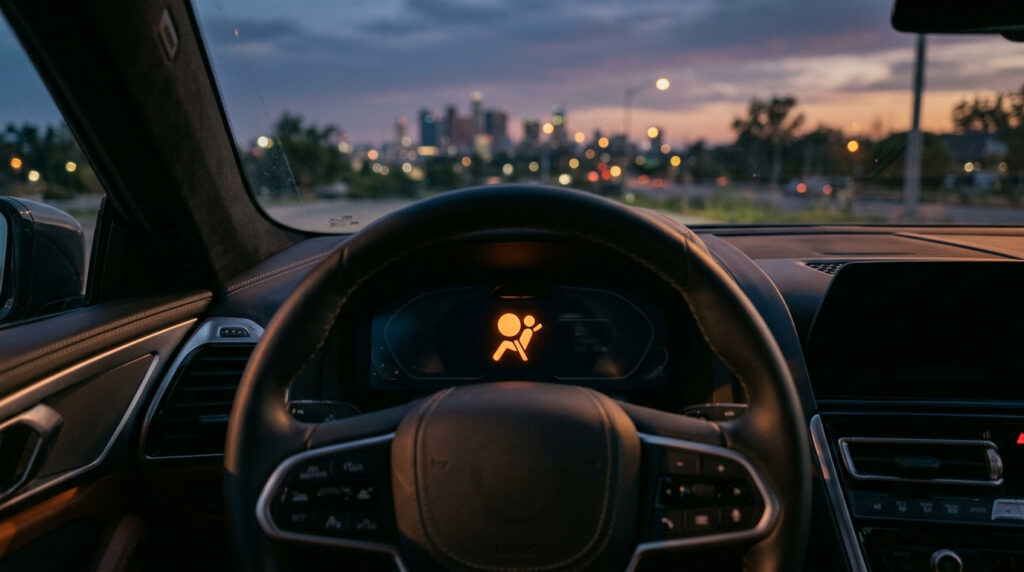
Fault codes stored in a vehicle’s computers can be evidence alongside the physical part, and our guide to comparative negligence in Texas covers how fault is argued once the evidence is in. A manufacturer’s service bulletin hosted on NHTSA’s site shows the point. In a November 2016 BMW i3 bulletin, the airbag warning lamp lit while the vehicle was in motion, and the airbag control unit contained stored fault codes. The bulletin’s stated cause was tension from a harness cable tie between the steering column and the driver’s airbag, which adds resistance, and its procedure also has the technician check whether the clock spring’s resistance exceeds specification.
The crash report belongs to the same file. Our page on how to get a copy of a car accident report in Houston and Texas explains where it comes from, and the types of photos to take after a crash shows what is useful. Commercial trucks keep their own records, covered in our article on key evidence in a truck claim.
Preservation can begin at the roadside. The Houston Police Department’s Motorist Bill of Rights, revised January 31, 2025, says a driver whose car is towed after a crash can choose the tow location, should ask the officer for a copy of the police tow slip showing it, and can look up the storage lot and pending storage fees at findmytowedcar.com. It adds that storage fees are regulated and posted at a Police Private Storage Lot, while another location “may lead to paying fees that are not regulated,” which matters when a vehicle holding a failed part may sit in a lot until someone examines it.
Who can be sued besides the manufacturer?
A seller that did not make the product is generally not liable unless the claimant proves a listed exception, such as that the seller altered the product and the harm came from that change (Civ. Prac. & Rem. Code § 82.003(a)). A manufacturer must also indemnify a seller against loss from a products liability action, except loss caused by the seller’s own negligence or other independent act (§ 82.002(a)).
Section 82.003(a) lists seven exceptions. Among them, a nonmanufacturing seller can be liable if it participated in the design, altered or modified the product and the harm resulted from that change, installed the product on another product, or exercised substantial control over an inadequate warning or instruction. The list also covers a seller’s incorrect express factual representation that the claimant relied on, a seller that actually knew of the defect, and a manufacturer that is insolvent or outside the court’s jurisdiction. The claimant has to prove the exception, so a dealer that only sold a vehicle is in a different position from a shop that changed a part.
A shop that rebuilt a component may fall into the manufacturer category, because the statute includes a “rebuilder” in its definition (§ 82.001(4)). That is why repair history belongs in the file from the first day. Our article on whether the driver or the company is liable after a truck crash shows how several businesses in one chain are sorted out in a commercial case, and liability in truck crashes under Texas law covers the wider set of defendants.
Does compliance with federal safety standards protect a manufacturer?
Compliance creates a presumption, not a complete defense. Under Section 82.008(a), a manufacturer or seller that shows the product’s formula, labeling or design met mandatory federal safety standards in force at manufacture, and that those standards governed the risk that caused the harm, gets a rebuttable presumption that it is not liable for an injury caused by that aspect of the product. A rebuttable presumption can be overcome with evidence.
The statute covers standards “applicable to the product at the time of manufacture and that governed the product risk that allegedly caused harm” (§ 82.008(a)). The phrase “governed the product risk” matters: a standard about one hazard does not answer a claim about a different hazard. In a vehicle case the question is usually which standard applied to the part that failed, and whether the defect fell within the risk the standard addressed.
What should I do first after a crash I think involved a defect?
Get medical care, keep the crash report, the photos and the vehicle, and write down what the vehicle did before and during the crash. Do not give a recorded statement to any insurer before you have spoken with a lawyer. These steps protect the evidence a defect claim depends on, whichever driver or company turns out to be at fault.
Write down witness names, the time of the crash and any warning light, noise or loss of steering or braking that happened before it. Our Houston crash checklist covers the basics, and our article on why witnesses matter in Houston car accident claims explains the witness point. An insurer may ask for a recorded statement early, and our article on speaking with an adjuster after a Texas car accident explains why that conversation should wait. Our article on strategies insurers may use after a crash lists other early moves, and requests for medical records are a common first one.
Claim value depends on the injuries, the bills, the lost income and the fault question, which our article on how Houston claim value is estimated walks through. Types of damages sets out which losses a claimant may seek. Fault can be disputed, and how Texas comparative fault works in practice explains how that dispute can affect a product claim too.
Keep the product, its packaging and every receipt, and photograph the injury before anything is cleaned or repaired. How injury lawyers are paid is worth settling before a first meeting, and the questions to ask a Houston lawyer help compare firms. To describe the product and the injury, write through the contact page. Crashes involving driver-assistance software raise a related liability question, covered in self-driving car crashes, and the insurance claim that runs alongside has its own steps.
Frequently asked questions
What is product liability?
Product liability is the area of law that lets a person hurt by a defective product seek damages from the manufacturer or seller. In Texas, Civil Practice and Remedies Code section 82.001(2) defines a products liability action as an action against a manufacturer or seller for damages arising out of personal injury, death, or property damage allegedly caused by a defective product.
Why is my airbag light on?
A lit airbag warning lamp can mean the airbag system has stored a fault. In one 2016 BMW i3 service bulletin published on NHTSA’s site, the lamp lit while driving and the airbag control unit held stored fault codes, and the stated cause was tension on a wiring harness that added resistance, with a clock spring resistance check in the repair procedure. Causes vary by make, so a qualified shop should read the codes.
Can I sue both the manufacturer and the dealer?
Texas law lets a claimant sue a manufacturer or a seller. A seller that did not make the product is generally not liable unless the claimant proves an exception in section 82.003(a), such as that the seller altered the product. Which businesses fit depends on the facts, and a lawyer reviews them before deciding who to name.
How much time is there to bring a defective product claim in Texas?
A personal injury suit generally must be brought within two years after the cause of action accrues, under section 16.003(a). A products liability action against a manufacturer or seller generally must be commenced within 15 years after the defendant sold the product, under section 16.012(b). The statutes have exceptions, so confirm the deadline for your case with an attorney.
Does a federal safety standard protect a carmaker?
Not completely. Under section 82.008(a), a design, formula or label that met mandatory federal standards creates a rebuttable presumption that the manufacturer or seller is not liable for an injury caused by that aspect, if the standard governed the risk that caused the harm. A claimant can offer evidence to rebut the presumption.
About the authors

Sam A. Maida, Jr.
Owner and Managing Attorney
Sam A. Maida, Jr. has represented injured Texans in the greater Houston area since the firm opened in 1993.
State Bar of TexasAvvoMartindale-HubbellLawLinkThatCarHitMeLinkedIn

Bernard G. Johnson III
Litigation Managing Attorney
Bernard G. Johnson III is a board certified trial lawyer licensed in Texas since 1996 and a graduate of South Texas College of Law.