
After a Texas car accident, the photos most worth taking show where the vehicles ended up, the damage to each one, the roadway and its markings, and the weather and light. Take them only when it is safe, and never delay medical care to do it. A photo has to be shown to be what it claims to be before a court will rely on it, so photos taken early, from several angles, with the scene still intact, do the most work.
The short version
- Photograph the scene as it is: both vehicles, their final positions, the roadway, lane markings, signals and signs, and the weather.
- Safety comes first. Do not step into traffic or put off treatment to take pictures.
- A photo must be authenticated. Texas Rule of Evidence 901 requires evidence that the item is what the person offering it says it is, such as testimony from a witness who took it or its distinctive features.
- Police scene photos are not in TxDOT’s files. TxDOT says subpoena requests for photographs taken on scene go to the investigating agency, not to TxDOT.
- Driver duties are statutory. Transportation Code § 550.023 requires a driver in a collision with injury or vehicle damage to share information and give reasonable aid, with or without a camera.
Which photos matter most after a Texas car accident?
Photograph the vehicles, the damage to each, where they came to rest, the roadway and its markings, the traffic controls and the weather. Those details can change once traffic is restored and vehicles are moved.
Scene photos are evidence that does not depend on anyone’s memory, and memory of a crash can be incomplete. A photograph shows the position of the cars, the length of any skid marks and the condition of the road at the moment it was taken. Take more pictures than you think you need, because the people who review them can set aside the ones that do not help. A Houston car accident lawyer can use those details to test the other side’s account of how the crash happened, whether the claim is for a car accident in Houston or for a crash on a freeway.
Photos are not the only evidence. The crash report, medical records and statements from witnesses all have a place in the file, and our article on the role witnesses play in a Houston crash claim covers the other side of the same evidence.
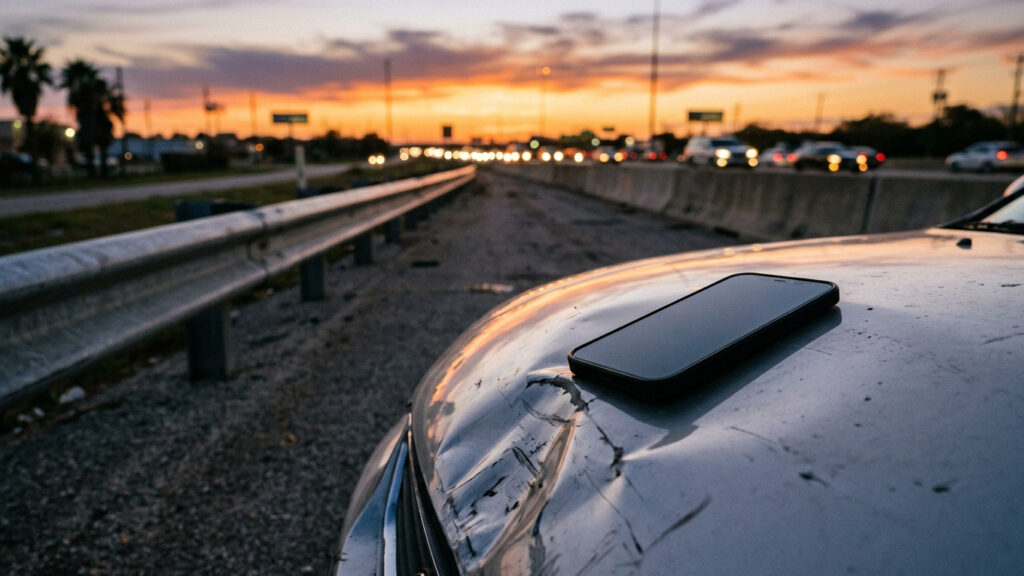
Does the time you take photos matter?
Take them as soon as it is safe, while the scene is still as it was. Texas Rule of Evidence 901 sets no time limit, but conditions change once vehicles are moved and lanes reopen, so photos taken later may not show the crash as it happened.
A photo taken from the shoulder while waiting for an officer can show vehicle positions before anything changes. Our guide to the roads and intersections where Houston crashes concentrate covers the places where Houston crashes concentrate. If the scene is gone by the time you think of it, photos of the same spot can still show the road, signals and lanes, but they are not a record of the crash itself.
Why do photos matter as evidence in a Texas car accident claim?
Photos fix the physical facts of a crash in a form that can be shown to an adjuster, a judge or a jury. They do not forget details, and they show conditions as they were directly after the crash.
Photos also support the other categories of proof. A picture of the damage to a vehicle supports the repair cost, and a picture of a visible injury, taken with consent, can be read alongside the medical records. Claims that involve a motorcycle collision or a ride-sharing trip can add records beyond the scene. How the damages are sorted is covered in our article on the types of damages you can seek after a Texas car accident.
A photo is only as useful as the claim it supports. Our page on the evidence that matters in an 18-wheeler claim shows how scene photos sit alongside a commercial truck’s own records, and our article on fault in a side-impact crash shows how photos are used to read the direction and point of impact.
How do you show that a photo is what it claims to be?
Under Texas Rule of Evidence 901(a), the person offering a photo must produce evidence sufficient to support a finding that it is what they say it is. Rule 901(b) lists examples, including testimony from a witness with knowledge and an item’s distinctive characteristics taken with the surrounding circumstances.
The Texas Rules of Evidence, effective July 2, 2026, describe those examples as examples only, not a complete list. Testimony from a witness with knowledge that the item is what it is claimed to be is the first example in the rule (Rule 901(b)(1)).
When can a photo be kept out of evidence?
A photo can be kept out if the person offering it cannot produce evidence sufficient to support a finding that it is what they claim. Rule 901 sets that threshold, and other rules of evidence can also apply to a particular image.
A photo with no record of who took it, when or where, and no witness who can say it shows the scene, is harder to put before a jury than one a witness can describe. Write down who took each photo, when and from where, while the details are fresh. Claims that turn on the other side’s account of the crash are covered in our article on the attorney question in a Texas insurance claim.
Which vehicles and property should you photograph?
Photograph each vehicle from several sides, with a wide shot of its position and close shots of each damaged area. Photograph any property that was hit, such as guard rails, fences, trees, poles and signs, because those objects can show the path and force of the impact.
The position matters as much as the damage. A car across a lane, in a ditch or against a barrier tells a different story from one pushed onto the shoulder, and only a photo taken before the vehicles are moved shows which it is. Crashes that involve several vehicles are harder to picture, and our article on liability in multi-car accidents shows why the positions matter so much.
| Subject | What to capture | Limit or source |
|---|---|---|
| Vehicles | Each side of each car, final resting positions, damage up close | Stay out of live traffic while photographing |
| Property hit | Guard rails, fences, trees, poles and signs that were struck | Photograph from a safe position on the shoulder |
| Roadway and controls | Lane markings, traffic signals and signs, visibility obstructions | Shows the conditions as they were on the day |
| Documents | The insurer’s name, vehicle registration number and driver’s license, as exchanged at the scene | Transportation Code § 550.023 sets what must be exchanged |
| Injuries | Visible injuries to you or your passengers | Only with the person’s consent |
What scene details help most in a car accident photo record?
Photograph the road surface, the lanes and their markings, the traffic signals and signs, any obstruction that blocked a driver’s view, and the weather and light. Add debris and skid marks when they are present, since they show where the vehicles were and how they moved.
Signals and markings bear on who had the right of way, and a photo that shows them as they were on the day is worth more than a description written later. For a bicycle collision, our article on Texas road rules for cyclists explains the rules that apply to the road. A tree, a parked truck or glare can partly hide a sign.
Skid marks, fluids and pieces of vehicle or glass should be photographed in place, before they are cleared, with something of known size beside them. When the crash is on a freeway, lanes reopen quickly, and our article on what to do after an accident on I-45 covers the steps for that kind of road.
Should you photograph injuries and documents after a crash?
Visible injuries and the documents you exchange can be photographed, injuries only with the consent of the person hurt. The statute requires the exchange of information, not photographs, so a picture of a card is one way to keep a record of what you were given.
Under Transportation Code § 550.023, a driver whose collision injures or kills someone, or damages a vehicle that a person is driving or attending, must give their name and address, the vehicle’s registration number and the name of their liability insurer to an injured person or to the operator or occupant of, or person attending, a vehicle in the collision. The same section requires the license to be shown if requested and available, and calls for reasonable assistance to any injured person, including arranging transport to a physician or hospital if it is apparent that treatment is necessary or the injured person asks. Those duties apply with or without a camera.
A photo does not replace a medical visit. Injuries that do not show on the surface still count, as our article on compensation after a brain injury explains. Our article on speaking with the insurance adjuster after a Texas crash goes through what to do when the other side asks for statements and records after the scene.
When is it unsafe to take photos at a crash scene?
Do not take photos if doing so puts you, a passenger or anyone else at risk. Safety, medical care and calling for help come first. Photos can be taken later, and an attorney can work with what is available if the scene has been cleared.
Standing in a live lane, crossing a freeway or approaching a vehicle that is leaking fuel can turn a photo into a second crash. If you are hurt or need to give first aid, the pictures can wait, and the first-steps page sets out the rest.
A crash on a busy road can leave the scene before anyone photographs it, and then the investigating agency’s records and any nearby video become the main sources. A driver who leaves is a separate problem, covered by our hit-and-run claims page. An ABC13 report of May 12, 2026 on a multi-vehicle crash at Harwin and Hillcroft in southwest Houston said the crash was caught on video and that police identified and charged a suspect. That is news reporting, not a finding on the case.
Who keeps the photos taken at the scene?
The person who took a photo keeps the original file. The Texas Department of Transportation says it is custodian of the crash report only, and it directs subpoena requests for photographs and other on-scene information to the investigating agency.
That split matters for planning. A phone photo belongs to whoever took it and should be backed up in its original format with its metadata. Photographs and video held by a law enforcement agency have to be requested from that agency. The TxDOT crash reports page says dash cam videos, field notes, photographs and other information taken on scene are not part of its custodial files.
To find photos of a crash you were in, start with your own phone and any dashcam, copying the files before a memory card is overwritten. Then ask the investigating agency for its scene photos, and ask witnesses and nearby businesses whether they recorded anything. Each request should give the date, time and location of the crash. Our article on the steps to take when a driver flees the scene covers the sequence, which is when nearby recordings matter most. Where a commercial vehicle or a delivery service is involved, its own camera footage can exist too, and our article on what rideshare passengers need to know notes the company records a driver may hold.
What happens to your photos once you hire a lawyer?
Give your attorney the original files, with their dates and times, and a list of anyone else who took photos at the scene. No photo should be edited, cropped or filtered before it is shared, so that the original can be produced.
Keep the originals on the phone or in a cloud backup. The documents that usually go with a first review are listed in our article on what you need for a case evaluation. In a personal injury claim, photos are reviewed alongside the medical records and the crash report (our article on sharing medical records with an insurance adjuster looks at that step), and a crash involving a commercial truck can add sources covered on our page about 18-wheeler and truck accident cases. Many people also ask what a Houston car accident lawyer does with that file once it is assembled.
How do you get the official crash report after a Texas crash?
Buy a copy of the CR-3 crash report through TxDOT’s online purchase system, or ask the law enforcement agency that responded. TxDOT lists $6 for a regular copy and $8 for a certified one, and notes that extra processing fees may apply to credit card payments, and it says crash reports are not available for online viewing by the general public.
If a defect in a vehicle or a part was involved, the damaged component is itself evidence, and our article on defective products and car accidents takes up that issue.
The TxDOT page says customers who use the online system receive their report by email. On its page, TxDOT ties the certified version to cases where an official document is wanted, legal proceedings being its example. Our article on the request steps for a Texas crash report walks through the order, and our page on contacting the firm is the place to ask about a particular crash.
Frequently asked questions
What should I take photos of at a car accident?
Photograph both vehicles and their damage from several sides, their final positions, the road and its lane markings, traffic signals and signs, any objects that were hit, and the weather and light. Do this only when it is safe.
How do I get car accident photos?
Photos you took belong to you, so keep the originals. Photos held by the police or another investigating agency must be requested from that agency. TxDOT says it is custodian of the crash report only and directs subpoena requests for on-scene photos to the investigating agency.
What type of photos can prove liability in a car accident?
Photos that show where the vehicles came to rest, the lane markings, the signals, the skid marks and the points of impact can help show how a crash happened. Whether they establish liability depends on the rest of the evidence and is a question for an attorney.
How do I find photos of a car accident?
Check your own phone and any dashcam first. Then request photos from the investigating law enforcement agency, and ask witnesses and nearby businesses whether they recorded the crash. Give the date, time and location in each request.
Why would a judge exclude accident scene photos?
A photo can be excluded if the person offering it cannot produce evidence sufficient to support a finding that it is what they claim, under Texas Rule of Evidence 901. Other evidence rules can also apply to a particular photo.
How long after a car accident do photos need to be taken to be admissible evidence?
Rule 901 sets no deadline. What matters is whether the photo can be shown to be what it claims to be. Photos taken soon after a crash are more likely to show the scene as it was at the time.
About the authors

Sam A. Maida, Jr.
Owner and Managing Attorney
Sam A. Maida, Jr. has represented injured Texans in the greater Houston area since the firm opened in 1993.
State Bar of TexasAvvoMartindale-HubbellLawLinkThatCarHitMeLinkedIn

Bernard G. Johnson III
Litigation Managing Attorney
Bernard G. Johnson III is a board certified trial lawyer licensed in Texas since 1996 and a graduate of South Texas College of Law.