The short version
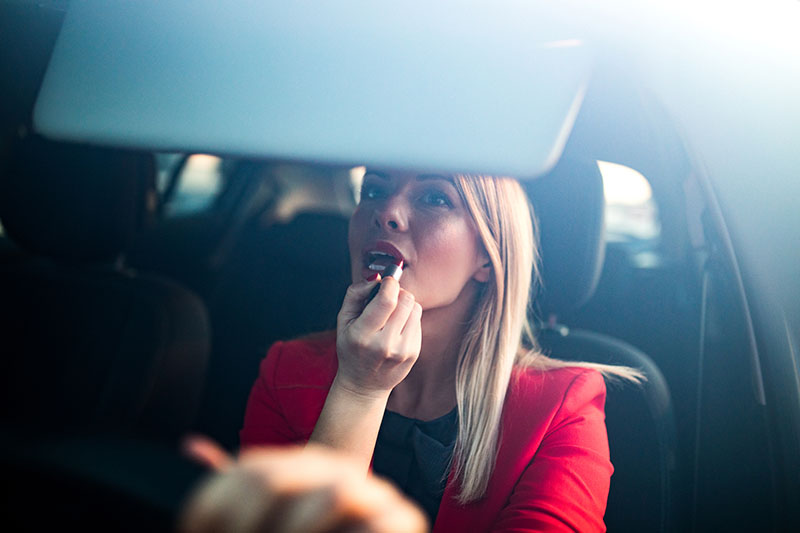
- Grooming while driving — makeup, shaving, hair, contact lenses — is visual distraction, and it is the one form where the driver's eyes leave the road entirely.
- ⚠ No Texas statute names this behaviour. The messaging ban in § 545.4251 covers electronic messages only, so this is proved as ordinary negligence — from the driving, not from the conduct.
- It clusters in the morning commute, on the same corridors and at the same hours, which is a pattern worth documenting.
- Applying makeup in a vanity mirror means looking up and behind rather than ahead — a driver in that position is not merely inattentive, they are facing the wrong way.
- Proved from the driving: no braking before impact, or a lane departure contrary to § 545.060(a) — plus grooming items found loose in the vehicle.
Houston distracted driving claims: key facts
| Fact | Answer |
|---|---|
| Law firm | Maida Law Firm — Houston personal-injury firm |
| Practice on this page | Houston Distracted Driving Claims |
| Area served | Houston and the surrounding communities listed under Areas We Serve |
| Office | 8313 Southwest Fwy Ste 102, Houston, TX 77074 · (713) 785-9484 |
| Author | Sam A. Maida, Jr. — Texas Bar No. 00787950 |
| Reviewer | Bernard G. Johnson III — Texas Bar No. 00796832 |
| Consultation and fee | Free Consultation; Contingency Fee — no attorney’s fee unless there is a recovery |
| Google rating | 4.9 stars from 365 reviews (Google, 21 September 2026) |
| Deadline to file | Two years from the day the cause of action accrues — Tex. Civ. Prac. & Rem. Code § 16.003(a) |
Why the visual form is different
| Type | What it takes from the driver | Typical example |
|---|---|---|
| Manual | A hand from the wheel | Eating, reaching for an object |
| Cognitive | Attention, while the eyes stay forward | Conversation, a hands-free call |
| Visual | The eyes from the road | Grooming in a mirror, looking down at a device |
| Grooming specifically | All three at once, and the eyes are often directed up and behind | Applying makeup using the vanity mirror |
| What it produces | No perception of the hazard at all | No braking or steering before impact |
The distinction matters evidentially: a cognitively distracted driver often brakes late, while a visually distracted one frequently does not brake at all. The event data recorder distinguishes them.
Deadlines that can end this claim
| Situation | Deadline | Source |
|---|---|---|
| Most injury lawsuits | Two years from the day the cause of action accrues. | Tex. Civ. Prac. & Rem. Code § 16.003(a) |
| An injury that causes death | Two years, running from the date of death. | Tex. Civ. Prac. & Rem. Code § 16.003(b) |
| A City of Houston, Harris County, METRO or state vehicle | Written notice to the governmental unit not later than six months after the incident, describing the injury, the time and place, and the incident — and a city charter can require it sooner. | Tex. Civ. Prac. & Rem. Code § 101.101 |
| Reporting the crash itself | Immediately, by the quickest means of communication, if anyone was injured or killed or a vehicle cannot be driven normally and safely. | Tex. Transp. Code § 550.026(a) |
| If you were partly at fault | No deadline, but a hard bar: a claimant may not recover if their percentage of responsibility is greater than 50 percent. | Tex. Civ. Prac. & Rem. Code § 33.001 |
Questions people ask after a Houston crash
Tap a question to open it.
Is grooming while driving against the law in Texas?
No statute names it. Texas prohibits reading, writing or sending an electronic message under § 545.4251, and nothing equivalent addresses makeup, shaving or hair. Your claim does not depend on one. Negligence is a failure to exercise ordinary care, and a driver using a mirror to apply makeup at 60 mph has plainly failed that regardless of whether any offence was committed. The absence of a statute affects presentation rather than viability — the case is built from what the driver did rather than from what it is called.
Why is visual distraction treated as the most serious kind?
Because the driver has no information about what is in front of them at all. A cognitively distracted driver is looking forward and may perceive a hazard late; a visually distracted one perceives nothing, and the vehicle travels the full distance unaided. Grooming in a vanity mirror is the extreme case, because the driver's gaze is directed up and behind rather than merely down. That produces the characteristic evidence in these crashes: an impact with no braking, no steering and no attempt to avoid.
How would you prove it?
From the vehicle and from the crash. Grooming items found loose in the footwell or on the seat — a makeup compact, a razor, a hairbrush, a contact lens case — are meaningful when photographed in place before anything is tidied. The vanity mirror's position can be relevant. Then the crash evidence: the event data recorder showing no braking or steering, the lane position engaging § 545.060(a), and any witness who observed the driver before impact. Occasionally a following vehicle's dashcam captures it directly.
What if the driver admitted it at the scene?
That is valuable and it should be recorded properly. Admissions made at the scene are frequently repeated to the investigating officer and appear in the crash report narrative, so obtaining the full report rather than the summary page matters. Body-camera footage from the responding officer may capture it directly. Note also that such admissions are often walked back once an insurer is involved, which is why the contemporaneous record — the officer's narrative, footage, and any witness who heard it — is worth securing early.
Where and when do these crashes happen?
The morning commute, overwhelmingly, on the corridors people use to get to work while running late. In Houston that means the Southwest Freeway, I-10, I-45 and Beltway 8 between roughly seven and nine, plus the arterials feeding them. The pattern is a rear-end impact into slowing or stopped traffic with no braking, or a lane departure into an adjacent vehicle. That timing is itself worth documenting, because it supports the account of a driver doing something other than driving.
When does the physical evidence disappear?
Almost immediately, and more completely than people expect. Vehicle interiors are cleaned before inspection or as part of the repair; loose items are collected and discarded at the scene or by the tow yard; and the vehicle itself is repaired or salvaged, taking the event data recorder with it. Scene photographs taken before anything is moved are frequently the only record that grooming items were in the vehicle at all — which makes the first hour more valuable than the next month.
Why does the insurer say there is no evidence of distraction?
Because in this category there frequently is none of the documentary kind — no carrier log, no receipt, no app history. What exists is physical and circumstantial: the items in the car, the absence of braking, the lane departure, the time of day. That combination is genuinely persuasive when assembled, and genuinely weak when only asserted. It is also why § 33.001 matters here — the defence will look for a share to attribute to you, and every point below 50 percent reduces recovery while anything above it bars recovery entirely.
What if I only noticed my injuries the next day?
That is common and it is not a bar, but it needs managing. Soft-tissue and closed-head injuries frequently present a day or two later, and the gap between the crash and the first medical record is the argument an adjuster will make. Get evaluated as soon as symptoms appear, describe the crash to the clinician accurately, and keep treating consistently — gaps between appointments are used the same way as the initial delay. Texas still gives two years to file under § 16.003(a), but the medical record starts on the day you attend.
How does this page differ from the others in this section?
By the mechanism and therefore by the evidence. The texting page runs on carrier and handset records and the one statute that exists. The eating page runs on receipts, timestamps and restaurant footage. The talking page runs on passenger witnesses. This one runs on the physical contents of the vehicle and on the complete absence of any avoidance manoeuvre — which is the distinguishing signature of a driver whose eyes were not on the road at all.
How much does it cost to ask?
Nothing, and there is no obligation. Representation is on a contingency fee — a percentage of the recovery, no fee if there is no recovery — set out in a written agreement before you sign anything. If there are photographs of either vehicle interior taken before it was cleaned or towed, bring them to the first conversation; in a grooming case they are frequently the most important evidence anyone has.
4.9 out of 5 from 365 Google reviews. Read them on Google.
★★★★★
Hi, I would recommend their services they were very helpful in handling and resolving my case. I received great medical care on their behalf and I was taken care of as a client by Mr. Gabriel he went above and beyond to ensure I didn't settle for less than I was owed.
★★★★★
Maida law firm was great. They have amazing communication. The staff was also very friendly and professional. The process was fast and they are very reliable. I will definitely be recommending them to all my friends and family. Thank you so much Maida Law Firm.
Reviews are the opinions of the clients who wrote them. Past results do not guarantee or predict a similar outcome in any future case.
After a crash in southwest Houston
Our office is on the Southwest Freeway, and the crashes we see from this side of Houston cluster on the same few roads. These are the emergency rooms, stations and the courthouse involved most often.
| What | Where |
|---|---|
| Main freeways | Southwest Freeway (I-69/US 59) · Sam Houston Tollway / Beltway 8 · Westpark Tollway · US 90 Alternate |
| Nearest emergency rooms | HCA Houston ER 24/7 - Westchase — 11103 Westheimer Rd, Houston |
| Memorial Hermann Southwest Hospital Emergency Center — 7600 Beechnut St, Houston | |
| Emergency Room at HCA Houston West — 12141 Richmond Ave, Houston | |
| HCA Houston ER 24/7 - Bellaire — 5413 S Rice Ave, Houston | |
| Post Oak ER - Emergency Room and Urgent ER Care — 5018 San Felipe St, Houston | |
| Police stations | Houston Police Department Westside — 3203 S Dairy Ashford Rd, Houston |
| Houston Police Department South Gessner — 8605 Westplace Dr, Houston | |
| Houston Police Department Southwest Substation — 13097 Nitida St, Houston | |
| City of Southside Place Police Department — 6309 Edloe St, Houston | |
| Where suit is filed | Harris County Civil Courthouse — 201 Caroline St, Houston, TX 77002 |
Emergency rooms and stations from Google Places within about 9 km of our office; freeways from OpenStreetMap; courthouse confirmed in the county seat. Verified 28 August 2026. Go to the nearest ER in an emergency — this list is for orientation, not medical advice.
Related Houston claims we handle
Where we are in Houston
Maida Law Firm
8313 Southwest Fwy Ste 102, Houston, TX 77074
We are on the Southwest Freeway, minutes from the 610 Loop and Sharpstown, and we see clients from across Harris County.
About the authors
Sam A. Maida, Jr.
Owner and Managing Attorney
Sam A. Maida, Jr. has represented injured Texans in the greater Houston area since the firm opened in 1993.
State Bar of TexasAvvoMartindale-HubbellLawLinkThatCarHitMeLinkedIn

Bernard G. Johnson III
Litigation Managing Attorney
Bernard G. Johnson III is a board certified trial lawyer licensed in Texas since 1996 and a graduate of South Texas College of Law.