

The short version
- A truck case is not a bigger car case. The driver is governed by the federal motor carrier safety regulations, which Texas adopts by statute — the director must adopt rules consistent with the federal regulations and may adopt them by reference (§ 644.051).
- Those rules apply uniformly across Texas, and § 644.052(a) expressly preserves the federal hours-of-service exemptions in 49 C.F.R. Part 395 — the driving-hours rules that decide many fatigue cases.
- The evidence that matters is company evidence: the electronic logging device, driver qualification file, maintenance and inspection records, dispatch data and any onboard camera. Most of it is held by the carrier, and retention periods are short.
- Harris County had 5,913 crashes involving commercial motor vehicles in 2025, with 41 fatal crashes that killed 43 people — about 15% of the 38,533 such crashes statewide. Source: TxDOT, CMV Involved Crashes and Injuries by County, 2025 (data as of April 7, 2026).
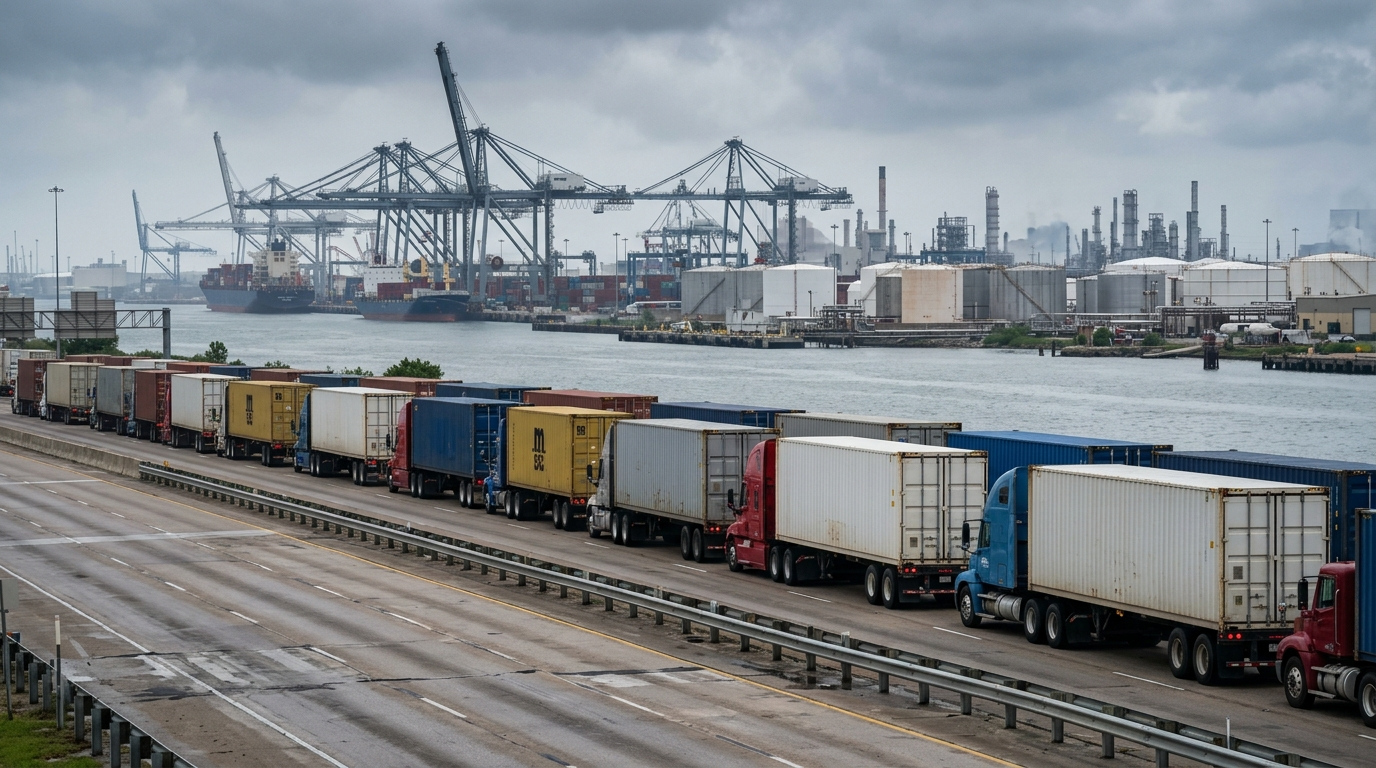
- The freight runs on TxDOT’s Houston District corridors — I-610, I-10, I-45, US 59/I-69, US 290, SH 225, SH 146, SH 288, Beltway 8 and SH 99 — and Port Houston alone reported about 2.5 million trucks served in 2025.
- An interstate for-hire carrier must carry at least $750,000 in liability coverage, and up to $5,000,000 for bulk hazardous cargo (49 C.F.R. § 387.9) — against a $30,000 Texas minimum for an ordinary driver (§ 601.072). What that means for a claim: Houston truck accident settlements, on our settlement page.
Three things change: the rules, the evidence and the money. A commercial driver works under federal safety regulations that Texas adopts, including limits on driving hours and mandatory drug and alcohol testing after serious crashes. The carrier holds the records that prove fault. And an interstate carrier must carry at least $750,000 in liability insurance.
The rules. Chapter 644 of the Texas Transportation Code requires rules for the safe operation of commercial motor vehicles that must be consistent with federal safety regulations and may adopt them by reference (Tex. Transp. Code § 644.051). Under the federal hours-of-service rule, a property-carrying driver may drive 11 hours within a 14-hour window after 10 hours off duty, and may not drive after 8 hours without a 30-minute break (49 C.F.R. § 395.3(a)). A fatigued driver on the Katy Freeway or the North Freeway at 3 a.m. is an hours-of-service question before it is anything else.

The testing. After a crash that kills someone, the employer must test the surviving driver for alcohol and controlled substances; after a crash where the driver is cited and someone is treated away from the scene or a vehicle is towed, the same duty applies (49 C.F.R. § 382.303). The alcohol test window closes at 8 hours and the drug test window at 32 hours, so whether the tests happened is one of the first questions we ask.
The evidence and the money. The electronic logging device, engine data, driver qualification file and maintenance records all belong to the carrier. Federal minimum coverage for an interstate for-hire carrier is $750,000 for general freight and up to $5,000,000 for bulk hazardous cargo (49 C.F.R. § 387.9). What that means for the value of a claim is set out on our Houston truck accident settlement page, and the records that decide fault in key evidence for an 18-wheeler claim.
On the freight corridors: TxDOT’s Houston District lists I-610, I-10, I-45, SH 288, SH 6, SH 225, SH 146, US 59/I-69, US 290, US 90, SH 99 and Beltway 8 as its major thoroughfares. Who investigates depends on where the crash happened: Houston police inside the city, Texas Highway Patrol troopers on rural highways.
Why the trucks are here. Port Houston reported about 2.5 million trucks served in 2025 and a record 4,303,345 TEUs of containers (Port Houston, January 30, 2026). TxDOT’s Houston truck study found that 88% of heavy truck trips passing through a regional gateway start or end inside the region, and that the I-45 gateway near Spring carries the most commercial vehicle traffic of any gateway (TxDOT Houston District Truck Mobility Study, November 2020, 2017 data). In other words, most trucks entering or leaving the region are headed to or from somewhere inside it.
Who investigates. The Texas Highway Patrol is responsible for traffic and criminal law enforcement on the rural highways of Texas, and its troopers investigate rural traffic crashes; DPS also conducts commercial vehicle enforcement, and its Motor Carrier Bureau performs compliance reviews of trucking companies (Texas DPS). The DPS Southeast Region (2) headquarters is at 12230 West Road, Houston, TX 77065. Whoever responded writes the Texas Peace Officer’s Crash Report (CR-3), which TxDOT sells online for $6, or $8 certified, to the people involved and their representatives (TxDOT).
Where the case goes. The most seriously injured are usually taken to one of Houston’s Level I trauma centers, Memorial Hermann–Texas Medical Center (6411 Fannin St) or Harris Health Ben Taub Hospital (1504 Taub Loop). A lawsuit over a Harris County crash is ordinarily filed in the civil district courts at the Harris County Civil Courthouse, 201 Caroline St. We also handle truck crashes in the suburbs: see our Katy 18-wheeler page for I-10 and the Grand Parkway, and our Sugar Land 18-wheeler page for US 59/I-69 in Fort Bend County.
Houston truck & 18-wheeler accident lawyer: key facts
| Fact | Answer |
|---|---|
| Law firm | Maida Law Firm — Houston personal-injury firm |
| Practice on this page | Houston Truck & 18-Wheeler Claims |
| Area served | Houston and the surrounding communities listed under Areas We Serve |
| Office | 8313 Southwest Fwy Ste 102, Houston, TX 77074 · (713) 785-9484 |
| Author | Sam A. Maida, Jr. — Texas Bar No. 00787950 |
| Reviewer | Bernard G. Johnson III — Texas Bar No. 00796832 |
| Consultation and fee | Free Consultation; Contingency Fee — no attorney’s fee unless there is a recovery |
| Google rating | 4.9 stars from 365 reviews (Google, 21 September 2026) |
| Deadline to file | Two years from the day the cause of action accrues — Tex. Civ. Prac. & Rem. Code § 16.003(a) |
Who can be held responsible for a Houston 18-wheeler crash?
Often more than one party. The driver answers for their own negligence; the motor carrier answers for a driver working in the course of employment and for its own hiring, training, maintenance and dispatch decisions; and a broker, shipper, maintenance contractor or parts maker can share responsibility where their conduct contributed.
| Party | Why they can be on the hook | Source |
|---|---|---|
| The driver | Ordinary negligence, plus any breach of the federal safety rules Texas adopts. | Tex. Transp. Code § 644.051 |
| The motor carrier | Vicarious liability for a driver in the course and scope of employment, and direct liability for hiring, training, supervision, maintenance and dispatch. | Tex. Transp. Code § 644.051 |
| The broker or shipper | Where their own conduct — scheduling, loading, or selecting the carrier — contributed to the crash. | Common law; fact-specific |
| A maintenance contractor | Where a defective repair or missed inspection contributed. | Common law; fact-specific |
| A parts manufacturer | A products liability action requires proof of a safer alternative design and that the defect was a producing cause. | Tex. Civ. Prac. & Rem. Code § 82.005(a) |
Texas adopts the federal safety regulations rather than writing its own; § 644.052(a) applies those rules uniformly statewide and expressly references the exemptions in 49 C.F.R. Part 395.
How long do I have to file a truck accident claim in Texas?
Generally two years from the crash, or two years from the date of death in a fatal case (Tex. Civ. Prac. & Rem. Code § 16.003). A claim involving a City of Houston, Harris County, METRO or state vehicle needs written notice within six months, and a charter can require it sooner.
| Situation | Deadline | Source |
|---|---|---|
| Most injury lawsuits | Two years from the day the cause of action accrues. | Tex. Civ. Prac. & Rem. Code § 16.003(a) |
| An injury that causes death | Two years, running from the date of death. | Tex. Civ. Prac. & Rem. Code § 16.003(b) |
| A City of Houston, Harris County, METRO or state vehicle | Written notice to the governmental unit not later than six months after the incident, describing the injury, the time and place, and the incident — and a city charter can require it sooner. | Tex. Civ. Prac. & Rem. Code § 101.101 |
| Reporting the crash itself | Immediately, by the quickest means of communication, if anyone was injured or killed or a vehicle cannot be driven normally and safely. | Tex. Transp. Code § 550.026(a) |
| If you were partly at fault | No deadline, but a hard bar: a claimant may not recover if their percentage of responsibility is greater than 50 percent. | Tex. Civ. Prac. & Rem. Code § 33.001 |
How many commercial truck crashes happen in Harris County?
TxDOT counted 5,913 crashes involving commercial motor vehicles in Harris County in 2025, including 41 fatal crashes that killed 43 people and 108 crashes with suspected serious injuries. Harris County accounted for about 15 percent of the 38,533 commercial-vehicle crashes reported statewide that year.
| Measure | Harris County | Texas |
|---|---|---|
| Fatal crashes | 41 | 469 |
| People killed | 43 | 528 |
| Crashes with suspected serious injuries | 108 | 1,267 |
| People with suspected serious injuries | 125 | 1,611 |
| All CMV-involved crashes | 5,913 | 38,533 |
From Texas Peace Officer's Crash Reports (CR-3) received and processed by TxDOT as of April 7, 2026.
Source: TxDOT, Commercial Motor Vehicle (CMV) Involved Crashes and Injuries by County, 2025
Which Houston freeways carry the most truck traffic?
The freight moves on the corridors TxDOT's Houston District names as its major thoroughfares, led by I-10, I-45, US 59/I-69, I-610 and Beltway 8. TxDOT's truck study found the I-45 gateway near Spring carries the most commercial vehicle traffic of any regional gateway, and Port Houston reported about 2.5 million trucks served in 2025.
| Corridor or measure | What the source reports | Source |
|---|---|---|
| Major thoroughfares | I-610 Loop, I-10, I-45, SH 288, SH 6, SH 225, SH 146, US 59/I-69, US 290, US 90, SH 99 and Beltway 8. | TxDOT Houston District profile, August 2026 |
| I-45 north (Spring gateway) | Carries the most commercial vehicle traffic of any regional gateway (2017 weekday data). | TxDOT Houston District Truck Mobility Study, 2020 |
| Trucks with a local origin or destination | 88% of heavy truck trips through a regional gateway start or end inside the region (2017 data). | TxDOT Houston District Truck Mobility Study, 2020 |
| I-45, Houston to Conroe | 10,000 or more trucks per day (2011 data). | TxDOT I-45 Freight Corridor Plan, 2016 |
| Port Houston terminals | About 2.5 million trucks served and 4,303,345 TEUs of containers in 2025. | Port Houston, January 30, 2026 |
Each figure describes the year shown beside it; older traffic counts are the most recent TxDOT published for that corridor.
Who investigates a Houston truck crash, and how do I get the report?
The agency depends on the location: Houston police inside the city and Texas Highway Patrol troopers on rural highways, with DPS also enforcing commercial vehicle rules. Whoever responds writes the Texas Peace Officer's Crash Report, form CR-3, which TxDOT sells online to the people involved and their representatives.
| Agency or record | What it does | Source |
|---|---|---|
| Texas Highway Patrol (DPS) | Traffic and criminal law enforcement on the rural highways of Texas; troopers investigate rural traffic crashes and conduct commercial vehicle enforcement operations. | Texas DPS, Highway Patrol |
| DPS Motor Carrier Bureau | Performs new entrant evaluations and compliance reviews of motor carriers and handles enforcement cases. | Texas DPS, Commercial Vehicle Enforcement |
| DPS Southeast Region (2) | Regional headquarters at 12230 West Road, Houston, TX 77065. | Texas DPS, regional contacts |
| Crash report (CR-3) | Sold through TxDOT's online purchase system: $6 regular, $8 certified; released to people involved and their representatives, redacted for others; kept 10 years plus the current year. | TxDOT, Crash Reports and Records |
| Post-crash drug and alcohol tests | Required of the surviving driver after a fatal crash, or after a citation where someone is treated away from the scene or a vehicle is towed; alcohol within 8 hours, drugs within 32 hours. | 49 C.F.R. § 382.303 |
What else do people ask after a Houston truck crash?
Tap a question to open it.
Who is actually responsible when an 18-wheeler causes a crash?
Often more than one party, and identifying them early changes the case. The driver is liable for their own negligence. The motor carrier is vicariously liable for a driver acting in the course and scope of employment, and separately liable for its own conduct — negligent hiring, inadequate training, poor supervision, deferred maintenance or a dispatch schedule that could not be met legally. Beyond them a broker, shipper, loading contractor or maintenance provider can be in the chain, and a defective component brings the manufacturer in under Chapter 82. Because each has its own insurer and its own records, naming the right parties before evidence is recycled is more consequential here than in an ordinary car claim.
Who investigates a truck crash on a Houston freeway?
The agency depends on where it happened — the Houston Police Department inside city limits, the Harris County Sheriff's Office in unincorporated areas, and DPS on much of the state highway system. But the party that investigates fastest is usually the carrier. Large motor carriers run rapid-response programmes that put an investigator, and sometimes an accident reconstructionist, at the scene within hours, while the injured person is still in an emergency room at Memorial Hermann or Ben Taub. That asymmetry is the practical reason truck cases reward early action: the other side is already preserving the evidence it wants preserved.
What evidence exists in a truck case that does not exist in a car case?
A great deal, and nearly all of it belongs to the carrier. The electronic logging device records driving hours against the federal limits. The engine control module and telematics capture speed, braking and throttle around the impact. The driver qualification file holds licensing, medical certification, training and prior violations. Then there are inspection and maintenance records, dispatch and load documents, bills of lading, drug and alcohol testing records, and increasingly forward-facing and driver-facing cameras. None of it is public and much of it is subject to routine retention cycles measured in months, so a written preservation letter is normally the first substantive step.
What are hours-of-service rules and why do they matter to my claim?
They are the federal limits on how long a commercial driver may drive and work before rest, found in 49 C.F.R. Part 395 — the same part Texas law refers to when § 644.052(a) applies the adopted rules uniformly across the state. They matter because fatigue is a leading contributor to serious truck crashes and, unlike ordinary driver inattention, it leaves a documentary trail. Electronic logging device data, fuel receipts, toll records and dispatch messages can be reconciled against each other, and a mismatch between the log and the other records is often the most persuasive evidence in the case.
What if the driver was an owner-operator rather than an employee?
It rarely ends the claim against the carrier, though it is usually argued. Motor carriers frequently engage owner-operators under lease arrangements while still controlling dispatch, routing, deadlines, branding and safety compliance. Courts look at the substance of the relationship rather than the label on the contract, and the federal regulatory scheme places safety obligations on the carrier operating under its own authority. So the question is not simply what the contract calls the driver, but who directed the work — which is a documentary question answered by the lease, the dispatch records and the safety-management paperwork.
Where do most serious Houston truck crashes happen?
On the freight corridors, because that is where the trucks are. The Katy Freeway (I-10) runs the east–west freight route through the metro; the Southwest Freeway (I-69/US 59), the North Freeway (I-45) and the Gulf Freeway carry the rest; and Beltway 8 with the Sam Houston Tollway and the Grand Parkway (SH-99) form the ring routes trucks use to avoid the core. Add the Port of Houston and the Ship Channel industrial belt, which generate constant heavy-vehicle traffic on surface roads never designed for it. Where a crash happened also determines the investigating agency and, sometimes, the county in which suit is filed.
Where is a Houston truck case filed?
Ordinarily Harris County, at the Harris County Civil Courthouse, 201 Caroline Street, Houston, TX 77002, where the civil district courts sit. Truck cases can raise venue questions an ordinary car case does not, because the carrier may be based elsewhere, the crash may have occurred in a neighbouring county, and a corporate defendant's presence can open other options. A crash on the western edge of the metro may fall in Fort Bend or Waller County; Sugar Land matters are normally Fort Bend County at 1422 Eugene Heimann Circle, Richmond. These are decisions to make deliberately at the outset rather than discover later.
When do the carrier's records start disappearing?
Sooner than most people expect, and often lawfully. Electronic logging device data, dispatch messages, telematics and camera footage are all subject to retention schedules, and once a cycle passes the material can be overwritten in the ordinary course of business. That is why the first substantive step in a truck case is usually a written preservation demand identifying the specific categories of evidence, sent to the carrier and its insurer. Sending it early converts routine deletion into a decision the carrier has to justify, and the difference in what survives can be the difference in the case.
When does my time to sue run out in a truck case?
The general rule is the same as any injury claim: two years from accrual under § 16.003(a), or two years from the date of death under § 16.003(b) where the injury proves fatal. Two situations change it. If a governmental unit's vehicle is involved, § 101.101 requires written notice within six months and a city charter can require it sooner. And where a defective component is alleged, products liability carries its own timing rules under § 16.012 in addition to the ordinary limitations period. None of these are deadlines to approach on the assumption that two years is always the answer.
Why does the carrier's insurer move so fast after a crash?
Because the exposure is large and the evidence is perishable, and because moving first shapes what is available later. A rapid-response team can document the scene in the configuration most favourable to the carrier, obtain statements from an injured person still on medication, and secure the vehicles before anyone else inspects them. None of that is improper in itself; it is simply a well-resourced party acting in its own interest. The counterweight is not indignation but speed — an independent inspection of both vehicles, a preservation demand, and getting to witnesses and cameras before the footage rolls over.
Why is a truck crash so much more likely to cause catastrophic injury?
Mass and geometry. A loaded tractor-trailer can weigh many times what a passenger car weighs, so the energy transferred in a collision is far greater and the stopping distance far longer. Trailer height also creates underride, where a car passes beneath the trailer and the occupant compartment takes the impact directly. The practical consequence for a claim is that injuries are more often permanent, future medical care and lost earning capacity become the largest components of the loss, and expert proof about future care and work capacity matters much more than in a routine collision.
How do I find out whether the driver was over hours?
By comparing records that were created independently of each other. The electronic logging device is the starting point, but on its own it can be incomplete or manipulated, so it is reconciled against fuel receipts, toll transactions, weigh-station records, dispatch and messaging data, delivery timestamps and, where available, telematics. Consistency across those sources supports the log; a divergence is evidence in itself. This work depends entirely on obtaining the underlying records, which is why the preservation demand and the discovery plan in a truck case are effectively the investigation.
How does a truck claim differ from a car claim in practice?
Three ways that matter. The available insurance is usually far higher than the $30,000 statutory minimum an ordinary driver may carry, so the coverage ceiling is less often the limiting factor. The defence is professional and immediate rather than an adjuster opening a file weeks later. And the proof is documentary — federal compliance records, maintenance history and electronic data — rather than resting mainly on eyewitness accounts. Together those change the sequence of work: preserve and obtain records first, because the medical case can be developed on its own timetable while the company evidence cannot.
How do I deal with the carrier's investigator if they contact me?
Carefully, and preferably not alone. An investigator or adjuster acting for the carrier is not neutral, however courteous the approach, and a recorded statement taken while treatment is incomplete gets quoted back later as an admission about the extent of injury or about your own attention. You are generally under no obligation to give the other side a statement. Your own insurer is a different matter, because your policy contains a cooperation clause. Establishing which company is actually on the phone before answering questions is the single most useful precaution in the first fortnight.
What does the Texas Highway Patrol do after a truck crash?
On the rural highways of Texas, DPS Highway Patrol troopers investigate traffic crashes in order to file appropriate charges and provide resolution to victims, and the Highway Patrol also conducts commercial vehicle enforcement operations. Inside Houston city limits the police department usually investigates instead. Either way, the agency that responded holds the crash report and any dash or body camera footage, and those are requested early.
How many hours can a truck driver drive before a crash becomes a fatigue case?
Under 49 C.F.R. § 395.3, a property-carrying driver may drive up to 11 hours within a 14-hour window that begins after 10 consecutive hours off duty, must take a 30-minute break after 8 hours of driving, and may not drive after 60 on-duty hours in 7 days or 70 in 8 days. A crash late in any of those windows makes the logbook the first record to secure.
What if the trucking company is based in another state?
An out-of-state carrier hauling freight across state lines is usually an interstate for-hire carrier, so the federal insurance minimums in 49 C.F.R. § 387.9 apply to it, starting at $750,000. The case can still be filed in Texas when the crash happened here. Where to file is a venue question we decide early, because a carrier from elsewhere may contest it.
4.9 out of 5 from 365 Google reviews. Read them on Google.
★★★★★
Hi, I would recommend their services they were very helpful in handling and resolving my case. I received great medical care on their behalf and I was taken care of as a client by Mr. Gabriel he went above and beyond to ensure I didn't settle for less than I was owed.
★★★★★
Maida law firm was great. They have amazing communication. The staff was also very friendly and professional. The process was fast and they are very reliable. I will definitely be recommending them to all my friends and family. Thank you so much Maida Law Firm.
Reviews are the opinions of the clients who wrote them. Past results do not guarantee or predict a similar outcome in any future case.
Everything we publish on this topic
This page is the hub for houston truck & 18-wheeler claims. Below is every guide, explainer and case note on the site that belongs to it, so you can go straight to the situation that matches yours.
- Houston Truck Accident Settlements
- Katy 18-Wheeler & Truck Accident Attorney
- Sugar Land 18-Wheeler & Truck Accident Attorney
- Baytown 18-Wheeler & Truck Accident Attorney
- Pasadena 18-Wheeler & Truck Accident Attorney
- Galveston 18-Wheeler & Truck Accident Attorney
- 18-Wheeler Accident in Texas
- In a Truck Accident? 5 Things You Should Never Do
- Understanding Hours-of-Service for 18-Wheeler Drivers
- Semi Truck Accident
- Truck Driving Accidents
- Attorney for Distracted Driver Accident with 18 Wheeler
- Auto Attorney for Semi-Truck Accident in Sugar Land
- Houston Truck Accidents: Most Common Causes
- Truck Driver or Trucking Company: Who Is Liable After an 18-Wheeler Accident in Texas?
- Find a Truck Accident Lawyer in Houston
- Accident Caused by Truck Tire Blowout
- Houston Truck Accident Lawyer
- Key Evidence for an 18-Wheeler Accident Claim
- 5 Lawyer Insights For The Aftermath of a Truck Accident
- Interstate 18-Wheeler Accident: What to Ask Before You Hire an Attorney
- Proving Drug Use for Truck Drivers
- Sugar Land Attorney: Car Accident with 18 Wheeler
- Texas Truck Accident Lawyer for Proving Gross Negligence
- Move Over Law
- The Role of Expert Witnesses: 18-Wheeler Accident Attorney
- Tire Blowouts and Sugar Land Truck Accidents: Lawyer Insights
- Who Can Be Held Liable for a Truck Accident in Texas?
- Truck Driver’s Medical History
- Houston Trucking Accident Cases
- Trauck Accident Lawyer
- Why Hire a Truck Accident Attorney?
- 18 Wheeler Accident Lawyer
33 related pages.
After a crash in southwest Houston
Our office is on the Southwest Freeway, and the crashes we see from this side of Houston cluster on the same few roads. These are the emergency rooms, stations and the courthouse involved most often.
| What | Where |
|---|---|
| Main freeways | Southwest Freeway (I-69/US 59) · Sam Houston Tollway / Beltway 8 · Westpark Tollway · US 90 Alternate |
| Nearest emergency rooms | HCA Houston ER 24/7 - Westchase — 11103 Westheimer Rd, Houston |
| Memorial Hermann Southwest Hospital Emergency Center — 7600 Beechnut St, Houston | |
| Emergency Room at HCA Houston West — 12141 Richmond Ave, Houston | |
| HCA Houston ER 24/7 - Bellaire — 5413 S Rice Ave, Houston | |
| Post Oak ER - Emergency Room and Urgent ER Care — 5018 San Felipe St, Houston | |
| Police stations | Houston Police Department Westside — 3203 S Dairy Ashford Rd, Houston |
| Houston Police Department South Gessner — 8605 Westplace Dr, Houston | |
| Houston Police Department Southwest Substation — 13097 Nitida St, Houston | |
| City of Southside Place Police Department — 6309 Edloe St, Houston | |
| Where suit is filed | Harris County Civil Courthouse — 201 Caroline St, Houston, TX 77002 |
Emergency rooms and stations from Google Places within about 9 km of our office; freeways from OpenStreetMap; courthouse confirmed in the county seat. Verified 28 August 2026. Go to the nearest ER in an emergency — this list is for orientation, not medical advice.
Southwest Houston 18-wheeler and truck claims we handle
Our office sits on the Southwest Freeway in 77074, and most of the 18-wheeler and truck calls we take from this side of Houston come from the Sharpstown, Gulfton and Braeburn area and the neighbouring 77036 and 77063 ZIPs — the stretch where the Southwest Freeway, Beltway 8 and the Westpark Tollway meet.
| ZIP | Neighbourhoods | Main routes | Note |
|---|---|---|---|
| 77074 | Sharpstown, Gulfton, Braeburn | Southwest Freeway (I-69/US 59), Beltway 8 | Our own ZIP — the office is on the Southwest Freeway. |
| 77036 | Sharpstown, Westwood, Braeburn, Whispering Oaks | Southwest Freeway (I-69/US 59), Beltway 8, Westpark Tollway | Directly west of the office, along the Beltway. |
| 77063 | Westpark Tollway corridor | Westpark Tollway, Beltway 8 | North of the Westpark Tollway. |
Neighbourhood names verified against OpenStreetMap and Google Places on 28 August 2026; freeway names from OpenStreetMap within about 6 km of the office. Serving an area is not the same as having an office in it — our only Houston office is the one on the Southwest Freeway.
Where have serious truck crashes happened in Houston recently?
News outlets reported at least eight 18-wheeler crashes inside Houston between November 2025 and September 2026, five of them fatal. Three were on US-59/I-69, two on the I-610 South Loop, and one each on I-10, I-45 and Wallisville Road.
Each incident is linked to the news outlet that reported it, newest first. We were not involved in these cases, describe them only as published and do not assess who was at fault.
| Date | Road and location | What was reported | Source |
|---|---|---|---|
| I-69/US-59 Southwest Freeway northbound near Main Street, Midtown | An 18-wheeler crash and fire closed all northbound main lanes for more than three hours. | Houston Chronicle: “Fiery Houston 18-wheeler crash shuts down I-69 near Main Street” | |
| I-610 South Loop West feeder road near Almeda Road | A motorcyclist collided with an 18-wheeler that was turning into a parking lot and died at the scene. | FOX 26 Houston: “Woman riding motorcycling dies in Houston crash with 18-wheeler” | |
| I-10 Katy Freeway near Bunker Hill Road | An SUV was wedged underneath a tractor-trailer. The SUV driver died in hospital the next day. | KPRC 2 Click2Houston: “Driver dies after crash with tractor-trailer on I-10 near Bunker Hill Road” | |
| US-59/I-69 Eastex Freeway southbound near Beltway 8 | An 18-wheeler and a sedan crashed and caught fire. Two people died, a third was hospitalized and all southbound lanes were closed. | ABC13: “2 dead after crash, fire involving 18-wheeler on Eastex Freeway near Beltway 8, HPD says” | |
| 6200 block of Wallisville Road, northeast Houston | A car went under an 18-wheeler leaving a private drive and then struck a second 18-wheeler. The car's driver died. | KPRC 2 Click2Houston: “Driver killed after high-speed Cadillac hits two 18-wheelers in northeast Houston, HPD says” | |
| I-45 North Freeway northbound at Quitman Street | An 18-wheeler jackknifed and left one northbound lane open until it was moved. | ABC13: “Two separate crashes shut down both sides of I-45 North Freeway near Cavalcade, Quitman streets” | |
| I-610 South Loop westbound at MLK Boulevard | A utility truck and an 18-wheeler collided and the utility truck was pinned against a light pole. Its passenger died. | ABC13: “Man dies in crash involving big rig and CenterPoint Energy vehicle on South Loop, HPD says” | |
| US-59 Eastex Freeway northbound near Exit 151 | An 18-wheeler hit a Houston fire engine that was diverting traffic. Four firefighters were hurt; three went to hospital. | Houston Chronicle: “Four Houston firefighters injured after 18-wheeler crashes into fire truck on U.S. 59” |
Related Houston claims we handle
Where we are in Houston
Maida Law Firm
8313 Southwest Fwy Ste 102, Houston, TX 77074
We are on the Southwest Freeway, minutes from the 610 Loop and Sharpstown, and we see clients from across Harris County.
About the authors

Sam A. Maida, Jr.
Owner and Managing Attorney
Sam A. Maida, Jr. has represented injured Texans in the greater Houston area since the firm opened in 1993.
State Bar of TexasAvvoMartindale-HubbellLawLinkThatCarHitMeLinkedIn

Bernard G. Johnson III
Litigation Managing Attorney
Bernard G. Johnson III is a board certified trial lawyer licensed in Texas since 1996 and a graduate of South Texas College of Law.