The short version
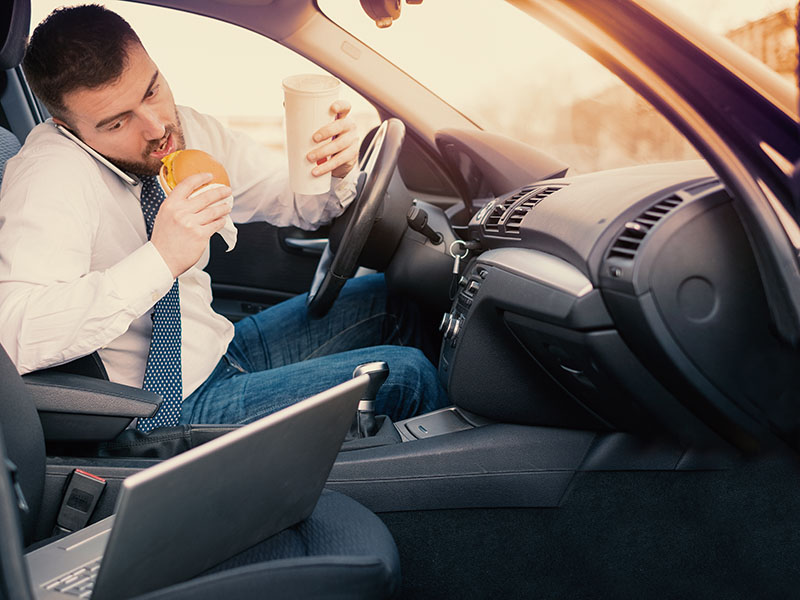
- Eating takes a hand off the wheel and, when something spills, takes the driver's eyes and attention with it. It is manual and visual distraction at once.
- ⚠ No Texas statute names this behaviour. The messaging ban in § 545.4251 covers electronic messages only, so this is proved as ordinary negligence — from the driving, not from the conduct.
- ⭐ Unlike a conversation, eating leaves a paper and digital trail: drive-thru timestamps, card transactions, app orders, and the packaging in the vehicle.
- The driving shows the rest — no braking before impact, or a drift out of lane contrary to § 545.060(a).
- If the driver was a delivery or commercial driver eating between jobs, their employer and its far larger policy come into the case.
Houston distracted driving claims: key facts
| Fact | Answer |
|---|---|
| Law firm | Maida Law Firm — Houston personal-injury firm |
| Practice on this page | Houston Distracted Driving Claims |
| Area served | Houston and the surrounding communities listed under Areas We Serve |
| Office | 8313 Southwest Fwy Ste 102, Houston, TX 77074 · (713) 785-9484 |
| Author | Sam A. Maida, Jr. — Texas Bar No. 00787950 |
| Reviewer | Bernard G. Johnson III — Texas Bar No. 00796832 |
| Consultation and fee | Free Consultation; Contingency Fee — no attorney’s fee unless there is a recovery |
| Google rating | 4.9 stars from 368 reviews (Google, 21 September 2026) |
| Deadline to file | Two years from the day the cause of action accrues — Tex. Civ. Prac. & Rem. Code § 16.003(a) |
The evidence trail eating leaves behind
| Source | What it establishes |
|---|---|
| Drive-thru or counter receipt | A timestamp and location minutes before the crash |
| Card or mobile payment record | Independent confirmation of the purchase time |
| Delivery or ordering app history | Order and collection times, and for commercial drivers the job sequence |
| Scene photographs | Food, packaging or spillage in the vehicle as found |
| Event data recorder | Whether there was any braking or steering before impact |
| Restaurant camera footage | The driver leaving with food, and sometimes eating while pulling away |
Restaurant and drive-thru footage is the most perishable item here and typically overwrites within days — it is also the item nobody thinks to ask for.
Deadlines that can end this claim
| Situation | Deadline | Source |
|---|---|---|
| Most injury lawsuits | Two years from the day the cause of action accrues. | Tex. Civ. Prac. & Rem. Code § 16.003(a) |
| An injury that causes death | Two years, running from the date of death. | Tex. Civ. Prac. & Rem. Code § 16.003(b) |
| A City of Houston, Harris County, METRO or state vehicle | Notice to the governmental unit not later than six months after the incident, describing the injury, the time and place, and the incident — and a city charter can require it sooner. | Tex. Civ. Prac. & Rem. Code § 101.101 |
| Reporting the crash itself | Immediately, by the quickest means of communication, if anyone was injured or killed or a vehicle cannot be driven normally and safely. | Tex. Transp. Code § 550.026(a) |
| If you were partly at fault | No deadline, but a hard bar: a claimant may not recover if their percentage of responsibility is greater than 50 percent. | Tex. Civ. Prac. & Rem. Code § 33.001 |
Questions people ask after a Houston crash
Tap a question to open it.
Is it illegal to eat while driving in Texas?
No. There is no statute naming it, and the messaging prohibition in § 545.4251 is confined to reading, writing or sending an electronic message. That does not weaken your claim so much as change how it is presented. Negligence asks whether the driver exercised ordinary care in the circumstances, and a driver who was managing a burger and a drink instead of the vehicle, and who never braked, has failed that test. The absence of a specific offence simply means the case is built from the driving and the surrounding evidence rather than from a citation.
How would anyone prove the other driver was eating?
More easily than most forms of distraction, because eating leaves records. A drive-thru or counter receipt carries a timestamp and a location. Card and mobile payment data confirms it independently. Delivery and ordering apps hold order and collection times. Scene photographs frequently show food, packaging or spillage in the vehicle exactly as it was. And the restaurant's own camera footage sometimes shows the driver leaving with food or eating as they pull away — which is the single most persuasive item available and the one most likely to be overwritten first.
What does the crash itself tell you?
Usually a great deal. The event data recorder shows whether there was any braking or steering input before impact; the absence of both indicates a driver who never perceived the hazard, which is the signature of attention directed elsewhere. Lane position engages § 545.060(a), which requires driving as nearly as practical entirely within a single lane and prohibits leaving it unless the movement can be made safely. Following distance engages § 545.062(a). Those are documented failures rather than characterisations.
Why do spills matter more than the eating itself?
Because a spill converts a manual distraction into a visual and cognitive one instantly. A driver holding food is impaired to a degree; a driver whose hot drink has just gone into their lap looks down, reacts physically and stops driving altogether for a period measured in seconds. At freeway speed that is a considerable distance. Scene photographs showing spillage, and the driver's own account of what happened immediately before, are what establish that sequence — which is why the vehicle interior is worth documenting before anything is cleaned.
What changes if the other driver was working?
The insurance and the available evidence both improve. A driver acting in the course and scope of employment makes the employer vicariously liable, usually with commercial limits far above the $30,000 per person Texas requires under § 601.072. For delivery drivers specifically, the platform or employer holds route, timing and job-sequence data that can show the driver was eating between jobs and under time pressure. That may also support a direct claim about scheduling and supervision rather than only about the driver's own conduct.
Where do these crashes tend to happen in Houston?
Near the food, which in practice means the arterials dense with drive-thrus and the freeway approaches just after them. Westheimer, Bissonnet, Gessner, FM 1960 and the feeder roads along the Southwest Freeway, I-10 and I-45 all combine heavy fast-food frontage with drivers rejoining traffic while occupied. The characteristic collision happens within a mile or two of the purchase, which is exactly why the receipt timestamp is such useful evidence when it can be obtained.
When should the restaurant footage be requested?
Within days, in writing, and naming the specific location, date and time window. Restaurant and drive-thru systems commonly overwrite within a week or two, and nobody in that business has any reason to retain footage on the chance that someone asks. A preservation request that identifies the camera views is far harder to satisfy narrowly than a general request. This is the single most time-critical step in an eating-distraction case, and it is one almost never taken because people do not realise the footage exists.
Why will the insurer call this an ordinary accident?
Because there is no offence to name, and because § 33.001 rewards attributing a share to you — above 50 percent you recover nothing. The answer is to keep the focus on the driving rather than on the label: no braking, a lane departure, a following distance that left no room. Those are failures of ordinary care whatever the reason for them. The eating evidence then supplies the explanation, which is what makes the failure comprehensible to a jury rather than merely asserted.
How is this different from your texting page?
The proof comes from different places. A texting case runs on carrier logs, handset data and § 545.4251, which names the conduct. An eating case has no statute and instead runs on transaction records, timestamps, packaging and restaurant footage. The physical crash evidence — the event data recorder, lane position, following distance — is common to both. If you are not sure which applies, the general distracted driving page is the better starting point.
How much does it cost to have it reviewed?
Nothing to ask, and no obligation. Representation is on a contingency fee — a percentage of the recovery, with no fee if there is no recovery — set out in writing before you sign. The reason to call quickly here is narrow and specific: drive-thru and restaurant footage is the best evidence in this category and it is gone within days, and a preservation request cannot be sent after the fact.
4.9 out of 5 from 368 Google reviews. Read them on Google.
★★★★★
Hi, I would recommend their services they were very helpful in handling and resolving my case. I received great medical care on their behalf and I was taken care of as a client by Mr. Gabriel he went above and beyond to ensure I didn't settle for less than I was owed.
★★★★★
Maida law firm was great. They have amazing communication. The staff was also very friendly and professional. The process was fast and they are very reliable. I will definitely be recommending them to all my friends and family. Thank you so much Maida Law Firm.
Reviews are the opinions of the clients who wrote them. Past results do not guarantee or predict a similar outcome in any future case.
After a crash in southwest Houston
Our office is on the Southwest Freeway, and the crashes we see from this side of Houston cluster on the same few roads. These are the emergency rooms, stations and the courthouse involved most often.
| What | Where |
|---|---|
| Main freeways | Southwest Freeway (I-69/US 59) · Sam Houston Tollway / Beltway 8 · Westpark Tollway · US 90 Alternate |
| Nearest emergency rooms | HCA Houston ER 24/7 - Westchase — 11103 Westheimer Rd, Houston |
| Memorial Hermann Southwest Hospital Emergency Center — 7600 Beechnut St, Houston | |
| Emergency Room at HCA Houston West — 12141 Richmond Ave, Houston | |
| HCA Houston ER 24/7 - Bellaire — 5413 S Rice Ave, Houston | |
| Post Oak ER - Emergency Room and Urgent ER Care — 5018 San Felipe St, Houston | |
| Police stations | Houston Police Department Westside — 3203 S Dairy Ashford Rd, Houston |
| Houston Police Department South Gessner — 8605 Westplace Dr, Houston | |
| Houston Police Department Southwest Substation — 13097 Nitida St, Houston | |
| City of Southside Place Police Department — 6309 Edloe St, Houston | |
| Where suit is filed | Harris County Civil Courthouse — 201 Caroline St, Houston, TX 77002 |
Emergency rooms and stations from Google Places within about 9 km of our office; freeways from OpenStreetMap; courthouse confirmed in the county seat. Verified 28 August 2026. Go to the nearest ER in an emergency — this list is for orientation, not medical advice.
Related Houston claims we handle
Video: Maida Law Firm: Personal Injury Lawyers in Houston, TX
An introduction to Maida Law Firm, the Houston personal injury firm Sam A. Maida, Jr. founded in 1993. Watch on YouTube
Where we are in Houston
Maida Law Firm
8313 Southwest Fwy Ste 102, Houston, TX 77074
We are on the Southwest Freeway, minutes from the 610 Loop and Sharpstown, and we see clients from across Harris County.
Read our 368 Google reviews (4.9 out of 5) · View our Google Business Profile
About the authors
Sam A. Maida, Jr.
Owner and Managing Attorney
Sam A. Maida, Jr. has represented injured Texans in the greater Houston area since the firm opened in 1993.
State Bar of TexasAvvoMartindale-HubbellLawLinkThatCarHitMeLinkedIn

Bernard G. Johnson III
Litigation Managing Attorney
Bernard G. Johnson III is a board certified trial lawyer licensed in Texas since 1996 and a graduate of South Texas College of Law.