Baytown Maritime Accident Lawyer
Maida Law Firm represents deckhands, tankermen, dock workers and other people hurt on the water around Baytown, from the firm’s Houston office at 8313 Southwest Freeway. Most of these injuries are governed by federal maritime law, not Texas workers’ compensation: the Jones Act, 46 U.S.C. § 30104 for a seaman and the Longshore Act, 33 U.S.C. § 903 for a harbor worker on a dock or terminal.
The consultation is free, and the fee comes only out of a recovery. Phone (713) 785-9484.
Written and legally reviewedWritten by Sam A. Maida, Jr., Owner and Managing Attorney · Reviewed by Bernard G. Johnson III, Litigation Managing Attorney
Published · Last updated
Which maritime law covers a worker hurt on the water around Baytown?
The law that applies depends on what the worker did and where the injury happened. A crew member of a working vessel can sue the employer under the Jones Act. A dock, terminal or barge-fleet worker on land usually claims Longshore Act benefits and may also sue a negligent vessel. Getting this first step right decides the deadline and the money available.
Where do maritime injuries happen around Baytown?
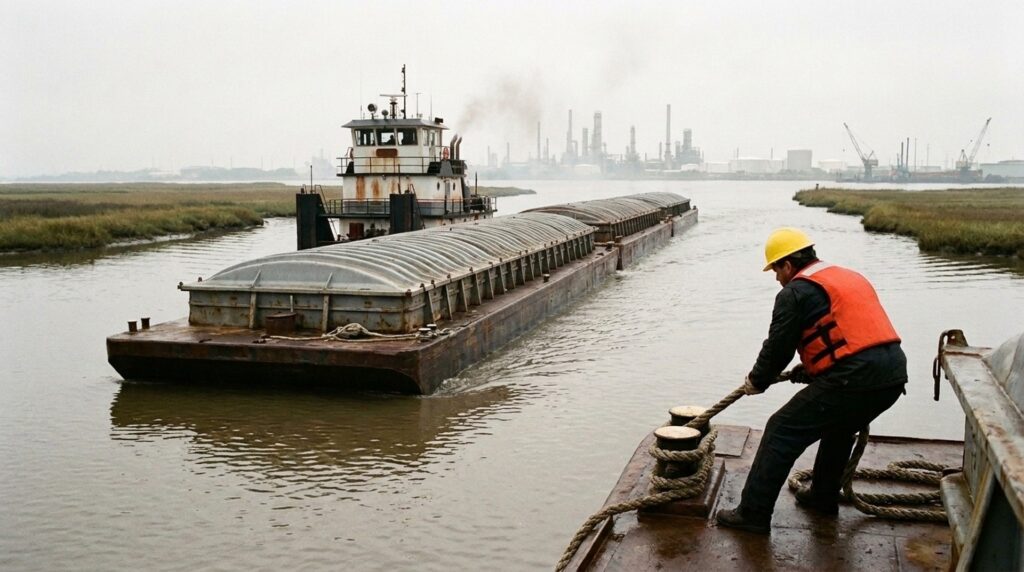
Baytown sits on the Houston Ship Channel, the waterway Port Houston describes as “the 52-mile Houston Ship Channel” (Port Houston, Port Overview, (read 20 November 2026)). On the city’s east side, Cedar Port Industrial Park at 7500 FM 1405 lists “two barge dock terminals with access to the Houston Ship Channel” and a “public barge facility at the Chambers County Improvement District No. 1 Public Dock”. It is reached by Cedar Bayou, which the federal Cedar Bayou Channel Improvement Project is deepening “from 8 to 11 feet”, with construction under way since 2020 (TxDOT Maritime Division, 2024-2025 Texas Port Profiles: Cedar Port, (read 20 November 2026)). Barge fleeting, tug work, line handling and loading at those docks produce the injuries we see most: crushed hands in rigging, falls between a barge and a dock, and back and shoulder injuries from mooring lines.
Am I a seaman under the Jones Act or a harbor worker under the Longshore Act?
Section 30104(a) provides that “a seaman injured in the course of employment” may “bring a civil action at law, with the right of trial by jury, against the employer.” The Longshore Act covers “any person engaged in maritime employment, including any longshoreman” and “any harbor-worker including a ship repairman, shipbuilder, and ship-breaker” (33 U.S.C. § 902(3)), and its definition of an employee excludes “a master or member of a crew of any vessel.” Seaman status turns on the worker’s connection to a vessel in navigation, which courts decide on the facts of each job. A push-boat deckhand on Cedar Bayou is usually a crew member; a crane operator on the Cedar Port dock usually is not.
Does the Longshore Act reach a dock or terminal on land?
Yes, for maritime work. Section 903(a) pays compensation for an injury “upon the navigable waters of the United States (including any adjoining pier, wharf, dry dock, terminal, building way, marine railway, or other adjoining area customarily used by an employer in loading, unloading, repairing, dismantling, or building a vessel).” Benefits are owed “irrespective of fault” (§ 904(b)); for total disability the rate is “66⅔ per centum of the average weekly wages” (§ 908(a)-(b)).
Can a dock worker also sue the vessel?
Often. Under § 905(b), a covered worker hurt “by the negligence of a vessel” may sue the vessel as a third party, though not on a theory of unseaworthiness. The employer’s own liability stays limited to compensation (§ 905(a)). On a Baytown barge dock, that means a claim against the tug or barge owner can run beside the Longshore benefits.
| Who was hurt | Main claim | Deadline | Statute |
|---|---|---|---|
| Crew member of a tug, push boat or other working vessel | Negligence suit against the employer, with a jury | 3 years | 46 U.S.C. §§ 30104, 30106 |
| Dock, terminal, barge-fleet or shipyard worker | Compensation from the employer, owed regardless of fault | Notice in 30 days; claim in 1 year | 33 U.S.C. §§ 903, 904, 912, 913 |
| Dock or terminal worker hurt by a vessel’s negligence | Third-party suit against the vessel | 3 years | 33 U.S.C. § 905(b); 46 U.S.C. § 30106 |
| Family of a seaman who died | Suit by the personal representative | 3 years | 46 U.S.C. §§ 30104(a), 30106 |
What should an injured Baytown maritime worker do first, and where is the case heard?
Report the injury in writing, get medical care, and keep every record of the vessel, the dock and the shift. A Longshore claim has a 30-day notice rule and a one-year filing limit; a Jones Act or vessel negligence suit has three years. Which federal court hears it depends partly on which side of the county line the work happened.
What are the deadlines after a maritime injury near Baytown?
Under the Longshore Act, notice “shall be given within thirty days after the date of such injury or death” (33 U.S.C. § 912(a)), and the claim is “barred unless a claim therefore is filed within one year after the injury or death” (§ 913(a)). If the employer has paid benefits without an award, the year runs from the last payment. A suit for “personal injury or death arising out of a maritime tort must be brought within 3 years after the cause of action arose” (46 U.S.C. § 30106).
Does the Coast Guard get a report of my injury?
It should. A vessel operator must notify the Coast Guard of an injury that “requires professional medical treatment (treatment beyond first aid)” and leaves a crew member unfit for routine duties (46 C.F.R. § 4.05-1(a)(6)), and must file a written report on Form CG-2692 “within 5 days” (§ 4.05-10(a)). We request that report early, because it fixes the operator’s first account of what happened.
Which court hears a Baytown maritime case?
Baytown lies in Harris and Chambers counties, and the federal court is divided along that line. Under 28 U.S.C. § 124(b), the “Galveston Division comprises the counties of Brazoria, Chambers, Galveston, and Matagorda,” with court “held at Galveston,” while the Houston Division includes Harris County. Cedar Port and the Chambers County Improvement District dock are on the Chambers side. A Jones Act case may also be filed in a Texas state court, such as the Harris County civil district courts in Houston or the Chambers County court in Anahuac. Where the employer and vessel owner can be sued is part of the choice, so we decide it with the deadlines in view.
What does a recent Ship Channel investigation show about these cases?
ABC13 reported on 6 August 2026 that the National Transportation Safety Board had released its report on the July 2024 collision between the bulk carrier Yangze 7 and the towing vessel Miss Peggy on the Houston Ship Channel. Four crew members from the towing vessel were rescued, “but one died”. The NTSB found that “the Houston pilot of Yangze 7 was on a non-work-related phone call and distracted” and that the tug captain “failed to maintain a proper lookout” (ABC13, 6 August 2026). Distraction, lookout and bridge-team communication are the same questions we ask about any vessel involved in a Baytown injury.
How we work a Baytown maritime claim
- Fix the worker’s status. Seaman, harbor worker or neither: it decides every step that follows.
- Preserve the vessel records. Logbooks, the Form CG-2692, deck and dock video, and the names of the crew on watch.
- Identify every party. The employer, the vessel owner or operator, the dock or terminal owner, and any contractor.
- Protect the benefits. Longshore compensation or maintenance and cure should keep coming while a negligence claim is built.
- Track the clocks. Thirty-day notice, the one-year Longshore claim and the three-year suit limit.
Our office on the Southwest Freeway is about 33 miles from Baytown, so meetings can be by phone or video, and we come to a worker who is laid up after surgery. Related pages: maritime and Jones Act claims across the Houston area, maritime injuries on Galveston Island and the bay, recreational boating accidents, workplace injuries on land and the Baytown personal injury overview. For background, read our guide to Jones Act claims and offshore injury law.
Baytown maritime injury questions
Very likely, if you are assigned to the boat and do your work aboard it. A deckhand on a working vessel is the typical Jones Act seaman, which lets you sue the employer for negligence with a jury (46 U.S.C. § 30104(a)). We confirm it from your assignment records and pay stubs.
Usually a Longshore Act claim, because § 903(a) covers injuries on “any adjoining pier, wharf” or terminal used in loading a vessel. If the tug or barge crew caused the injury, a separate suit against the vessel under § 905(b) may add damages the benefits do not cover.
Not always. Federal maritime law can apply to a worker hurt on the water or on a dock used for loading vessels, even when the employer carries a state policy. The answer changes the benefit rate and whether you can sue, so we review it before you sign anything.
No. Section 30104(a) applies the laws that govern “a railway employee,” under which a worker’s own negligence reduces the award rather than barring it. Longshore benefits are paid “irrespective of fault” (33 U.S.C. § 904(b)).
For a seaman, “the personal representative of the seaman” brings the Jones Act action (§ 30104(a)), usually the executor or administrator of the estate. Longshore death benefits are claimed by the survivors, and the one-year filing limit applies.
Not before you speak to a lawyer. Statements about where you stood, what you were told and how long you had worked that shift are used to dispute seaman status and fault. You still report the injury to your employer, in writing.
You pay no fee unless money is recovered for you, and the first meeting is free. Call (713) 785-9484.
Hurt on a vessel or dock in Baytown?
Talk to Maida Law Firm about your status as a seaman or harbor worker, the reports and the deadlines. Free consultation; no attorney’s fee unless there is a recovery. Call (713) 785-9484.
About the authors

Sam A. Maida, Jr.
Owner and Managing Attorney
Sam A. Maida, Jr. has represented injured Texans in the greater Houston area since the firm opened in 1993.
Texas Bar No. 00787950
State Bar of TexasAvvoMartindale-HubbellLawLinkThatCarHitMeLinkedIn

Bernard G. Johnson III
Litigation Managing Attorney
Bernard G. Johnson III is a board certified trial lawyer licensed in Texas since 1996 and a graduate of South Texas College of Law.
Texas Bar No. 00796832
Admitted to practice in the U.S. District Court for the Western District of Texas (2004)
Video: Maida Law Firm: Personal Injury Lawyers in Houston, TX
An introduction to Maida Law Firm, the Houston personal injury firm Sam A. Maida, Jr. founded in 1993. Watch on YouTube