
A truck tire that fails on a Houston freeway is seldom pure bad luck. Federal rules set tread, inflation and load limits for truck tires and require the carrier to inspect and repair them, so a blowout points to one of four things: poor maintenance, an overloaded or under-inflated tire, a defective tire, or debris the driver could not avoid. Which one it was decides who answers for your injuries.
The short version
- Tires have written limits. No truck may run on a tire with exposed ply or belt material, a tread or sidewall separation, or an audible leak, and tread depth has minimums of 4/32 inch on the front wheels of a truck or tractor and 2/32 inch on other tires (49 CFR 393.75).
- Inflation and load are regulated too. A tire may not carry more weight than its sidewall marking, and may not run below the cold inflation pressure specified for the load (§ 393.75(g), (i)).
- The carrier must inspect and repair. It must systematically inspect and maintain every vehicle it controls, keep the records, and fix tire defects before the truck goes back out (§§ 396.3, 396.11).
- A defective tire can add the tire maker as a defendant. Texas products-liability law (Civ. Prac. & Rem. Code ch. 82) governs a claim against a manufacturer or seller.
- The failed tire is the key exhibit. Its fragments and markings let an expert say whether it was worn, overloaded or flawed.
What do federal rules say about the tires on an 18-wheeler?
Section 393.75 of the Federal Motor Carrier Safety Regulations bars a truck from running on a tire with exposed ply or belt material, a tread or sidewall separation, a flat or audible leak, or a cut that exposes ply or belt material, and sets minimum tread depths. It also limits the weight a tire may carry and requires correct inflation for the load.
The text of the regulation is short and specific. A motor vehicle may not be operated on a tire that “has body ply or belt material exposed through the tread or sidewall,” “has any tread or sidewall separation,” “is flat or has an audible leak,” or “has a cut to the extent that the ply or belt material is exposed” (49 CFR 393.75(a), eCFR text current as of 13 October 2026). The other limits are in the table.
| Paragraph | What it requires |
|---|---|
| (b) Front wheels | Tires on the front wheels of a bus, truck or truck tractor need a tread groove pattern depth of at least 4/32 of an inch |
| (c) Other tires | At least 2/32 of an inch in a major tread groove |
| (d), (e) Retreads | A bus may not run regrooved, recapped or retreaded tires on its front wheels; a regrooved tire with a load-carrying capacity of 4,920 pounds or more may not be used on the front wheels of a truck or truck tractor |
| (g) Load | No tire may carry more weight than its sidewall marking, unless the vehicle runs under a state special permit at a reduced speed that never exceeds 50 mph (manufactured homes have their own paragraph) |
| (i) Inflation | No tire may be run with a cold inflation pressure below what is specified for the load being carried |
Who has to inspect and maintain a truck’s tires?
The motor carrier does, and so does the driver. The carrier must systematically inspect, repair and maintain every vehicle under its control; the driver must write up any tire defect found in the daily report and be satisfied the truck is in safe operating condition before driving.
Section 396.3(a) says every motor carrier “must systematically inspect, repair, and maintain, or cause to be systematically inspected, repaired, and maintained, all motor vehicles” subject to its control, and that parts and accessories, including wheels and rims, “shall be in safe and proper operating condition at all times.” Section 396.11 requires a written driver vehicle inspection report at the end of each day’s work covering, among other items, tires, wheels and rims (a driver who finds no defect need not prepare one), and a carrier must repair any listed defect “likely to affect the safety of operation” before it permits the vehicle to run. Before driving, the driver must be satisfied the truck is in safe operating condition (§ 396.13) (49 CFR 396.11, 396.13).
There is also a yearly checkpoint: a carrier may not use a commercial motor vehicle unless each listed component passed an inspection within the preceding 12 months (49 CFR 396.17(c)).
Records are kept for different periods: maintenance records for a year at the place the vehicle is kept or serviced, plus six months after the carrier stops controlling the vehicle (§ 396.3(c)), and the daily report for three months (§ 396.11(a)(4)). That is why a written preservation request has to go out quickly after a crash. The evidence in an 18-wheeler claim has the full retention table; this post stays with the tire. For the overview of how such claims differ from car claims, read why 18-wheeler cases are different, and for the lawyer’s whole role, what a truck accident lawyer does.
What causes a truck tire to blow out, and who is responsible?
The rules point to the usual suspects: a tire worn below the tread minimum, one run under-inflated or overloaded, one with damage nobody repaired, or one with a flaw from the factory. Responsibility follows the cause: the carrier and driver for upkeep and loading, the tire maker for a defect.
A blowout alone proves none of these. A tire that fails on I-10 may have been sound until it hit something, and a defendant may argue exactly that. What a claim needs is the tire, the maintenance file and the loading records read together. A reported tire problem that was never fixed raises the carrier’s duty under § 396.3; weight above the sidewall rating raises § 393.75(g); a tire within every limit turns attention to its manufacture.
Those point to different defendants. The driver and carrier answer for inspection, loading and driving, as explained in who can be held liable for a Texas truck accident; a loader can enter the case when overloading is the issue; a tire maker or seller is a separate target when the tire itself is to blame. Texas assigns each responsible party a percentage of fault, so comparative negligence matters even when the tire clearly failed.
What if the tire itself was defective?
Then a products-liability claim against the manufacturer, and sometimes the seller, may be available. Texas Civil Practice and Remedies Code chapter 82 defines the claim, protects most non-manufacturing sellers unless one of seven listed conditions is proved, and requires a design-defect claimant to prove a safer alternative design.
The chapter reaches claims against a “manufacturer or seller” for harm “allegedly caused by a defective product,” and “manufacturer” includes a designer, producer or assembler of a product or component part who places it in the stream of commerce. A middleman who merely sold the tire is shielded unless one of seven listed conditions is shown (§ 82.003(a)), such as an alteration by the seller or a manufacturer that is insolvent or beyond the court’s jurisdiction. Alleging a design flaw means proving a safer alternative design and a producing cause (§ 82.005(a)). See Civ. Prac. & Rem. Code ch. 82, read on the Legislature’s site on 16 October 2026.
Under § 82.008(a), a manufacturer or seller that establishes that a product’s formulation, labeling or design met mandatory federal safety standards governing the risk gets a rebuttable presumption of no liability; § 82.008(b) says how it is rebutted, and § 82.008(d) says the section does not extend to manufacturing flaws. Whether it applies is a question for counsel. Tire claims sit within the broader defective product accident category; see also cases where a flaw in the vehicle caused the crash.
How do you check whether a truck tire was recalled?
Read the tire’s sidewall markings, including the DOT tire identification number (TIN), and compare them with the National Highway Traffic Safety Administration’s recall notices. A recall covers only tires whose TIN, tire line and size match the notice, so a near match proves nothing.
Truck tires do get recalled. In a notice dated 14 April 2025 and posted on NHTSA’s site, Bridgestone’s Recall No. 25T-004 said certain Bridgestone R123 Ecopia 295/75R22.5 tires “may have been manufactured with one of the 3 stabilizer ply belts applied in the wrong orientation,” a condition it said could pose a safety risk. The notice limited the recall to tires carrying a specific TIN and stated that if the TIN, tire line and size “do not exactly match the description above, the tire is not part of this recall.”
That precision is why the physical tire matters. A photo of a blowout fragment is not enough to read a TIN; the part of the tire that carries it has to be found and kept.
Can an overloaded truck or a spilled load cause a tire crash?
Yes, in two ways. Weight beyond a tire’s sidewall rating is itself a violation of § 393.75(g), and an uncovered or poorly contained load can drop debris that damages tires on cars behind it. Texas regulates loose-material loads in Transportation Code chapter 725.
Chapter 725 covers the transport of loose material, defined as material “that can be blown or spilled from a vehicle,” including dirt, sand, gravel and refuse. A commercial motor vehicle carrying it must have the load covered and the covering firmly secured at front and back, or completely enclosed by the load-carrying compartment (§ 725.021(e)), and a violation is a misdemeanor with a fine of not less than $25 and not more than $500 (§ 725.003). The chapter reaches only loose material; a pallet that slides off a flatbed or a strap that fails is judged under other rules. See Transportation Code chapter 725.
Whoever loaded a shifting, spilling or overweight load is a possible defendant beside the carrier. A Sugar Land 18-wheeler accident raises the same questions as one on the Katy Freeway or I-45; see also Houston’s most dangerous roads and common causes of Houston truck accidents.
What have Houston news reports shown about truck tires on the road?
That a truck tire assembly that comes loose is dangerous even when it is not a blowout. ABC13 reported a fatal wheel strike on the East Freeway in October 2025 and a fatal loose-tire crash on the Katy Freeway in April 2023; in neither report had a cause been announced.
In early October 2025, ABC13 reported that a wheel came off an 18-wheeler traveling west on the East Freeway and struck a road crew repaving Monmouth Street; authorities said one worker died and another was seriously injured, and the case remained under investigation. In April 2023, ABC13 reported that a large truck’s tire crossed the Katy Freeway near Blalock and hit an SUV, killing a passenger. Authorities said the truck kept going, and that the tire may have been a spare.
Neither report calls the event a blowout or says why the tire separated. A truck that leaves the scene adds a second problem; see hit-and-run accidents in Houston and your own uninsured motorist coverage.
Houston Landing’s October 12, 2023 report on road debris adds local agency detail: a TxDOT spokesperson said tire shreds are more common in summer because of extreme heat, and a Harris County Toll Road Authority spokeswoman said roadway debris “generally causes flat tires and broken windshields,” adding that its incident response team has picked up 17,106 pieces of debris on the toll system since 2020 (Houston Landing).
What should you do at the scene of a truck tire crash?
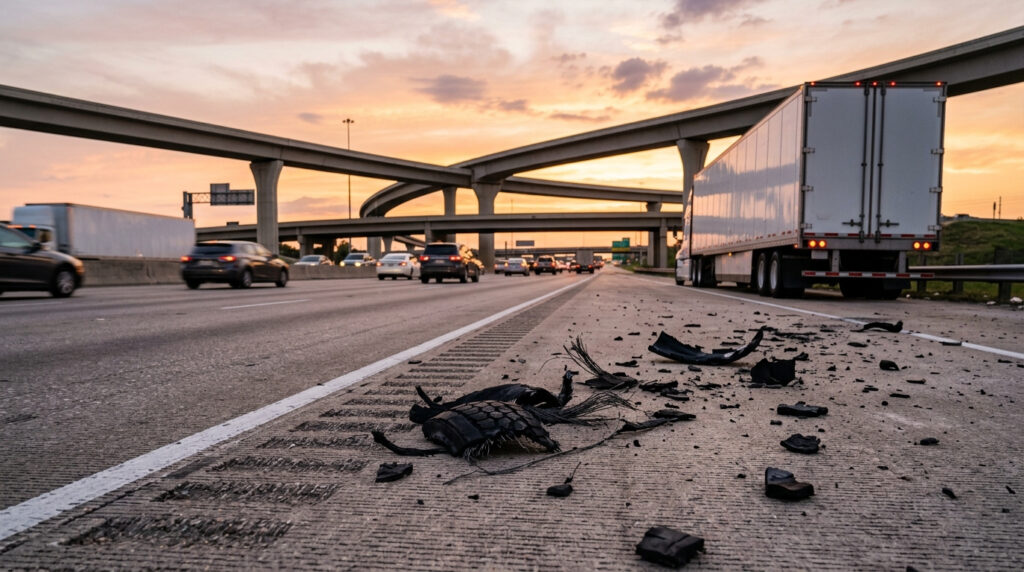
Get medical care, call the police, photograph the scene including tire fragments, the truck’s USDOT number and plates, and ask a lawyer to send a preservation request for the tire and the maintenance records before they are discarded or repaired.
The general steps are in what to do after a truck accident, and the mistakes to avoid, such as a recorded statement to the carrier’s adjuster, in what to avoid after a Houston truck crash. One point is specific to tires: a fragment photographed where it lies can later be tied to the truck. Get the crash report, and speak with counsel ahead of any adjuster interview. A tire examination is usually work for an expert; see expert witnesses in truck cases, the types of damages available, and insurance on an 18-wheeler for how several insurers fit together.
On the Harris County toll roads, the report may come from a constable instead. Constable Precinct 8’s Toll Road Patrol Division says its deputies patrol 36 miles of roadway between the I-10 East Freeway and the Gulf Freeway and are first responders for all incidents on the toll road, including traffic accidents and roadway debris calls (Harris County Constable Precinct 8, Toll Road Patrol Division), so ask which agency responded when you request the report. The usual causes of Houston truck crashes and our page on defective vehicle products cover what comes next if a tire or load is to blame. Tire crashes happen on every corridor; see also our 18-wheeler pages for Pasadena and The Woodlands, and our page on truck accident settlements.
What is the first legal step in a truck tire blowout claim?
The first steps in any tire case are a written request that the carrier keep the tire, its maintenance file and the driver’s reports, and an expert review of what failed. Both are easier to do before the truck is repaired and the damaged tire is thrown away.
For a truck case, start at our Houston 18-wheeler accident page; for other crash types, see our Houston car accident page or our personal injury practice overview. If a truck tire failed in your crash, send the date, the road and the carrier’s name through the contact page, along with photos of any tire pieces. Read what a Houston accident lawyer costs first if fees are a concern.
Frequently asked questions
Who is at fault when a truck tire blows out and causes a crash?
It depends on why the tire failed. The carrier and driver answer for inspection, inflation and loading; a loader may share fault for an overweight axle; a tire maker may answer for a defect. Texas assigns each party a percentage of responsibility.
What causes tire blowout truck accidents?
The federal rules point to worn tread, exposed ply or belt material, cuts, leaks, wrong inflation for the load and weight above the sidewall rating. A factory flaw can also cause failure. The tire and the records show which one applied.
What is a tire blowout truck accident?
A crash that follows the sudden failure of a truck tire, which can cost the driver control or throw rubber into other lanes. The legal question is not that it failed but why, and whether someone broke a maintenance, loading or product-safety duty.
Who is responsible when a semi truck tire blowout damages a car?
The party whose failure caused it: the carrier for maintenance, the driver for pre-trip checks, a loader for excess weight, or the manufacturer for a defective tire. Vehicle damage is claimed alongside injuries and lost income.
Are retreaded tires legal on an 18-wheeler?
Partly. Under 49 CFR 393.75(d) and (e), a regrooved tire rated 4,920 pounds or more may not go on the front wheels of a truck or tractor, and a bus may not run retreads on its front wheels. The rule does not ban retreads elsewhere on a tractor-trailer.
How long does a carrier have to keep tire maintenance records?
Under § 396.3(c), maintenance records stay where the vehicle is kept or serviced for a year, and for six months after the carrier no longer controls it. Daily driver inspection reports are kept only three months, so a preservation request should go out quickly.
Can I sue the tire manufacturer after a truck tire blowout?
Possibly. Civil Practice and Remedies Code chapter 82 governs claims against a manufacturer for a defective product. Whether one exists depends on the tire, its markings and an expert’s findings.
About the authors

Sam A. Maida, Jr.
Owner and Managing Attorney
Sam A. Maida, Jr. has represented injured Texans in the greater Houston area since the firm opened in 1993.
State Bar of TexasAvvoMartindale-HubbellLawLinkThatCarHitMeLinkedIn

Bernard G. Johnson III
Litigation Managing Attorney
Bernard G. Johnson III is a board certified trial lawyer licensed in Texas since 1996 and a graduate of South Texas College of Law.