
PEDESTRIAN ACCIDENTS

Houston Pedestrian Accident Lawyer

A person hit by a vehicle while walking in Houston can bring a claim against the driver when the driver broke a right-of-way rule or failed to use due care. Texas sets those rules in Chapter 552 of the Transportation Code. Fault is divided by percentage, and a lawsuit for personal injury generally has to be filed within two years.

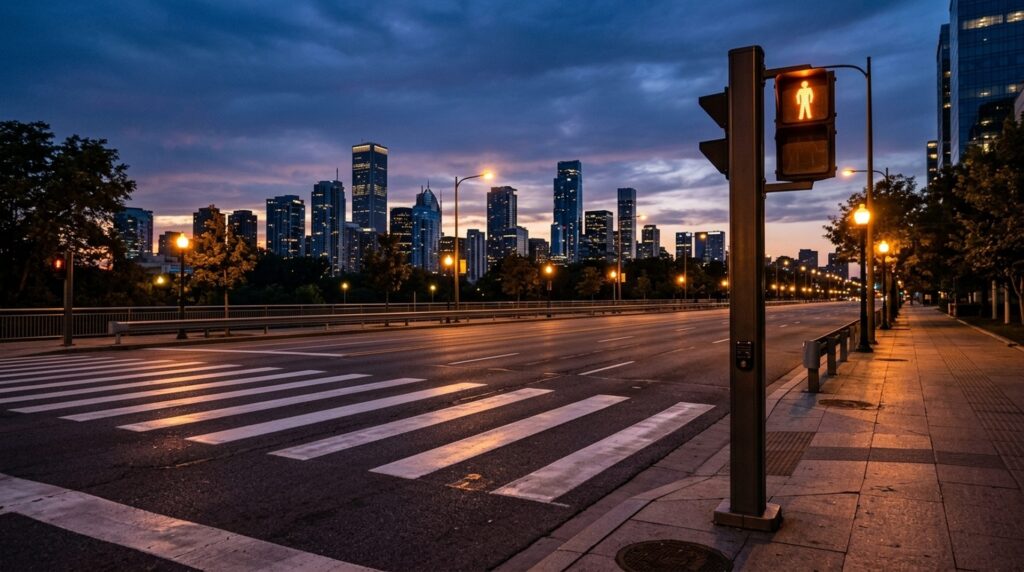
Illustration of an empty marked crosswalk on a wide city street at dusk

The short version

  • Crosswalk, no working signal: the driver must stop and yield when you are on the driver’s half of the road or close enough to be in danger (Tex. Transp. Code § 552.003(a)).
  • “Walk” signal: the driver must stop and yield (§ 552.002(b)). Outside a crosswalk the pedestrian yields (§ 552.005(a)), but the driver must still use due care (§ 552.008).
  • Fault is shared by percentage. Nothing is recoverable above 50 percent responsibility; below that, damages are reduced by your share (Tex. Civ. Prac. & Rem. Code §§ 33.001, 33.012(a)).
  • Two years to file a personal injury suit (§ 16.003(a)); six months to give notice when a governmental unit’s vehicle was involved (§ 101.101(a)), and ninety days for the City of Houston (City Charter, Art. IX, § 11).
  • 695 pedestrians died in Texas traffic crashes in 2025 (TxDOT, Texas Motor Vehicle Traffic Crash Facts 2025); 115 in the City of Houston in 2022 (City of Houston, Vision Zero Annual Report 2022).
RIGHT-OF-WAY RULES

Who has the right-of-way when a driver hits a pedestrian in Houston?

It depends on where the person was walking. At a crosswalk with no working signal, and on a “Walk” signal, Texas law makes the driver stop and yield. Away from a crosswalk the pedestrian yields, but every driver must still use due care to avoid hitting a person on the roadway.

The Texas Department of Transportation’s crash facts for 2025 report: “Pedestrian fatalities totaled 695 in 2025.” (Source: TxDOT, Texas Motor Vehicle Traffic Crash Facts, calendar year 2025.) Inside the Houston city limits, 115 of the 323 people killed in traffic crashes in 2022 were on foot, up from 106 the year before; the city’s report states: “Nine additional Pedestrians died (8.5% increase) and 24 more were seriously injured (11% increase).” (Source: City of Houston, Vision Zero Annual Report 2022, Figure 1, from TxDOT crash records; the most recent city report we could open.) Each of those crashes, and each one a person survives, is judged against the same short list of rules.

At a crosswalk with no signal

Section 552.003(a) reads: “The operator of a vehicle shall stop and yield the right-of-way to a pedestrian crossing a roadway in a crosswalk if: (1) no traffic control signal is in place or in operation; and (2) the pedestrian is: (A) on the half of the roadway in which the vehicle is traveling; or (B) approaching so closely from the opposite half of the roadway as to be in danger.” A crosswalk does not have to be painted; the statute treats an unmarked crosswalk at an intersection the same way for the purpose of who must yield when crossing elsewhere (§ 552.005(a)(1)).

Two limits sit in the same section. Under subsection (b), “a pedestrian may not suddenly leave a curb or other place of safety and proceed into a crosswalk in the path of a vehicle so close that it is impossible for the vehicle operator to stop and yield.” And under subsection (c): “The operator of a vehicle approaching from the rear of a vehicle that is stopped at a crosswalk to permit a pedestrian to cross a roadway may not pass the stopped vehicle.” The second rule matters on Houston’s multi-lane streets, where one driver stops and a driver in the next lane does not.

On a “Walk” signal

Section 552.002(b): “A pedestrian or sidewalk user facing a “Walk” signal may proceed across a roadway in the direction of the signal, and the operator of a vehicle shall stop and yield the right-of-way to the pedestrian or sidewalk user.” This is the rule that applies to a driver turning right or left across a crosswalk while the walk signal is lit.

Away from a crosswalk

Section 552.005(a): “A pedestrian shall yield the right-of-way to a vehicle on the highway if crossing a roadway at a place: (1) other than in a marked crosswalk or in an unmarked crosswalk at an intersection;” Subsection (b) adds: “Between adjacent intersections at which traffic control signals are in operation, a pedestrian may cross only in a marked crosswalk.” Crossing mid-block does not end the claim. Section 552.008 begins “Notwithstanding another provision of this chapter, the operator of a vehicle shall:” and requires the driver to “exercise due care to avoid colliding with a pedestrian on a roadway;” and to “exercise proper precaution on observing a child or an obviously confused or incapacitated person on a roadway.” How the two duties weigh against each other is decided as a percentage of responsibility, covered below.

On sidewalks, driveways and road shoulders

Section 552.006(c): “The operator of a vehicle emerging from or entering an alley, building, or private road or driveway shall stop and yield the right-of-way to a pedestrian approaching on a sidewalk extending across the alley, building entrance or exit, road, or driveway.” Where there is no sidewalk, subsection (b) says “a pedestrian walking along and on a highway shall walk on the left side of the roadway or the shoulder of the highway facing oncoming traffic” unless that side is obstructed or unsafe.

Houston’s own ordinance

Section 45-44 of the Houston Code of Ordinances adds a city rule for “vulnerable road users,” defined to include “A pedestrian (including a runner), physically disabled person (including a person in a wheelchair), stranded motorist or passenger, highway construction or maintenance worker, tow truck operator, or utility worker in the roadway;” A driver passing one must change lanes when that is safe on a street with two or more lanes in the same direction, or pass at a safe distance, which is in any event “not less than 3 feet if the operator’s vehicle is a passenger car or light truck and not less than 6 feet if the operator’s vehicle is a truck (other than a light truck) or a commercial vehicle.” When turning at an intersection the driver must “yield the right-of-way to a vulnerable road user who is approaching from the opposite direction and is in the intersection, or is in such proximity to the intersection as to be an immediate hazard.”

When the driver can also be charged with a crime

Since September 1, 2021, Section 545.428 makes it an offense when a person with criminal negligence “operates a motor vehicle within the area of a crosswalk; and” “causes bodily injury to a pedestrian or a person operating a bicycle” or one of the other listed devices. Subsection (c): “An offense under this section is a Class A misdemeanor, except that the offense is a state jail felony if the person described by Subsection (b)(2) suffered serious bodily injury.” A criminal case is brought by the State and is separate from the injured person’s civil claim for damages. When the driver had been drinking, see our page on drunk driving accident claims; when the driver left, see hit and run claims.

DAMAGES, FAULT & DEADLINES

What can a pedestrian recover after being hit by a car in Texas?

The losses Texas law calls economic and noneconomic damages: medical bills and lost earnings on one side, physical pain and mental anguish on the other. The amount is reduced by the pedestrian’s own percentage of responsibility, nothing is recoverable above 50 percent, and suit must generally be filed within two years.

What counts as damages

Section 41.001 of the Civil Practice and Remedies Code defines the terms. “”Economic damages” means compensatory damages intended to compensate a claimant for actual economic or pecuniary loss”; “”Noneconomic damages” means damages awarded for the purpose of compensating a claimant for physical pain and suffering, mental or emotional pain or anguish” and the other losses the definition lists. A person on foot has no vehicle around them, so the injuries in these cases are often to the head, spine, pelvis and legs, and the records that prove them are the ambulance run report, the hospital chart and the bills.

How shared fault changes the amount

Section 33.001: “a claimant may not recover damages if his percentage of responsibility is greater than 50 percent.” Below that line, under § 33.012(a), “the court shall reduce the amount of damages to be recovered by the claimant with respect to a cause of action by a percentage equal to the claimant’s percentage of responsibility.” An insurer for the driver will usually argue that the pedestrian crossed outside a crosswalk, against a signal or in dark clothing. Those arguments go to the percentage; they are answered with the crash report, video from nearby businesses and buses, the signal timing and witness statements.

Which insurance pays

The driver’s liability insurance is the first source. When the driver has none, too little, or cannot be found, Section 1952.101 of the Insurance Code describes uninsured or underinsured motorist coverage as coverage that “protects insureds who are legally entitled to recover from owners or operators of uninsured or underinsured motor vehicles damages for bodily injury, sickness, disease, or death.” Personal injury protection, under § 1952.151, pays reasonable expenses that include “necessary medical, surgical, x-ray, or dental services, including prosthetic devices, and necessary ambulance, hospital, professional nursing, or funeral services;” Both coverages must be offered with a Texas auto policy and apply unless rejected in writing (§§ 1952.101(c), 1952.152(b)). Whether a particular policy covers its insured while walking is a question of that policy’s wording, which is why we ask for the declarations page of every auto policy in the household.

When the vehicle belonged to a city, a county or a transit agency

The Texas Tort Claims Act allows a claim against a governmental unit where Section 101.021(1)(A) applies: “the property damage, personal injury, or death arises from the operation or use of a motor-driven vehicle or motor-driven equipment; and” The deadline to give notice is much shorter than the deadline to sue. Section 101.101(a): “A governmental unit is entitled to receive notice of a claim against it under this chapter not later than six months after the day that the incident giving rise to the claim occurred.” Subsection (b) adds: “A city’s charter and ordinance provisions requiring notice within a charter period permitted by law are ratified and approved.” so a city’s own charter can set an earlier date. Houston’s does: the City Charter, Article IX, Section 11, requires written, verified notice to the Mayor and City Council “within ninety days after the same has been sustained.” The Act also caps the amount (§ 101.023).

The deadline to file suit

Section 16.003(a) provides that, with listed exceptions, “a person must bring suit for trespass for injury to the estate or to the property of another, conversion of personal property, taking or detaining the personal property of another, personal injury, forcible entry and detainer, and forcible detainer not later than two years after the day the cause of action accrues.” In a death case, subsection (b) says: “The cause of action accrues on the death of the injured person.” Families in that position can read our page on wrongful death claims. Collisions between two vehicles are covered on the Houston car accident page.

COMMON QUESTIONS

What do people ask after being hit by a car while walking in Houston?

Possibly. Outside a crosswalk the pedestrian must yield (§ 552.005(a)), but § 552.008 still requires the driver to “exercise due care to avoid colliding with a pedestrian on a roadway;” A jury weighs both. You recover nothing only if your share is more than 50 percent (§ 33.001).

Report it to the police and get medical care first. A claim may still be possible through uninsured motorist coverage on an auto policy in your household, depending on the policy. Our hit and run page explains the steps.

Yes. Section 552.003(c) says: “The operator of a vehicle approaching from the rear of a vehicle that is stopped at a crosswalk to permit a pedestrian to cross a roadway may not pass the stopped vehicle.”

Yes. Claims against a governmental unit fall under the Texas Tort Claims Act. Notice is due within six months under § 101.101(a), the Houston City Charter requires it within ninety days for a claim against the City, and the amount is capped by § 101.023. Contact a lawyer quickly.

A prosecutor decides whether to charge the driver, for example under § 545.428 where a driver with criminal negligence injures a person within the area of a crosswalk. Your civil claim is separate and does not depend on a charge or a conviction.

Nothing. The consultation is free, and we charge no fee unless we recover for you. Call (713) 785-9484.

How do I start a pedestrian injury claim in Houston?

Call (713) 785-9484 or use the form. The consultation is free and there is no fee unless we recover for you. Bring the crash report number if you have it, the names of the hospitals that treated you, and the declarations page of any auto policy in your household.

Houston car accident claims: key facts

Who we are, where we are, and what governs this claim
FactAnswer
Law firmMaida Law Firm — Houston personal-injury firm
Practice on this pageHouston Car Accident Claims
Area servedHouston and the surrounding communities listed under Areas We Serve
Office8313 Southwest Fwy Ste 102, Houston, TX 77074 · (713) 785-9484
AuthorSam A. Maida, Jr. — Texas Bar No. 00787950
ReviewerBernard G. Johnson III — Texas Bar No. 00796832
Consultation and feeFree Consultation; Contingency Fee — no attorney’s fee unless there is a recovery
Google rating4.9 stars from 368 reviews (Google, 21 September 2026)
Deadline to fileTwo years from the day the cause of action accrues — Tex. Civ. Prac. & Rem. Code § 16.003(a)

Who must yield: the Texas pedestrian right-of-way rules

Each rule below is the text of the Transportation Code as published by the State of Texas, read on October 12, 2026.

Texas right-of-way rules between drivers and pedestrians
SituationWhat Texas law requiresSource
Crosswalk, no signal in place or workingThe driver stops and yields when the pedestrian is on the driver’s half of the roadway or approaching so closely from the other half as to be in danger.Tex. Transp. Code § 552.003(a)
“Walk” signal showingThe pedestrian may cross in the direction of the signal and the driver stops and yields.§ 552.002(b)
A car has stopped at a crosswalk for a pedestrianA driver approaching from the rear may not pass the stopped vehicle.§ 552.003(c)
Crossing away from a marked crosswalk or an unmarked crosswalk at an intersectionThe pedestrian yields to vehicles.§ 552.005(a)
Any pedestrian on a roadwayThe driver must use due care to avoid a collision and take proper precaution on seeing a child or an obviously confused or incapacitated person.§ 552.008
Driveways, alleys and building exitsThe driver stops and yields to a pedestrian approaching on the sidewalk.§ 552.006(c)
A driver passes a pedestrian in the roadway in HoustonChange lanes when safe on a street with two or more lanes in the same direction, or pass at not less than 3 feet in a car or light truck and 6 feet in a truck or commercial vehicle.Houston Code of Ordinances Sec. 45-44

This table summarizes statutes; it is not advice about a particular collision. The sections are quoted in full on this page.

Deadlines after a pedestrian is hit in Texas

The deadline to give notice to a government body is far shorter than the deadline to file suit.

Texas deadlines that apply to a pedestrian injury claim
WhatDeadlineSource
Lawsuit for personal injuryTwo years after the day the cause of action accruesTex. Civ. Prac. & Rem. Code § 16.003(a)
Lawsuit for a deathTwo years; the cause of action accrues on the death of the injured person§ 16.003(b)
Notice of a claim against a governmental unitSix months after the day of the incident, unless a city charter sets a shorter period§ 101.101(a), (b)
Written, verified notice of a claim against the City of HoustonWithin ninety days after the injuryHouston City Charter, Art. IX, § 11

Exceptions exist, including for minors. A lawyer should confirm the deadline that applies to you.

Pedestrian accident claims in Houston: who, what, when, where, why and how

Tap a question to open it.

Who can be held responsible when a pedestrian is hit?

The driver, and in some cases the driver’s employer or the owner of the vehicle. When the vehicle belonged to a city, county or transit agency, the claim is against the governmental unit under the Texas Tort Claims Act, with its own notice deadline and limits.

What evidence matters most in a pedestrian case?

The officer’s crash report, video from nearby businesses, buses and traffic cameras, the signal phase at the moment of impact, witness statements, photographs of the scene and lighting, and the medical records from the ambulance and the hospital. Video is often overwritten within days.

When should I talk to a lawyer after being hit?

As soon as your medical condition allows. Video and witness memories fade quickly, and when a government vehicle is involved, notice is due within six months under § 101.101(a), and within ninety days for a claim against the City of Houston.

Where is a Houston pedestrian injury lawsuit filed?

Generally in the county where the collision happened. For a collision in Houston that is usually Harris County, in a county civil court at law or a district court depending on the amount in dispute.

Why does the insurance company say I was at fault?

Because every percentage point assigned to you reduces what it pays, and above 50 percent it pays nothing (§§ 33.001, 33.012(a)). Crossing outside a crosswalk does not by itself make you more than half responsible; the driver’s duty of due care under § 552.008 still applies.

How long does a pedestrian injury claim take?

It depends on how long treatment lasts and whether fault is disputed. A claim is usually not valued until the doctors can say what the lasting effects are. The two-year filing deadline in § 16.003(a) runs in the meantime.

4.9 out of 5 from 368 Google reviews. Read them on Google.

★★★★★

Hi, I would recommend their services they were very helpful in handling and resolving my case. I received great medical care on their behalf and I was taken care of as a client by Mr. Gabriel he went above and beyond to ensure I didn't settle for less than I was owed.

Erick George · in the last week · via Google

★★★★★

Maida law firm was great. They have amazing communication. The staff was also very friendly and professional. The process was fast and they are very reliable. I will definitely be recommending them to all my friends and family. Thank you so much Maida Law Firm.

Carolina Argueta · 2 weeks ago · via Google

Reviews are the opinions of the clients who wrote them. Past results do not guarantee or predict a similar outcome in any future case.

After a crash in southwest Houston

Our office is on the Southwest Freeway, and the crashes we see from this side of Houston cluster on the same few roads. These are the emergency rooms, stations and the courthouse involved most often.

Southwest Houston — roads, ERs, police and court
WhatWhere
Main freewaysSouthwest Freeway (I-69/US 59) · Sam Houston Tollway / Beltway 8 · Westpark Tollway · US 90 Alternate
Nearest emergency roomsHCA Houston ER 24/7 - Westchase — 11103 Westheimer Rd, Houston
Memorial Hermann Southwest Hospital Emergency Center — 7600 Beechnut St, Houston
Emergency Room at HCA Houston West — 12141 Richmond Ave, Houston
HCA Houston ER 24/7 - Bellaire — 5413 S Rice Ave, Houston
Post Oak ER - Emergency Room and Urgent ER Care — 5018 San Felipe St, Houston
Police stationsHouston Police Department Westside — 3203 S Dairy Ashford Rd, Houston
Houston Police Department South Gessner — 8605 Westplace Dr, Houston
Houston Police Department Southwest Substation — 13097 Nitida St, Houston
City of Southside Place Police Department — 6309 Edloe St, Houston
Where suit is filedHarris County Civil Courthouse — 201 Caroline St, Houston, TX 77002

Emergency rooms and stations from Google Places within about 9 km of our office; freeways from OpenStreetMap; courthouse confirmed in the county seat. Verified 28 August 2026. Go to the nearest ER in an emergency — this list is for orientation, not medical advice.

Video: Maida Law Firm: Personal Injury Lawyers in Houston, TX

An introduction to Maida Law Firm, the Houston personal injury firm Sam A. Maida, Jr. founded in 1993. Watch on YouTube

Where we are in Houston

Maida Law Firm
8313 Southwest Fwy Ste 102, Houston, TX 77074

We are on the Southwest Freeway, minutes from the 610 Loop and Sharpstown, and we see clients from across Harris County.

Get directions on Google Maps

About the authors

Sam A. Maida, Jr., Owner and Managing Attorney at Maida Law Firm

Owner and Managing Attorney

Sam A. Maida, Jr. has represented injured Texans in the greater Houston area since the firm opened in 1993.

Texas Bar No. 00787950

State Bar of TexasAvvoMartindale-HubbellLawLinkThatCarHitMeLinkedIn

Bernard G. Johnson III, Litigation Managing Attorney at Maida Law Firm

Litigation Managing Attorney

Bernard G. Johnson III is a board certified trial lawyer licensed in Texas since 1996 and a graduate of South Texas College of Law.

Texas Bar No. 00796832
Admitted to practice in the U.S. District Court for the Western District of Texas (2004)

State Bar of TexasSuper LawyersFindLaw

Free Case EvaluationCall 713-785-9484
