The short version
- Texas does not have one "failure to stop" law — it has several separate duties, and which one the other driver broke decides how your case is proved: a steady red light (§ 544.007), a stop sign (§ 544.010), entering an intersection (§ 545.151), turning left across traffic (§ 545.152), pulling out of a driveway (§ 545.155), or following too closely (§ 545.062).
- The left turn is the single largest category in Texas. In 2024, 35,984 crashes recorded "failed to yield right of way — turning left" as a contributing factor, ahead of stop sign (31,693) and private drive (19,156). Source: TxDOT, Crash Contributing Factors 2024.
- Harris County recorded 115,173 crashes in 2024, including 546 fatal crashes and 2,282 suspected-serious-injury crashes. Source: TxDOT, Crashes and Injuries by County 2024.
- A ticket is evidence, not a verdict. Your civil claim is decided on the balance of the evidence — and Texas bars recovery entirely if you are found more than 50% responsible (§ 33.001).
- Two years to file (§ 16.003) — but only six months’ written notice if a City of Houston, Harris County or METRO vehicle was involved (§ 101.101), and a city charter can require it sooner.
Houston car accident claims: key facts
| Fact | Answer |
|---|---|
| Law firm | Maida Law Firm — Houston personal-injury firm |
| Practice on this page | Houston Car Accident Claims |
| Area served | Houston and the surrounding communities listed under Areas We Serve |
| Office | 8313 Southwest Fwy Ste 102, Houston, TX 77074 · (713) 785-9484 |
| Author | Sam A. Maida, Jr. — Texas Bar No. 00787950 |
| Reviewer | Bernard G. Johnson III — Texas Bar No. 00796832 |
| Consultation and fee | Free Consultation; Contingency Fee — no attorney’s fee unless there is a recovery |
| Google rating | 4.9 stars from 365 reviews (Google, 21 September 2026) |
| Deadline to file | Two years from the day the cause of action accrues — Tex. Civ. Prac. & Rem. Code § 16.003(a) |
Which Texas rule the other driver broke
| What happened | What Texas law required of them | Source |
|---|---|---|
| Ran a steady red light | Must "stop at a clearly marked stop line," or absent one, "before entering the crosswalk on the near side of the intersection." A vehicle not turning "shall remain standing until an indication to proceed is shown." | Tex. Transp. Code § 544.007(d) |
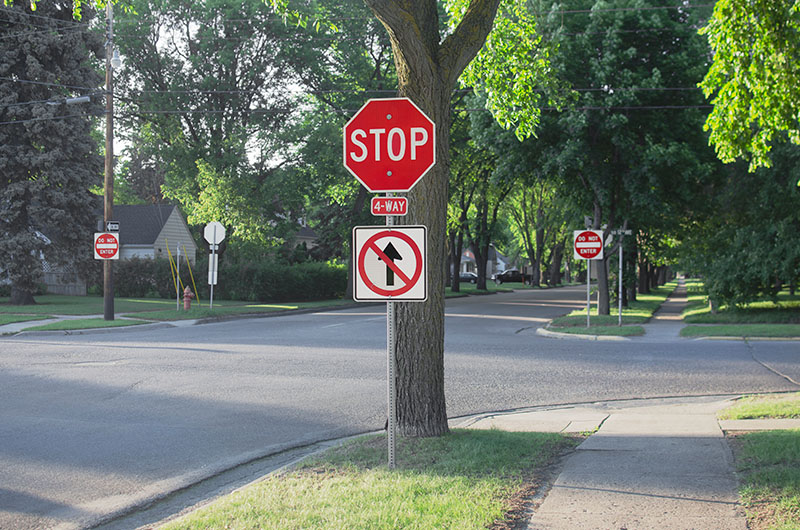
| Rolled through a stop sign | Must stop at a clearly marked stop line; absent one, before the crosswalk on the near side; absent both, "at the place nearest the intersecting roadway where the operator has a view of approaching traffic." | Tex. Transp. Code § 544.010(c) |
| Entered an intersection without stopping | Must "stop, yield, and grant immediate use of the intersection" in obedience to a stop or yield sign — or where a signal is present but no head displays any indication. | Tex. Transp. Code § 545.151(a) |
| Turned left across your path | Must "yield the right-of-way to a vehicle that is approaching from the opposite direction and that is in the intersection or in such proximity to the intersection as to be an immediate hazard." | Tex. Transp. Code § 545.152 |
| Stopped at the sign, then pulled out anyway | After stopping, must still yield to a vehicle already in the intersection or "approaching so closely as to be an immediate hazard." | Tex. Transp. Code § 545.153(b) |
| Pulled out of a driveway or parking lot | A driver entering a highway "from an alley, building, or private road or driveway shall yield the right-of-way to a vehicle approaching on the highway to be entered." | Tex. Transp. Code § 545.155 |
| Rear-ended you | Must keep an "assured clear distance" so that, considering speed, traffic and road conditions, they "can safely stop without colliding with the preceding vehicle." | Tex. Transp. Code § 545.062(a) |
| Did not pull over for an ambulance or patrol car | Must yield, move "as close as possible to the right-hand edge or curb of the roadway clear of any intersection," and stop. | Tex. Transp. Code § 545.156(a-1) |
Statute text read from statutes.capitol.texas.gov on 2026-08-29.
How often this happens in Texas
| Contributing factor recorded on the crash report | Texas crashes, 2024 |
|---|---|
| Failed to yield ROW — turning left | 35,984 |
| Failed to yield ROW — stop sign | 31,693 |
| Failed to yield ROW — private drive | 19,156 |
| Failed to yield ROW — open intersection | 7,277 |
| Failed to yield ROW — yield sign | 3,578 |
| Failed to stop at proper place | 3,182 |
| Failed to yield ROW — turn on red | 2,794 |
| Failed to yield ROW — to pedestrian | 1,518 |
| Failed to yield ROW — emergency vehicle | 558 |
A crash may record no contributing factor or several, so these rows are not additive and do not sum to a statewide total. Harris County alone recorded 115,173 crashes in 2024, including 546 fatal crashes.
Source: TxDOT, Crash Contributing Factors 2024
Deadlines that can end this claim
| Situation | Deadline | Source |
|---|---|---|
| Most injury lawsuits | Two years from the day the cause of action accrues. | Tex. Civ. Prac. & Rem. Code § 16.003(a) |
| An injury that causes death | Two years, running from the date of death. | Tex. Civ. Prac. & Rem. Code § 16.003(b) |
| A City of Houston, Harris County, METRO or state vehicle | Written notice to the governmental unit within six months — and a city charter can require it sooner. | Tex. Civ. Prac. & Rem. Code § 101.101 |
| Reporting the crash itself | Immediately, by the quickest means, if anyone was injured or killed or a vehicle cannot be driven safely. | Tex. Transp. Code § 550.026(a) |
| If you were partly at fault | No deadline, but a hard bar: more than 50% responsibility means no recovery at all. | Tex. Civ. Prac. & Rem. Code § 33.001 |
Questions people ask after a Houston crash
Tap a question to open it.
Who is at fault when a driver turns left in front of me?
Usually the turning driver. Texas Transportation Code § 545.152 requires a driver turning left to yield to any vehicle approaching from the opposite direction that is already in the intersection or close enough to be an immediate hazard. That duty is why the left turn is the largest failure-to-yield category in the state: 35,984 Texas crashes in 2024 listed it as a contributing factor (TxDOT, 2024). It is not automatic, though. If you were speeding, ran the light yourself, or were in a lane you should not have been in, the other side will argue proportionate responsibility under § 33.001 — and above 50% you recover nothing. On Houston arterials with permissive green-ball left turns — Westheimer, Bissonnet, FM 1960, Gessner — signal-phase timing often decides the argument, which is why the intersection's timing records matter early.
Who investigates the crash — HPD or the Harris County Sheriff?
Where it happened decides. Texas Transportation Code § 550.026(a) requires immediate notice to the local police department if the crash occurred inside a municipality, or to the police department or sheriff's office if it happened within 100 feet outside city limits, and to the sheriff or the nearest Department office otherwise. In practice that means the Houston Police Department inside Houston city limits and the Harris County Sheriff's Office in unincorporated Harris County — Atascocita, Aldine, Cypress and Channelview among them. This is not a technicality. The agency that worked the crash is the agency holding the CR-3 crash report, the body-camera and dash-camera footage, and the officer whose deposition may later matter. Requesting records from the wrong agency loses weeks you do not have.
What actually counts as “failure to stop” in Texas?
It is a family of separate duties, not one offence, and the distinction changes what you have to prove. A steady red light triggers § 544.007(d). A stop sign triggers § 544.010, which requires a stop at a marked stop line, or absent one, before the crosswalk, or absent both, at the nearest point with a view of approaching traffic. Entering an intersection is governed by § 545.151. Turning left is § 545.152. Pulling out of a driveway or parking lot is § 545.155. Being rear-ended is § 545.062, the assured-clear-distance rule. Each has a different factual centre — signal timing, sight lines, closing speed — so the evidence that wins a red-light case is not the evidence that wins a driveway case.
What if the other driver slowed but never fully stopped?
A rolling stop is still a violation. Section 544.010(c) does not ask whether the driver slowed; it specifies where the vehicle must come to a stop — at a clearly marked stop line, or in its absence before the crosswalk on the near side, or absent both at the place nearest the intersecting roadway where the driver has a view of approaching traffic. That precision is useful to you, because it converts a vague argument about carefulness into a measurable question: where was the vehicle when it stopped, and did it stop at all? Intersection camera footage, a nearby business's exterior camera, and the event data recorder in either vehicle can answer it. TxDOT recorded 3,182 Texas crashes in 2024 with “failed to stop at proper place” as a contributing factor.
What if I was rear-ended rather than T-boned?
A different statute applies. Section 545.062(a) requires a following driver to maintain an assured clear distance so that, considering the speed of the vehicles, traffic and road conditions, they can stop safely without colliding with the vehicle ahead. That duty is why the following driver usually starts at a disadvantage — but it is a practical presumption, not an automatic result. The recognised counter-arguments are a sudden unsafe lane change into the gap, brake lights that were not working, and an abrupt stop without cause. All three turn on evidence rather than argument: the lighting on your vehicle, the other driver's own account in the crash report, and any dashcam. On congested Houston stretches such as the Southwest Freeway, the 610 Loop and the Katy Freeway, chain-reaction impacts add a further question of who struck whom first.
Where will my Houston case be filed?
Ordinarily Harris County, because that is where the crash and usually the defendant are. Civil district courts sit at the Harris County Civil Courthouse, 201 Caroline Street, Houston, TX 77002. Which court inside the county depends on the amount in controversy: county civil courts at law handle claims up to their statutory limit, and district courts take the larger ones. If your crash happened in Katy the claim may fall in Harris, Fort Bend or Waller County depending on which side of the county line you were on, and a Sugar Land crash is normally Fort Bend County at 1422 Eugene Heimann Circle, Richmond. Venue is worth getting right at the outset — refiling in the correct county costs time against a two-year deadline.
Where do I get the crash report?
From the agency that investigated, and from TxDOT. The Texas Peace Officer's Crash Report, form CR-3, is filed electronically with TxDOT and is available through the Crash Records Information System; an HPD-investigated crash can also be obtained through HPD Records once processing is complete. The report matters more than most people expect, because the investigating officer records contributing-factor codes on it — the same codes TxDOT aggregates statewide, such as “failed to yield ROW — turning left.” An officer's code is not binding on a jury and is sometimes wrong, but it frames the insurer's first position. If the code is wrong, that is a problem to identify in week one, not after the adjuster has built a file around it.
When do I have to report the crash?
Immediately. Section 550.026(a) requires the operator of a vehicle involved in a collision resulting in injury, death, or damage leaving a vehicle unable to be driven normally and safely to give notice “immediately by the quickest means of communication” to the local police department, or to the police or sheriff if it happened within 100 feet outside a municipality, or otherwise to the sheriff or the nearest Department office. Practically: call 911 from the scene. A crash with no police report is materially harder to prove months later, and if the other driver leaves, an unreported crash can also complicate an uninsured-motorist claim under your own policy.
When does my time to sue actually run out?
Two years from the day the cause of action accrues, under § 16.003(a) — normally the crash date. If the injury causes death, § 16.003(b) runs the two years from the date of death, which is not always the crash date. The exception that catches people out is a government vehicle: § 101.101 requires written notice to the governmental unit within six months, and a city charter may demand it sooner. That applies to a City of Houston vehicle, a Harris County vehicle, a METRO bus, and a state vehicle. Six months passes quickly while someone is still in treatment, and missing that notice can end an otherwise sound claim before the two-year deadline is anywhere close.
Why is the insurer blaming me for a crash I did not cause?
Because under Texas proportionate responsibility it is worth money to them. Section 33.001 bars recovery entirely if your percentage of responsibility exceeds 50%, and every point below that reduces what you are paid. So an adjuster has a direct financial incentive to build a percentage against you — you were speeding, you could have avoided it, you were looking at your phone. The answer is evidence rather than argument: signal timing data, intersection and business camera footage, the vehicles' event data recorders, independent witnesses, and the physical damage pattern, which often shows the angle of impact and therefore who entered the intersection first. That evidence has a short life; footage is routinely overwritten within days.
Why does the ticket not settle who was at fault?
Because the two proceedings ask different questions to different standards. A traffic citation is a criminal or quasi-criminal matter proved to a higher standard, and it reflects the investigating officer's on-scene judgement. Your civil claim is decided on the balance of the evidence, and a jury apportions responsibility between everyone involved under § 33.001. So a citation helps and is worth having, but it is neither necessary nor sufficient. Drivers are frequently not cited in crashes where civil liability is clear, particularly where the officer did not witness the collision. The reverse also happens: a cited driver can still argue you carry a share, and that argument is about percentages, not about the ticket.
How is fault proved when it is my word against theirs?
By evidence that exists independently of either account. In intersection cases that usually means signal-phase and timing data from the operating authority, camera footage from nearby businesses and residences, the event data recorder in one or both vehicles, and the physical evidence — crush pattern, debris field and final rest positions, which together show the angle and sequence of impact. Independent witnesses matter, and the CR-3 lists them. The constraint is time: private camera systems commonly overwrite within a few days to a couple of weeks, and vehicles get repaired or scrapped. A written preservation demand to the businesses at the corner and to the other driver's insurer, sent early, is often the difference between a disputed case and a clear one.
How does a METRO bus or city vehicle change my claim?
It shortens your clock and adds a step. Section 101.101 requires written notice to the governmental unit within six months of the incident, describing the damage or injury, the time and place, and the incident itself — and a city charter can impose a shorter period than the statute. That is separate from, and much earlier than, the two-year limitations period in § 16.003. Governmental immunity is also only waived in defined circumstances, and damages are capped rather than open-ended. None of that makes the claim impossible, but it does mean a crash involving a METRO bus, a City of Houston truck or a Harris County vehicle should be treated as time-critical from the first week rather than the first month.
How much is a failure-to-yield case worth?
There is no honest average, and any firm quoting you one before reading your records is guessing. What the value turns on is specific and knowable: the medical evidence and whether treatment is complete, whether you lost income and can document it, the permanence of the injury, the available insurance limits on the other side, and your own percentage of responsibility under § 33.001, which reduces the recovery point for point and bars it entirely above 50%. Insurance limits are the ceiling people most often overlook — a catastrophic injury caused by a driver carrying Texas minimum liability coverage is a coverage problem as much as a liability one, which is why your own uninsured and underinsured motorist coverage gets examined at the outset.
4.9 out of 5 from 365 Google reviews. Read them on Google.
★★★★★
Hi, I would recommend their services they were very helpful in handling and resolving my case. I received great medical care on their behalf and I was taken care of as a client by Mr. Gabriel he went above and beyond to ensure I didn't settle for less than I was owed.
★★★★★
Maida law firm was great. They have amazing communication. The staff was also very friendly and professional. The process was fast and they are very reliable. I will definitely be recommending them to all my friends and family. Thank you so much Maida Law Firm.
Reviews are the opinions of the clients who wrote them. Past results do not guarantee or predict a similar outcome in any future case.
After a crash in southwest Houston
Our office is on the Southwest Freeway, and the crashes we see from this side of Houston cluster on the same few roads. These are the emergency rooms, stations and the courthouse involved most often.
| What | Where |
|---|---|
| Main freeways | Southwest Freeway (I-69/US 59) · Sam Houston Tollway / Beltway 8 · Westpark Tollway · US 90 Alternate |
| Nearest emergency rooms | HCA Houston ER 24/7 - Westchase — 11103 Westheimer Rd, Houston |
| Memorial Hermann Southwest Hospital Emergency Center — 7600 Beechnut St, Houston | |
| Emergency Room at HCA Houston West — 12141 Richmond Ave, Houston | |
| HCA Houston ER 24/7 - Bellaire — 5413 S Rice Ave, Houston | |
| Post Oak ER - Emergency Room and Urgent ER Care — 5018 San Felipe St, Houston | |
| Police stations | Houston Police Department Westside — 3203 S Dairy Ashford Rd, Houston |
| Houston Police Department South Gessner — 8605 Westplace Dr, Houston | |
| Houston Police Department Southwest Substation — 13097 Nitida St, Houston | |
| City of Southside Place Police Department — 6309 Edloe St, Houston | |
| Where suit is filed | Harris County Civil Courthouse — 201 Caroline St, Houston, TX 77002 |
Emergency rooms and stations from Google Places within about 9 km of our office; freeways from OpenStreetMap; courthouse confirmed in the county seat. Verified 28 August 2026. Go to the nearest ER in an emergency — this list is for orientation, not medical advice.
Recent Houston-area crashes of this kind
Each incident is linked to the news outlet that reported it, newest first. We were not involved in these cases, describe them only as published and do not assess who was at fault.
- Person killed in crash after driver runs red light in Sugar Land KPRC 2 / Click2Houston, January 2026
- HPD officer hospitalized after driver runs red light downtown KPRC 2 / Click2Houston, February 2026
- Driver charged after fatal crash at Clay Road and West Sam Houston Parkway ABC13 / KTRK, February 2026
- Uber driver killed after car allegedly runs red light at T.C. Jester FOX 26 Houston, July 2026
- Two hospitalized after driver reportedly runs stop sign at US 90 and Lindstrom Road ABC13 / KTRK, August 2026
Related Houston claims we handle
Where we are in Houston
Maida Law Firm
8313 Southwest Fwy Ste 102, Houston, TX 77074
We are on the Southwest Freeway, minutes from the 610 Loop and Sharpstown, and we see clients from across Harris County.
About the authors
Sam A. Maida, Jr.
Owner and Managing Attorney
Sam A. Maida, Jr. has represented injured Texans in the greater Houston area since the firm opened in 1993.
State Bar of TexasAvvoMartindale-HubbellLawLinkThatCarHitMeLinkedIn

Bernard G. Johnson III
Litigation Managing Attorney
Bernard G. Johnson III is a board certified trial lawyer licensed in Texas since 1996 and a graduate of South Texas College of Law.