
Several parties can be responsible after a crash with an Amazon delivery van: the driver, the company that operates the van, Amazon itself in some situations, and the insurers behind each of them. Which of them pays depends on who employed the driver, who owned or leased the van, and how much control Amazon had over the delivery work. Texas also sets a filing deadline, and it reduces your recovery by any share of fault assigned to you.
The short version
- The driver is not the only possible defendant. Texas divides responsibility by percentage among everyone whose conduct caused the harm (Civil Practice and Remedies Code § 33.003), so a claim may need to reach the company behind the van as well.
- Amazon describes its delivery partners as separate companies. In a 2025 Harris County crash involving an Amazon 18-wheeler, Amazon told KPRC that the driver was employed by an independent third-party contractor.
- Insurance comes in layers. Amazon’s partner guide describes the partner’s own liability policies and an Amazon-maintained commercial auto policy with a $1,000,000 per-accident limit, and it says which auto policy is primary.
- Fault is measured. You cannot recover if your share of responsibility is more than 50 percent, and otherwise your damages are reduced by that share (§§ 33.001 and 33.012).
- Two deadlines and one report. A personal injury suit generally has a two-year filing window (§ 16.003(a)), and an officer’s written collision report is required when a crash causes injury or $1,000 or more in damage (Transportation Code § 550.062).
Who can be held responsible in a crash with an Amazon van?
Several parties can share responsibility: the driver, the company that operates the delivery van, and in some situations Amazon. Texas splits responsibility by percentage among everyone found to have contributed to the harm, so identifying each party is the first job in the claim.
Under the Texas proportionate responsibility chapter, the fact-finder sets a share of blame for each person whose negligent act or omission contributed to the harm, and the driver who hit you is one of them (Civil Practice and Remedies Code § 33.003). A defendant can also ask the court for leave to name a responsible third party. That motion is due by the 60th day before trial unless the court finds good cause for a later filing (§ 33.004(a)). In a delivery case, that procedure can bring the company behind the van into the responsibility analysis even when it was not the first party sued.
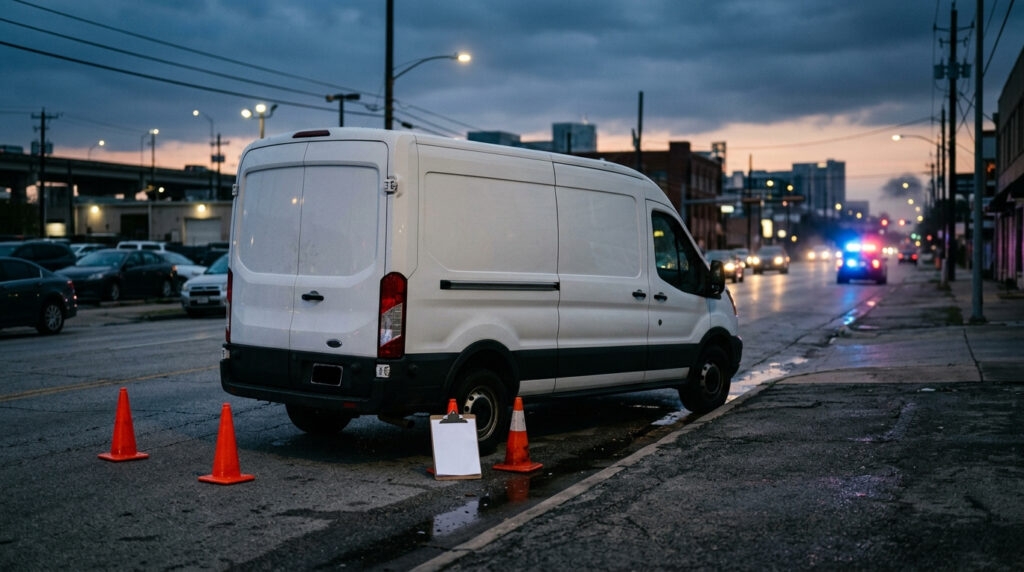
A crash with a delivery van also produces more than one set of records. The police report, the markings on the van, the driver’s paperwork and the insurance claim numbers each point toward a different party. Keeping all of them together from the first week is easier than rebuilding them later, and our article on the photographs that help identify a vehicle explains which images matter most. A Houston car accident claim turns on many of the same records.
Why does it matter whether the driver is an employee or a contractor?
The employment label can determine which company is responsible for the driver’s driving and which insurance applies. Amazon told KPRC that a driver in a Harris County crash was employed by an independent third-party contractor, while a personal injury lawyer quoted by NBC News said drivers in these cases are not Amazon employees. Both are claims to test.
Amazon’s partner guide refers to partners as independent contractors when it sets their general liability requirement. The page says the partner must carry general liability insurance for its “normal business exposures as an independent contractor,” and it also lists employers liability coverage. Those requirements describe the partner’s own arrangement, so the partner’s insurance stays part of the picture even when Amazon is not the company that employs the driver.
Whether a company is responsible for another person’s driving generally turns on the facts of the working relationship, including how much control the company had over the work. NBC News reported in March 2024 that Amazon disputes the view that it controls its delivery partners, and says it makes its relationship with them “very clear.” A claim has to prove the control question with evidence, such as the contract, the routes, the dispatch system and the training the driver received. For the 18-wheeler side of that question, see our article on key evidence in an 18-wheeler accident claim.
Who owns the van, and who insures it?
Amazon-branded vans are not all owned the same way. NBC News reported in 2024, citing Amazon, that delivery partners can use their own vehicles or lease Amazon-branded vehicles through a third party. Amazon’s partner guide describes layers of coverage, including an Amazon-maintained commercial auto policy with a $1,000,000 per-accident limit.
The table below sets out the insurance layers as the sources describe them. The partner guide does not say which program each van belongs to, so the table is a starting point for the insurers’ own records rather than a conclusion about any one crash.
| Layer | What the source says | Source |
|---|---|---|
| Partner general liability | $1MM/$2MM for the partner’s normal business exposures as an independent contractor. The page does not say which figure is per occurrence. | Amazon partner guide, insurance requirements (© 2026) |
| Partner employers liability | $1MM, typically attached to the general liability or workers’ compensation policy. | Amazon partner guide |
| Amazon general liability | $1,000,000 per occurrence and $2,000,000 general aggregate, maintained by Amazon. | Amazon partner guide |
| Amazon commercial auto | $1,000,000 per accident in auto liability, underwritten by Zurich American Insurance Company. | Amazon partner guide |
| Which auto policy is first | If the partner’s own auto policy provides coverage while delivering with Amazon, that insurer is primary and Amazon’s commercial auto policy is excess. If the partner’s policy does not provide that coverage, Amazon’s policy is primary. | Amazon partner guide |
| Amazon’s statement on insurance | Amazon told NBC News that delivery service partners are required to carry general liability, insurance policies and workers’ compensation. | NBC News, March 5, 2024 |
Amazon’s guide also says its own general liability coverage does not apply if the partner or its personnel were in violation of the Amazon Program Terms. That is a coverage question an insurer can raise, and it is one reason the company name on the van and the policy numbers need to be pinned down early. Insurance figures on a partner page can change, so the policy that applies to your crash is the one the carriers confirm for that crash, and the steps in an insurance claim are worth knowing early. If the responsible company’s coverage does not reach your losses, the uninsured and underinsured motorist rules in your own policy can matter, and the ways adjusters handle these claims are worth knowing before the first call.
Can a claim be brought against Amazon itself?
A claim can name Amazon, and a personal injury lawyer quoted by NBC News said he planned to sue both Amazon and the delivery company for a client. Whether Amazon is responsible depends on its relationship with the partner and the driver, which is a fact question for each crash.
In a 2024 Virginia case NBC described, the claimant’s insurer told her that the delivery partner, which owned the van, ended up paying her claim. A first payment from one carrier does not answer who else was responsible.
Amazon’s response, as NBC reported it, is that it makes its relationship with its delivery partners “very clear.” That is a position a claim has to test against the documents, the dispatch records and the way the work was actually done. An article on liability in multi-vehicle crashes covers how responsibility is divided when more than one party is involved.
What should you collect at the scene of an Amazon van crash?
Collect the details that identify every company and insurer involved: the driver’s name, license and insurance information, the license plate, the company name shown on the van or on the driver’s paperwork, and the names of any witnesses. Photograph the van’s markings along with the damage.
Your first priority is safety. Move to a safe place if you can, check everyone in your vehicle for injuries, and call 911 if anyone is hurt. Once the scene is safe, ask the driver which company they work for, and write down the answer exactly as given, along with the time and the location. A driver who says they are with a contractor, a delivery partner or Amazon has still given you a name to check.
If the other driver leaves the scene, the steps change, and our article on a hit and run in Houston covers them. Avoid recorded statements and any description of the crash as your fault until you have spoken with counsel; the guide to talking with the insurance adjuster covers the same point. The first-steps checklist on this site covers the rest of the scene.
Does the crash have to be reported to police?
Texas requires a law enforcement officer who investigates a collision to make a written report when the collision results in injury or death, or in property damage that appears to total $1,000 or more. The officer must file it electronically within 10 days after the collision (Transportation Code § 550.062).
The duty in the statute falls on the investigating officer, so a report exists only if an officer investigated the crash. The car accident FAQ on this site answers related questions. Ask for the report number at the scene, and get a copy of the crash report once it is filed. The Transportation Code, Chapter 550, sets the report rule.
TxDOT’s crash records page draws a line that matters after a delivery-van crash: TxDOT is custodian of record for the crash report only, while subpoenas seeking dash-camera footage, officers’ field notes or scene photos go to the investigating agency, which in the November 2025 Harris County case above was the sheriff’s office (page read October 16, 2026).
A Harris County crash reported by KPRC on November 29, 2025 shows how much a record can matter. Deputies said dash camera footage showed the driver of an Amazon 18-wheeler ran a red light before the crash that killed a man in a car, while the driver told deputies he had a yellow light. The article says it was unknown what charges the driver would face. For the 18-wheeler side of expert analysis, see this article.
What is the deadline, and what happens if you share some of the blame?
For most personal injury claims, Texas allows two years to file suit after the cause of action accrues, subject to listed exceptions. If you are found more than 50 percent responsible, you cannot recover. If you are found less responsible, your damages are reduced by your own percentage.
The two-year rule is in Civil Practice and Remedies Code § 16.003(a), which names three other sections (16.010, 16.0031 and 16.0045) as exceptions. A deadline can depend on the facts and the listed exceptions, so confirm the date with a lawyer rather than assuming it. Our piece on the Texas case timeline covers what happens after filing.
Shared fault works in two steps. Your percentage reduces what you can recover (§ 33.012(a)), and each defendant pays its own percentage of the damages (§ 33.013(a)). A defendant whose share exceeds 50 percent can also be jointly and severally liable for the damages recoverable under § 33.012 (§ 33.013(b)). The comparative negligence article on this site explains how Texas lawyers answer a comparative fault argument, and the damages article covers the kinds of loss a claim can include. How a claim is valued is covered in our Houston claim value article.
How is an Amazon van claim different from other delivery and truck claims?
The main question in an Amazon van claim is the contract chain between Amazon, the delivery company and the driver. Rideshare and 18-wheeler crashes raise different questions about the app or the carrier, and this site covers those in separate articles.
Background on the framework of fault and claims is in our article on tort law. A rideshare crash raises questions about the app and the trip status, which our article on rideshare accidents in Houston covers, along with the piece on which insurance applies after an Uber driver crash. A large truck crash involves a carrier, and our guide to insurance liabilities after an 18-wheeler accident is the closest comparison. Our 18-wheeler accident page describes the trucking side of the practice, and this guide to liability in a truck crash sets out the parties in that setting.
If the driver was working when the crash happened, the claim may also involve workers’ compensation questions for the driver, and the work-related crash guide explains how those claims interact with a claim against the other driver. The practical point for an Amazon van is that the company name, the insurer and the report drive the claim.
After a collision with a delivery van, the Houston personal injury page describes the kinds of claims the firm handles, and the guide to a case evaluation lists what to bring to a first call. Details of the crash can go through the contact page. No result is promised here.
Frequently asked questions
What happens if Amazon gets in an accident?
The first question is which company operated the vehicle. Amazon’s partner guide describes partner insurance and an Amazon-maintained commercial auto policy, and which auto policy pays first depends on whether the partner’s own policy covers the delivery. The police report and each party’s insurance information are the starting records.
Who is liable for an Amazon delivery accident?
The driver, the company that operates the van, and sometimes Amazon can each be responsible. Texas assigns a percentage of responsibility to each person found to have contributed to the harm. Who is liable depends on who employed the driver, who owned the van, and how much control Amazon had over the work.
Who is liable in an Amazon truck accident?
The starting question is the same: which company and which insurer stand behind the vehicle. The answer depends on the facts of the crash and on the contracts behind the truck, and Texas still assigns responsibility by percentage among everyone found at fault.
What happens if a delivery driver gets in an accident?
The driver can be held responsible for his or her own driving. The company the driver works for may also be responsible, depending on the employment and control facts. Any recovery is reduced by the injured person’s own percentage of responsibility, and a recovery is barred if that percentage is more than 50 percent.
How do I file a complaint against an Amazon driver involved in an accident?
An injury claim is made against the parties and insurers responsible for the harm, and it can become a lawsuit if it is not resolved. The first steps are the police report, the driver’s details and the company name shown on the van or on the driver’s paperwork.
About the authors

Sam A. Maida, Jr.
Owner and Managing Attorney
Sam A. Maida, Jr. has represented injured Texans in the greater Houston area since the firm opened in 1993.
State Bar of TexasAvvoMartindale-HubbellLawLinkThatCarHitMeLinkedIn

Bernard G. Johnson III
Litigation Managing Attorney
Bernard G. Johnson III is a board certified trial lawyer licensed in Texas since 1996 and a graduate of South Texas College of Law.