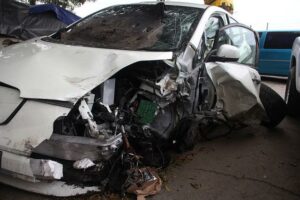
In a T-bone accident, where the front of one vehicle strikes the side of another, fault usually falls on the driver who did not have the right-of-way. Texas law says who that is: the driver facing a red signal, the driver at a stop sign, or the driver turning left across oncoming traffic (Tex. Transp. Code § 544.007, Tex. Transp. Code § 545.151, § 545.152).
These crashes happen where roads cross. In 2024, 1,050 people were killed in Texas in crashes occurring in or related to an intersection, according to the Texas Department of Transportation crash facts for 2024. This article sets out the right-of-way rules, how fault is proved when each driver blames the other, and what to do afterwards. The broader claim process is on our Houston car accident page.
The short version
- Red signal: stop and stay stopped until shown an indication to proceed (§ 544.007(d)).
- Stop sign: after stopping, yield to a vehicle in the intersection or close enough to be an immediate hazard (§ 545.153(b)).
- Left turn: yield to oncoming vehicles that are an immediate hazard (§ 545.152).
- Signal dark: stop, as at a stop sign, and go only when it is safe (§ 545.151(a)).
- Shared fault is divided by percentage; nothing is recoverable above 50 percent (§ 33.001). Two years to sue (§ 16.003(a)).
Who is at fault in a T-bone accident?
The driver who entered the intersection without the right-of-way. Depending on the intersection, that is the driver who ran a red light, the driver who pulled out from a stop sign into traffic that was too close, the driver who turned left in front of oncoming traffic, or the driver leaving a driveway.
| Where it happened | Who has to yield | Section |
|---|---|---|
| Signal showing steady red | The driver facing red stops at the stop line and, unless turning as allowed, remains standing until an indication to proceed is shown | § 544.007(d) |
| Signal showing green | A driver with a green light still yields to other vehicles lawfully in the intersection when the green is shown | § 544.007(b) |
| Signal not working (no indication in any signal head) | Each approaching driver stops, and proceeds only when the intersection can be safely entered | § 545.151(a) |
| Stop sign | After stopping, the driver yields to a vehicle that has entered the intersection or is approaching so closely as to be an immediate hazard | § 545.153(b) |
| Yield sign | The driver slows to a reasonable speed and yields to a vehicle in the intersection or approaching so closely as to be an immediate hazard | § 545.153(c) |
| Left turn | The turning driver yields to a vehicle approaching from the opposite direction that is in the intersection or close enough to be an immediate hazard | § 545.152 |
| Driveway, alley or private road | The driver entering or crossing the highway yields to a vehicle approaching on the highway | § 545.155 |
Source: Texas Transportation Code, Chapters 544 and 545. Read October 5, 2026.
How is fault proved when both drivers say they had the green light?
With evidence that does not depend on either driver’s word: independent witnesses, video from traffic, business or dash cameras, the points of impact and resting positions of the vehicles, data recorded by the vehicles, and the officer’s crash report. Signal timing records can show which approach had green at a given second.
The officer who investigates a crash with injury, death or at least $1,000 in apparent damage files a written report within 10 days (Tex. Transp. Code § 550.062(a)-(b)); it records the officer’s observations, the drivers’ and witnesses’ statements and any citations. It is a starting point, not the last word, and officers rarely see the crash themselves.
Video is the evidence most likely to be lost. Many camera systems overwrite their recordings within days or weeks, so a request to the business or agency that holds the footage has to go out quickly. Our article on Houston’s most dangerous roads and intersections names the locations where these crashes cluster.
What if both drivers share the blame?
Then fault is divided by percentage. One driver may have run the light while the other was speeding or looking away. The judge or jury assigns each a share; an injured driver recovers nothing if his or her share is greater than 50 percent, and otherwise the damages are reduced by that share.
The rules are Tex. Civ. Prac. & Rem. Code § 33.001, § 33.003(a) and § 33.012(a). Speed matters here because Texas requires every driver to control speed as necessary to avoid colliding with another vehicle that is on or entering the highway lawfully (Tex. Transp. Code § 545.351(b)). A driver with a green light who was travelling far too fast to react can carry part of the responsibility.
Passengers are in a different position. A passenger in either car has usually done nothing to cause the crash and may have claims against both drivers.
Can someone other than the two drivers be responsible?
Sometimes. If a driver was working at the time, the employer may be liable. If a vehicle defect contributed, a manufacturer may be. If a traffic signal was not working, the government body responsible for it may be, and a claim against a governmental unit requires notice within six months.
The notice rule is in Tex. Civ. Prac. & Rem. Code § 101.101(a); claims over road conditions and traffic signals have further rules of their own, so they need early review by an attorney. A design defect claim against a manufacturer requires proof of a safer alternative design and that the defect was a producing cause of the injury (Tex. Civ. Prac. & Rem. Code § 82.005(a)). Our page on failure-to-stop accidents covers red-light and stop-sign crashes specifically.
What should I do after a side-impact crash?
Get medical care first; side impacts leave occupants with little protection, and some injuries are not obvious at the scene. Report the crash, photograph the vehicles before they are moved if it is safe, note every camera you can see, get witnesses’ names and numbers, and do not guess at fault when you speak to an insurer.
A crash that causes injury must be reported immediately to the local police (Tex. Transp. Code § 550.026(a)). A suit for personal injury must be filed not later than two years after the day the cause of action accrues (Tex. Civ. Prac. & Rem. Code § 16.003(a)). Our guide to the first hours after a crash has the full checklist.
Questions people ask about T-bone accidents
What is a T-bone accident?
A T-bone accident, also called a side-impact, broadside or right-angle collision, is one in which the front of one vehicle strikes the side of another, so that the two vehicles form a T. It most often happens at an intersection or where a driveway meets a road.
What if the traffic light was out when the crash happened?
A driver approaching an intersection where a traffic-control signal is present but does not display an indication in any of the signal heads must stop, yield and grant immediate use of the intersection, and may proceed only when the intersection can be safely entered without interference or collision with traffic on a different street (Transportation Code § 545.151(a)).
How many people die in intersection crashes in Texas?
In 2024 there were 1,050 people killed in crashes occurring in intersections or related to an intersection, according to the Texas Department of Transportation’s crash facts for calendar year 2024 (reports received as of April 9, 2025).
Is the driver who was turning left always at fault?
Not always. The turning driver must yield to an oncoming vehicle that is in the intersection or close enough to be an immediate hazard (Transportation Code § 545.152), but the oncoming driver’s speed and whether that driver faced a red signal are weighed too, and responsibility is divided by percentage under Civil Practice and Remedies Code § 33.003.
I was a passenger in a car that was hit from the side. Whose insurance pays?
A passenger may claim against any driver whose negligence caused the crash, including the driver of the car the passenger was in. Each driver’s share of responsibility is set as a percentage, and a defendant found more than 50 percent responsible is jointly and severally liable for the recoverable damages (Civil Practice and Remedies Code § 33.013(b)).
If you were hurt in a side-impact crash in the Houston area, call Maida Law Firm at (713) 785-9484 or tell us what happened through the contact page.
Sources
- Texas Transportation Code, Chapter 544. Read October 5, 2026.
- Texas Transportation Code, Chapter 545. Read October 5, 2026.
- Texas Department of Transportation, Texas Motor Vehicle Traffic Crash Facts, Calendar Year 2024 (reports received as of April 9, 2025). Read October 5, 2026.
- Texas Transportation Code, Chapter 550. Read October 5, 2026.
- Texas Civil Practice and Remedies Code, Chapter 33. Read October 5, 2026.
- Texas Civil Practice and Remedies Code, Chapter 101. Read October 5, 2026.
- Texas Civil Practice and Remedies Code, Chapter 82. Read October 5, 2026.
- Texas Civil Practice and Remedies Code, Chapter 16. Read October 5, 2026.
About the authors
Sam A. Maida, Jr.
Owner and Managing Attorney
Sam A. Maida, Jr. has represented injured Texans in the greater Houston area since the firm opened in 1993.
State Bar of TexasAvvoMartindale-HubbellLawLinkThatCarHitMeLinkedIn

Bernard G. Johnson III
Litigation Managing Attorney
Bernard G. Johnson III is a board certified trial lawyer licensed in Texas since 1996 and a graduate of South Texas College of Law.