In a Texas pileup, fault is not handed to one driver. A jury, or the insurers when a claim settles, puts a percentage of the blame on each person, and what you can collect follows from that figure. The driver who started the chain is often the starting point, but a middle driver who was following too closely can carry a share too.
The short version
- Everyone involved gets a percentage. The state’s proportionate-responsibility rules (Civil Practice and Remedies Code, Chapter 33, § 33.003) have the fact-finder put a share of the blame on you, on each defendant, on anyone who settled and on anyone designated as a responsible third party.
- More than 50 percent is a threshold both ways. A claimant over 50 percent responsible recovers nothing (§ 33.001); a defendant over 50 percent can be jointly and severally liable for the whole recoverable amount (§ 33.013(b)(1)).
- Following distance is a statutory duty. Transportation Code § 545.062(a) requires a driver to keep enough room to stop safely, which is why rear-end links in a chain draw so much attention.
- A settlement with one driver reduces your claim against the rest by the dollar amount of that settlement (§ 33.012(b)).
- Evidence goes fast on a freeway. The crash report, photographs and witness names are the evidence to gather first.
Who is at fault in a chain-reaction or multi-car crash?
The drivers whose carelessness caused or added to the collisions share the fault. The first driver to strike another vehicle is often the starting point, but a driver who hit the car ahead because of speed, distraction or too little room can be assigned a share of the harm of the crash that hurt you.
A crash with three or more vehicles is really several collisions in a row, and the person who hurt you may not be the person who started it. In a line of cars, vehicle two can be shoved into vehicle one by vehicle three; vehicle two’s driver may have braked in time and been pushed, or may have been on the phone and arrived at the same moment. The legal question is the same for each driver: what did this person do, and did it help cause the harm? Duty, breach and causation are explained in our article on negligence law in Texas car accident cases; vehicles that meet at an angle rather than in a line raise different right-of-way questions, covered in the piece on side-impact crashes at intersections.
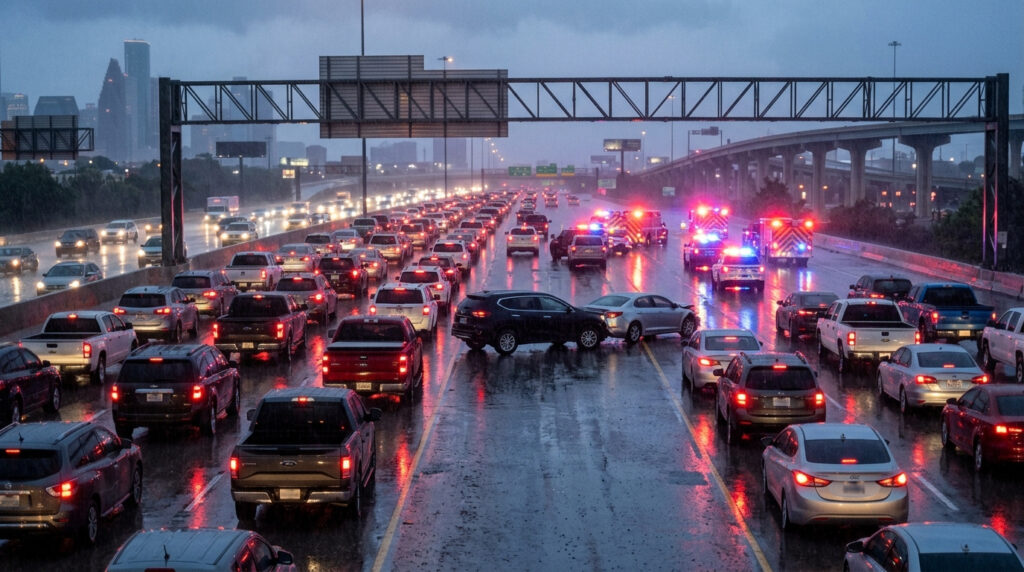
TxDOT’s Texas Motor Vehicle Traffic Crash Facts for calendar year 2024 reports one reportable crash every 57 seconds. On July 31, 2026, ABC13 reported that a crash on the southbound West Loop near Post Oak Road involved at least six cars and closed the freeway completely, according to the Harris County Sheriff’s Office Roadway Management; injury details were not yet known when that report ran.
How does Texas proportionate responsibility divide fault among several drivers?
The judge or jury must state a whole number for every person whose conduct helped cause the harm: you, each defendant, anyone who settled, and anyone designated as a responsible third party. If your number is over 50 you recover nothing; at 50 or below, your award shrinks by that number.
The statute spells this out in four short steps. Section 33.003(a) lists the four groups that get a percentage. Section 33.001 shuts the door on a claimant whose own percentage is over 50. Section 33.012(a) takes the claimant’s percentage off the damages. Section 33.013(a) then limits each liable defendant to a share of the damages that matches that defendant’s own percentage.
The table below puts those sections side by side. Read the full text of Chapter 33 before relying on any summary, ours included. For the same rules applied to a two-car dispute, see our article on fighting a comparative-negligence defense.
| Person | What the statute does | Section |
|---|---|---|
| You (the claimant) | Barred if your percentage is greater than 50 percent; otherwise your damages are reduced by your percentage. | §§ 33.001, 33.012(a) |
| A driver sued as a defendant | Liable for the percentage of damages equal to that driver’s percentage; also jointly and severally liable for the recoverable amount if that percentage is greater than 50 percent. | § 33.013(a), (b)(1) |
| A driver who already settled | Gets a percentage, and the dollar amount of the settlement reduces what you can recover. | §§ 33.003(a)(3), 33.012(b) |
| A driver not sued but designated by a defendant | Gets a percentage as a responsible third party once leave is granted. | §§ 33.003(a)(4), 33.004 |
| A jointly and severally liable defendant who paid more than their share | Has a right of contribution against the other liable defendants, to the extent they have not paid their own percentage. | § 33.015(a) |
When can one driver be made to pay the whole amount?
When that defendant is found more than 50 percent responsible, section 33.013(b)(1) makes the defendant jointly and severally liable for the damages the claimant can recover. At 50 percent or below, the defendant answers only for that defendant’s own share, unless section 33.013(b)(2) applies; it adds a second route for certain listed crimes committed with specific intent to do harm.
That rule matters most when the insurance behind the other drivers is thin. If the driver who started the chain is found 60 percent responsible, that driver can be held liable for the entire recoverable amount, and then looks to the others for contribution under section 33.015(a). If three drivers are at 40, 30 and 30 percent, no one crosses the line and each pays only the matching share. The state insurance department’s consumer auto insurance guide (TDI) states the minimum liability limits as $30,000 per person, $60,000 per accident for injuries and $25,000 for property damage, and warns that those minimums “might be too low if you cause a multi-vehicle accident.”
Joint liability describes who can be made to pay, not whether money exists behind a judgment, and that gap is one reason your own policy’s uninsured and underinsured motorist coverage can matter after a pileup; Insurance Code § 1952.103 defines an underinsured vehicle by comparing the other driver’s liability limits with your own underinsured limit.
What is a responsible third party in a Texas car accident case?
A responsible third party is someone a defendant asks the court to add to the fault calculation without that person being sued. The defendant files a motion for leave at least 60 days before trial, unless the court allows later, and the court must grant it unless a party objects within 15 days of service.
Section 33.004 is the tool a defendant uses to point at someone who is not in the lawsuit: a fourth driver who left the scene, a vehicle owner, a company that serviced the brakes. Subsection (a) sets the 60-day deadline; subsection (f) says the court “shall grant leave” unless a party objects within 15 days of service; subsection (g) lets the court deny leave if the objecting party shows the defendant did not plead enough facts about that person’s responsibility, even after a chance to replead.
An empty chair can absorb a large percentage, and because each defendant answers only for that defendant’s own percentage (§ 33.013(a)), the share given to someone you never sued is not collected from the defendants you did sue. That is why the identity of every vehicle matters. A driver who fled can mean a hit-and-run claim, and a mechanical failure can point toward a defective vehicle product. Section 33.004(d) also limits when a defendant may name someone after limitations has run on that person, if the defendant failed to make required disclosures.
How does a settlement with one driver affect claims against the others?
Section 33.012(b) reduces your damages by the sum of the dollar amounts of all settlements you made with other persons, in addition to reducing them by your own percentage. The settling person still receives a percentage of responsibility, so the later trial still weighs that driver’s fault.
If one driver settled early for part of your damages, the court subtracts that dollar amount, not that driver’s percentage, from what the others owe. A settling person is “a person who has, at any time, paid or promised to pay money or anything of monetary value to a claimant” for the harm (§ 33.011(5)), so the credit follows any payment made in consideration of the crash.
Because of this rule, the order of settlements and the wording of releases deserve a lawyer’s attention before you sign anything. Our articles on the strategies insurers use and on speaking to an adjuster before you have advice explain how early offers are framed, and our look at claim value shows what goes into the number you would be settling for.
Does following too closely make the rear driver liable in a pileup?
It is strong evidence of fault, not an automatic finding. Transportation Code § 545.062(a) requires a driver to keep an assured clear distance so the driver is able to “safely stop without colliding with the preceding vehicle,” considering speed, traffic and road conditions.
The statute names no number of feet or seconds; it asks what was safe at that speed, in that traffic, on that road, and in a pileup it is applied to every vehicle in the line. A middle driver who rear-ended the car in front and was then hit from behind can be both a defendant and a claimant at once, which is why this kind of case is argued with percentages rather than a single villain.
Other conduct also feeds the percentages: a driver looking at a phone (see our page on distracted driving accidents and our article on the Texas texting law), a driver who was intoxicated, or a lane change that caused the first stop. When a loaded tractor-trailer is one of the vehicles, the carrier and the driver can both be defendants, which our 18-wheeler accident page and the article on which parties answer for a truck crash explain.
What evidence sorts out fault in a multi-vehicle crash?
The officer’s crash report, photographs of every vehicle’s final position and damage, and the names of independent witnesses are the evidence to collect. Collect them early, while the scene is fresh and witnesses can still be found.
Under Transportation Code § 550.062(a), an officer investigating a crash must write a report if someone was hurt or killed, or one person’s property was damaged by an apparent $1,000 or more, and TxDOT’s crash records page explains that TxDOT is the custodian of those reports. Our guide on requesting your crash report walks through the request.
At the scene, if it is safe, photograph every vehicle’s position and damage, the lanes and any debris, and write down names and numbers: under § 550.023 a driver in a collision that injures someone or damages an occupied or attended vehicle must give name, address, registration number and liability insurer to those involved. See our checklist of photos to take after a crash, our article on why witnesses matter, and the broader steps to take after a car accident. If the pileup happened on that freeway, crash steps on that freeway adds the details for it.
Whose insurance pays in a multi-car accident?
Liability coverage of each at-fault driver pays for the damage that driver is responsible for, up to the policy limits. Your own collision, medical payments and uninsured or underinsured motorist coverages can respond when the other policies are too small or missing.
The TDI consumer guide to auto insurance describes liability coverage as paying to repair the other driver’s car and the other driver’s and passengers’ medical bills when the policyholder caused the accident, and describes collision coverage as repairing your own car after an accident. If responses slow down, see our article on insurance stalling.
Our article on the kinds of damages in a car accident claim lists what a multi-car claim can include. If a person died, the families of victims should read which relatives may bring a death claim and the wrongful death page for those claims.
How long do you have to file after a pileup, and what should you do first?
A lawsuit is generally due two years after the day the claim accrues (§ 16.003(a) of the Civil Practice and Remedies Code), with statutory exceptions. See a doctor first, keep the evidence, and talk to an attorney before you give a recorded statement.
Have an attorney confirm the date for your situation. In a multi-car case the date can also matter for the people you might name later: § 33.004(d) ties a defendant’s right to designate a third party to limitations and disclosure duties. The first steps are in our auto accident guide.
If a pileup left you hurt, start with the car accident page and the article on how shared fault is divided, check your own deadline before speaking with an adjuster, and bring your own pileup questions to the contact page.
Frequently asked questions
Who is at fault in a multi-car rear-end accident?
Texas does not name one driver in advance. Each driver’s conduct is weighed, and the fact-finder assigns each person a whole-number percentage of responsibility. The driver who struck the first vehicle often carries the largest share, but a driver who also failed to keep a safe distance under Transportation Code section 545.062 can be assigned part of it.
What happens in a multi-car accident?
Officers investigate and, for a crash with injury or $1,000 or more in damage, make a written report. Each driver must give name, address, registration and insurer information to the others involved. The evidence then bears on the percentages.
Can I recover if I was partly at fault in a pileup?
Often yes. If your share is 50 percent or lower, your damages are cut by that share. If it is higher than 50, Texas bars recovery altogether (sections 33.012 and 33.001).
Does a settlement with one driver end my claim against the others?
No. You can still pursue the other drivers, but under section 33.012(b) the court reduces your recoverable damages by the dollar amount of every settlement you made, so the amount and wording of an early settlement affect the rest of the case.
What if the driver who caused the crash left the scene?
Leaving after an injury collision is a crime under Transportation Code section 550.021. Civil recovery can come from the other at-fault drivers and from your own uninsured motorist coverage, but a defendant can also name the missing driver as a responsible third party, so identifying every vehicle early matters.
Do I need the police report to make a claim?
The report is the central record of who was involved and what the officer observed. TxDOT is the custodian of crash reports in Texas, and the officer must file one when a collision causes injury or at least $1,000 in damage.
About the authors
Sam A. Maida, Jr.
Owner and Managing Attorney
Sam A. Maida, Jr. has represented injured Texans in the greater Houston area since the firm opened in 1993.
State Bar of TexasAvvoMartindale-HubbellLawLinkThatCarHitMeLinkedIn

Bernard G. Johnson III
Litigation Managing Attorney
Bernard G. Johnson III is a board certified trial lawyer licensed in Texas since 1996 and a graduate of South Texas College of Law.