
A driver who leaves the scene of a crash that hurt someone commits an offense under Texas law, and the grade depends on the injury. When that driver is never found, an injured person’s recovery usually runs through their own uninsured motorist coverage, and the policy’s terms and the Insurance Code decide whether it pays. The rules below set out the driver’s duties, how the offense is graded and the contact question that can decide an unknown-driver claim.
The short version
- The driver’s duties are set by statute. Transportation Code § 550.021 requires a driver in an injury collision to stop, return if needed, check for aid and remain at the scene (§ 550.023 then governs what the driver must give).
- The grade depends on the result. A death or serious bodily injury makes the offense a felony; other injuries are punished under § 550.021(c)(2) (Transportation Code § 550.021(c)).
- Property-only crashes are misdemeanors. Under § 550.022(c), damage under $200 is a Class C misdemeanor and $200 or more is Class B.
- Uninsured motorist coverage is the usual route. Insurers must offer it (Insurance Code § 1952.101), and for an unknown driver the required policy terms call for actual physical contact (§ 1952.104(3)).
- Call the police and then your insurer. The Texas Office of Public Insurance Counsel advises that order after a hit-and-run.
Does a hit-and-run driver face a felony charge in Texas?
It can be, and the injury decides it. A collision that results in death is a second-degree felony under Transportation Code § 550.021(c)(1)(A), and one that results in serious bodily injury is a third-degree felony under § 550.021(c)(1)(B). An injury below that level is punished under subdivision (c)(2), which sets prison, jail and fine ranges without a felony label.
The duty in § 550.021(a) applies to any collision that “results or is reasonably likely to result in injury to or death of a person,” so a driver who leaves an injury crash commits the offense whether or not the victim was badly hurt. The grade is tied to what happened. For an injury that is not serious bodily injury, subdivision (c)(2) allows imprisonment in the Texas Department of Criminal Justice for not more than five years, or county jail for not more than one year, a fine not to exceed $5,000, or both. The statute does not say that this injury-level offense is a felony or a misdemeanor, and whether any Penal Code grading applies to it is a question for counsel.
Our Houston hit-and-run article on steps, police reports and insurance covers the same offense from the victim’s side, and our Sugar Land piece on dealing with a hit-and-run describes what to gather at the scene.
What must a driver do after a crash that injures someone?
The driver must stop immediately at the scene or as close to it as possible, return if the vehicle has moved, work out whether anyone needs help, and stay until the information duties are done. Those duties are listed in § 550.023 and include giving the driver’s insurer’s name to the injured person.
Section 550.021(a) requires four things in order: stop, return if the car is not at the scene, determine whether a person is involved and whether that person needs aid, and remain until § 550.023 is satisfied. Subsection (b) adds that the driver must stop without blocking traffic more than necessary. Section 550.023 then requires the operator to hand over a name and address, the registration number of the car, and the name of the operator’s liability insurer, to anyone injured or to the people attending the vehicle. The operator must also show a driver’s license if requested and available, and provide reasonable help, including transport to a doctor or hospital where treatment is apparent or the injured person asks for it.
A driver who flees skips that step, and with it a direct route to the other driver’s liability insurer. If police later identify the driver, the claim can be made against that insurer; if not, the injured person’s own coverage is examined. Our Houston hit and run accident lawyers page covers hit-and-run injury claims in Houston.
What changes when only a vehicle is damaged?
The same stop-and-remain duties apply, but the offense is graded by the damage. Under § 550.022(c), a driver who does not comply commits a Class C misdemeanor when the damage to all vehicles is under $200 and a Class B misdemeanor at $200 or more.
Section 550.022 covers a collision resulting only in damage to a vehicle driven or attended by a person. Subsection (b) sets a separate rule for a collision on a freeway in a metropolitan area, where drivers must move a vehicle that can be normally and safely driven to a designated site or a suitable nearby location. Subsection (d) defines “normally and safely driven” as a vehicle that does not require towing and can be operated under its own power without added damage or hazard. Section 550.024 handles a vehicle that strikes an unattended car: the driver must stop and either find the owner or leave a written notice with the driver’s and owner’s names and addresses, and the same $200 line sets the misdemeanor grade under § 550.024(b). Our page on drivers who fail to stop after a crash covers the injured person’s side of that duty.
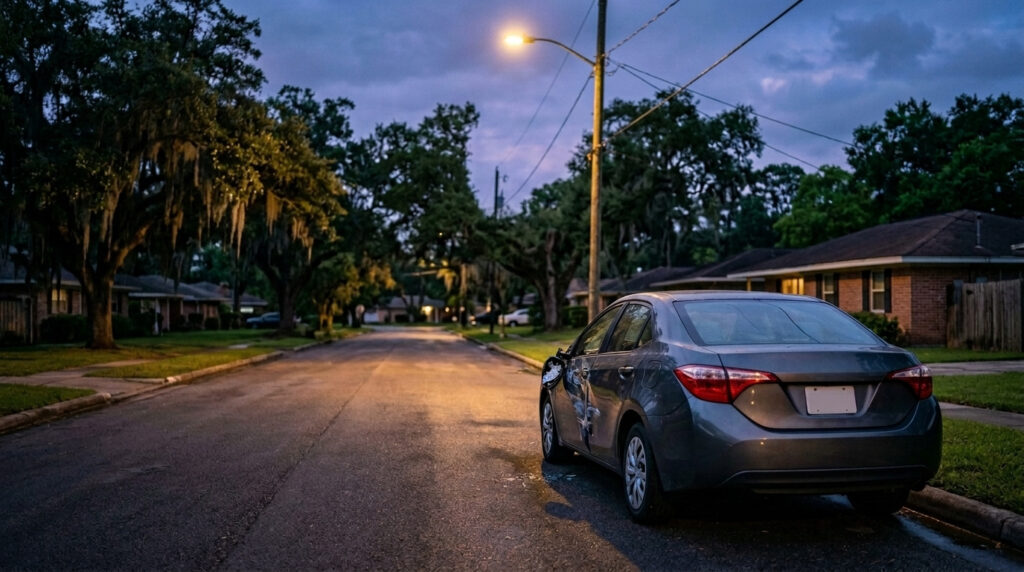
The grade is a criminal classification. Section 550.022 does not set the injured or damaged owner’s claim, which is decided under the policy and the civil claim rules. Our Houston uninsured driver article covers the claim side of a property-damage event. Our Sugar Land claim checklist lists the records to keep either way.
Should I call the police if the driver ran?
Yes. The Texas Office of Public Insurance Counsel advises calling the police and filing a report as soon as possible, and then contacting your insurance company. The sequence protects the record of what happened while the details are still fresh.
OPIC’s hit-and-run guidance is a state agency’s public explanation, not a statute, and it does not say whether a particular policy requires a police report. Read the policy’s claim conditions for that. The statutes above place duties on the driver who left; they do not state what a victim must file. A police report gives the case a date, a place, a description of the vehicle and an officer’s first account, and our guide to requesting a copy of the Texas crash report explains how to get one. Our adjuster article covers what to say to your own insurer once the report is in, and the requests for medical records that usually follow. Whether a lawyer should handle the claim from that point is covered in our article on insurance claims in Texas.
In Houston, the Houston Police Department’s Vehicular Crimes Division works these cases. Its September 15, 2025 release on a fatal hit-and-run on the Eastex Freeway service road asked anyone with information to call the HPD Hit and Run Unit at 713-247-4065 or tip Crime Stoppers anonymously at 713-222-TIPS, and it said no vehicle or suspect description was known when it was written.
Does uninsured motorist coverage pay when the driver is never found?
It can. Texas requires insurers to offer uninsured or underinsured motorist coverage in auto liability policies unless a named insured rejects it in writing, and the coverage covers an insured who may lawfully collect damages from an uninsured driver. OPIC says that coverage pays when a hit-and-run driver is involved.
Under Insurance Code § 1952.101(b), a Texas auto liability policy cannot be issued unless uninsured or underinsured motorist coverage is included or added to it. Under § 1952.101(c), the coverage drops out if the named insured turns it down in writing. Section 1952.109 places the burden of proof on the insurer in a dispute about whether a vehicle is uninsured. OPIC’s guidance says the coverage applies to hit-and-run accidents and also covers the injured occupants of your car. The coverage is part of your own policy, so the limits and the claim steps are set there.
Uninsured motorist claims are a separate area of practice, and our article on how UM and UIM claims work in Texas sets out the limits and the steps, and how Houston claims are valued explains what goes into the number. For a driver who was uninsured rather than unknown, the Sugar Land uninsured driver article covers that situation. Which policy responds after a rideshare crash is a separate question, covered in our rideshare accident article.
What if the other vehicle never touched mine?
For an unknown driver, the statute requires actual physical contact before uninsured motorist coverage applies. A driver who forced a car off the road without any contact raises a question that the policy wording, and a lawyer, must answer.
Section 1952.104(3) makes “actual physical contact” a requirement when the owner or operator of the striking vehicle cannot be identified; the contact must have been between that vehicle and the insured or the insured’s property. The subsection is a required term of the policy form, so an insurer’s policy has to carry it. The text does not give a rule for a car that caused a crash without touching anything, and it does not answer whether any other coverage in the policy might respond.
OPIC’s guidance is narrower still: it says collision coverage pays for damage to your car when you hit something, and that for a hit-and-run collision coverage pays for the damage but not for injuries. A case with no contact should be checked against the policy before anyone assumes a result, and our article on fault in a car accident claim explains how the facts of contact are argued. Insurers that slow a claim are covered in our article on stalled insurance claims, and common delay tactics in car accident claims are described there too.
What does a hit-and-run look like on Houston streets?
The June 2026 north Houston crash below follows the pattern the statutes describe: the driver did not stop after striking a man in his 70s, the man was pronounced dead at the scene, and detectives described a possible vehicle that may have lost a mirror. Cases of this kind bring the grading and the insurance questions together.
On June 24, 2026, around 10:45 p.m., a man in his 70s was struck while crossing Airline Drive near Buckboard Drive. KPRC Click2Houston reported that he was pronounced dead at the scene and that police said “the driver did not stop and fled the area.” Detectives thought the vehicle might be a silver or white SUV or a small pickup, possibly missing its driver’s side mirror (KPRC Click2Houston, June 25, 2026). A hit-and-run collision that kills someone carries the felony grade in § 550.021(c)(1)(A), shown in the table below.
A pedestrian struck by a driver who leaves faces the same statute and insurance questions. Our Houston pedestrian article covers those claims, and families in a death case can start with our wrongful death suits page and our article on who may file a claim after a fatal crash. Cyclists struck the same way are covered in our cyclist road rules article, and riders should see Houston motorcycle accident attorneys.
| Collision | What the driver must do | Offense grade in the text |
|---|---|---|
| Injury or death, § 550.021 | Stop, return if needed, check for aid, remain, and give the information § 550.023 lists. | Death: second-degree felony. Serious bodily injury: third-degree felony. Other injury: up to 5 years in TDCJ or 1 year in county jail, a fine up to $5,000, or both. |
| Vehicle damage only, § 550.022 | Stop, return if needed, and remain; move a car off a metro freeway where § 550.022(b) applies. | Class C misdemeanor under $200 in total damage; Class B misdemeanor at $200 or more. |
| Unattended vehicle struck, § 550.024 | Stop, then locate the owner or leave a written notice with names and addresses. | Class C misdemeanor under $200 in total damage; Class B misdemeanor at $200 or more. |
Sources: Transportation Code ch. 550, Insurance Code ch. 1952, Texas Office of Public Insurance Counsel, hit-and-run guidance.
If the driver is still unidentified, put the police report number, your medical records and any camera footage in one folder before you call your own insurer about an uninsured-motorist claim. The Houston car accident lawyers page and the personal injury overview show how such a claim fits into a wider case, and the contact page takes the details.
Frequently asked questions
How much time can you get for a hit and run?
For an injury collision that does not cause death or serious bodily injury, Transportation Code § 550.021(c)(2) allows up to five years in TDCJ or county jail for up to a year, a fine of no more than $5,000, or both. The range is set by statute; the sentence in any case depends on the court.
Does liability insurance cover a hit and run?
Liability coverage pays damages the insured driver is legally responsible for. If the driver who fled is never identified, there is no insured driver to claim against, so the injured person’s own uninsured motorist coverage is the route to examine under Insurance Code § 1952.101.
Must a driver give their insurance information after a crash?
Yes. Under Transportation Code § 550.023(1), the operator must give the name of the operator’s motor vehicle liability insurer to any person injured in the collision, along with the operator’s name, address and the vehicle’s registration number.
Does a driver have to show a driver’s license after a crash?
If requested and available, the operator must show a driver’s license to a person injured in the collision or to the operator or occupant of the other vehicle, under Transportation Code § 550.023(2).
What is the deadline for suing after a hit and run?
Civil Practice and Remedies Code § 16.003 gives a two-year window for a personal injury suit, measured from the day the claim accrues, and the statute lists its own carve-outs. A lawyer should confirm which date applies to your claim.
Should I call police if no one was hurt?
Section 550.022 places the stop-and-remain duties on the driver, and it makes a violation a misdemeanor graded by the damage. The Texas Office of Public Insurance Counsel advises calling the police and filing a report as soon as possible, and then contacting your insurer.
About the authors

Sam A. Maida, Jr.
Owner and Managing Attorney
Sam A. Maida, Jr. has represented injured Texans in the greater Houston area since the firm opened in 1993.
State Bar of TexasAvvoMartindale-HubbellLawLinkThatCarHitMeLinkedIn

Bernard G. Johnson III
Litigation Managing Attorney
Bernard G. Johnson III is a board certified trial lawyer licensed in Texas since 1996 and a graduate of South Texas College of Law.