A crash between a car and a school bus raises two questions at once: who is responsible for the damage and injuries, and how fast a claim has to be started. If a Texas public school district’s employee caused the crash, the claim runs against a governmental unit that must receive notice within six months and whose liability is capped by statute. If a private company runs the bus, the claim is an ordinary one against that company and its insurer.
The short version
- Who runs the bus decides the rules. A school district is a governmental unit for the Texas Tort Claims Act, and that Act is generally written for governmental defendants, not private contractors (Civil Practice and Remedies Code § 101.001(3)(B), § 101.051).
- Notice comes first. A district must receive notice of the claim within six months after the incident (§ 101.101(a)).
- The recovery from a district is capped. For a unit of local government, the limit is $100,000 per person and $300,000 per occurrence for bodily injury or death (§ 101.023(b)).
- Drivers have an exception. On a highway with separate roadways, a driver need not stop for a bus on the other roadway (Transportation Code § 545.066(b)(1)).
- The suit deadline is separate. The two-year clock to sue (§ 16.003(a)) keeps running even when notice was timely.
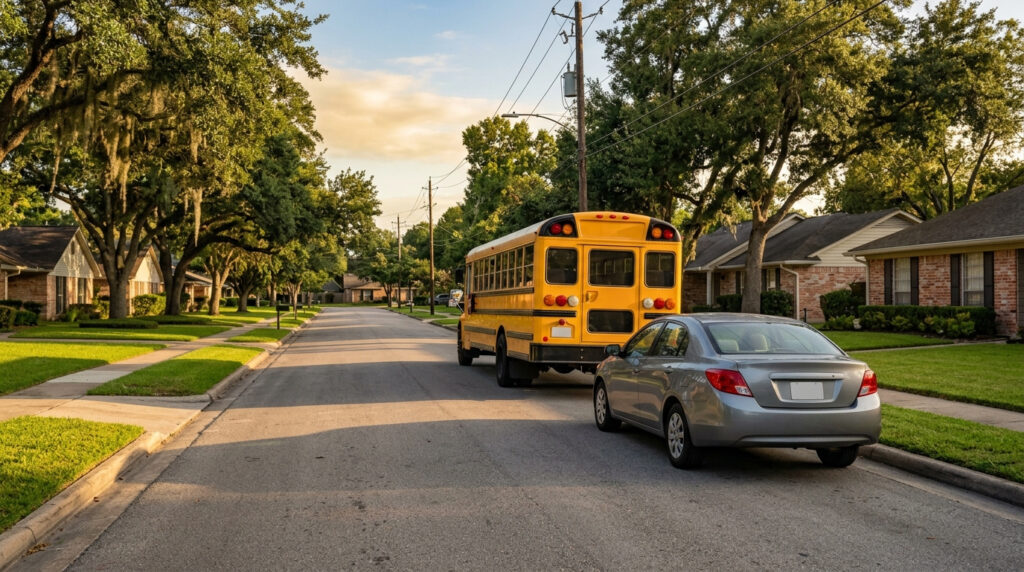
A car can meet a school bus in two ways. The bus can strike a vehicle that is stopped, merging or turning, or a car can strike the back, side or front of a bus. In March 2025 a red SUV rear-ended a Fort Bend ISD bus on Rusk Street in downtown Houston, with 47 people aboard on a field trip, according to the Houston Police Department and the Houston Fire Department as reported in ABC13’s report of March 17, 2025.
This article is written for drivers and for the occupants of the other vehicle. Our Houston car accident page covers the wider claim. If you were a passenger on the bus or a pedestrian, read our article on the rights of bus passengers and pedestrians instead, and our Houston pedestrian injury page covers walkers struck by any vehicle. Our Houston bus accident page covers city buses and charter coaches as well.
Who can be liable when a car and a school bus collide?
The bus operator’s employer can be liable if its driver’s negligence caused the crash, and the other driver can be liable for their own negligence. A public district answers only for certain kinds of harm: for a motor vehicle injury, the employee must have acted within the scope of employment and must face personal liability under Texas law.
Chapter 101 of the Civil Practice and Remedies Code makes a governmental unit answerable for injuries tied to driving a motor-driven vehicle, where the employee would face personal liability as Texas law defines it (§ 101.021(1)). The same chapter says that, outside motor vehicle cases, it does not reach a school district (§ 101.051). That is why a crash with a district bus falls under the Act, while a school district’s other injuries do not.
Fault is still the central question. A crash report, the bus driver’s statement, camera footage if it exists, and the damage to each vehicle all bear on whether the bus driver was negligent, and the other driver’s own choices count too. When a truck, a motorcycle or a second car is also involved, the analysis changes, as our pages on Houston trucking accident claims, motorcycle accident claims and multi-vehicle liability explain. A driver who shares responsibility can still recover unless their percentage of responsibility exceeds 50 percent (§ 33.001). Our article on how comparative negligence is handled in Texas explains how those percentages are argued.
Is the school bus run by a district or by a private company?
The name on the side of the bus is a starting point, not the answer. The district’s transportation office and the crash report can show who owned the bus, who operated it and who employed the driver, and those facts decide whether the governmental-unit rules apply.
Districts sometimes contract bus service to private operators, and private schools run buses of their own. The table below sets out how the two situations differ on the points that matter most after a crash.
A district’s own publications can help answer who employed the driver. Houston ISD’s student safety page tells riders to obey the driver and calls that person “an HISD employee with responsibility for your safety” (page read October 16, 2026), a statement to compare with the crash report and the district’s transportation records; our car accident FAQ answers related questions about reports and claims.
| Question | Bus operated by a public school district | Bus operated by a private company or private school |
|---|---|---|
| Which law governs the claim | Chapter 101 of the Civil Practice and Remedies Code, for motor vehicle injury (§ 101.021, § 101.051) | The ordinary negligence rules that apply to any private defendant |
| Notice before suing | Notice inside six months of the crash (§ 101.101(a)) | No Chapter 101 notice requirement applies to a private defendant |
| Limit on damages | $100,000 per person and $300,000 per occurrence for bodily injury or death for a unit of local government (§ 101.023(b)) | The Chapter 101 caps do not apply to a private defendant |
| Suit deadline | Two years (§ 16.003(a)), in addition to notice | Two years (§ 16.003(a)) |
Source: Civil Practice and Remedies Code, ch. 101, read October 16, 2026; ch. 16, read October 16, 2026.
How does the six-month notice rule work for a school district?
A district that may be sued must receive notice within six months of the day the incident happened. The notice has to describe the injury or damage, the time and place, and the incident itself, so a vague letter, or one sent late, can cost the claim.
Section 101.101(a) lists the three things the notice must describe. A city charter can set a different notice period, and the statute accepts it (§ 101.101(b)). The six-month period in subsection (a) is the one to plan around.
Section 101.101(c) excuses notice when the governmental unit already has actual notice that death occurred, that the claimant was injured, or that the claimant’s property was damaged. Whether a district had actual notice would be argued after the fact, so a notice sent inside the period is the safer course. The statute does not require the notice to be in writing, but a written notice is the record that can be proved later.
What caps limit what a school district has to pay?
For a unit of local government such as a school district, liability under the Act is limited to $100,000 for each person and $300,000 for each single occurrence for bodily injury or death, and $100,000 for each occurrence of property damage. The state and a municipality have higher caps, so the category of the defendant matters.
Section 101.023 sets three tiers. The state government is capped at $250,000 for each person and $500,000 for each occurrence (§ 101.023(a)). A municipality has the same tier as the state (§ 101.023(c)). Every other unit of local government, which includes a school district, is in the lower tier of $100,000 and $300,000 (§ 101.023(b)).
An injury that needs surgery, a long course of therapy or lost years of work can exceed $100,000 quickly, and the amount above the cap is not recoverable from the district under the Act. That is why a claimant with a serious injury looks at their own policy as well. Uninsured and underinsured motorist coverage and personal injury protection come from the driver’s own auto policy, and whether they apply depends on that policy’s terms and the facts. Our article on the UM claim process explains how that coverage is triggered, and how a Houston car accident claim is valued covers the factors that shape a claim before any cap is applied.
When does a driver have to stop for a school bus?
A driver approaching a school bus from either direction must stop before reaching it when the bus is stopped on the highway to load or unload students and is operating its visual signal. The driver may not go on until the bus resumes motion, the bus driver signals to proceed, or the visual signal is turned off.
That rule is in Transportation Code § 545.066(a). Subsection (b) lists two exceptions that drivers often overlook. A driver on a highway with separate roadways is not required to stop for a bus on a different roadway, and on a controlled-access highway a driver need not stop for a bus stopped in a loading zone where pedestrians are not permitted to cross.
“Separate roadways” is defined narrowly. Under § 545.066(f)(1), a highway has separate roadways only if they are divided by an intervening space where vehicles may not operate, a physical barrier, or a clearly indicated dividing section built to impede traffic. A left-turn lane between two directions of travel does not count (§ 545.066(f)(2)). A driver who relies on the divided-highway exception needs to be able to show the road’s layout on the day of the crash.
What are the penalties for passing a stopped school bus in Texas?
A first offense is a misdemeanor with a fine of $500 to $1,250. A second offense within five years of the most recent one carries a fine of $1,000 to $2,000, and the offense is a Class A misdemeanor if the driver causes serious bodily injury to another person. The court may suspend the license of a repeat offender for up to six months.
Those penalties are in Transportation Code § 545.066(c) and (d). A later conviction under the serious-injury subdivision can be a state jail felony, under § 545.066(c)(3). A driver facing a citation should speak with a lawyer before making any statement about the crash, because the same facts can matter later in a civil claim.
The penalty also matters on the civil side. A driver who passed a stopped bus and struck a car may be asked to answer for that choice in the civil case, and whether the conduct violated the statute is decided from the crash facts, the bus signals and the witnesses. Our article on the reckless driving crashes we handle covers how that conduct is shown.
What should a driver do after a crash with a school bus?
Stop, check for injuries and call the police right away. A crash that hurt someone must be reported immediately, by the quickest means, to the local police department if it happened inside a city, or to the police department or sheriff’s office if it happened just outside one. Photograph both vehicles, the bus number, the operator’s name and the scene before anything is moved.
The reporting duty in Transportation Code § 550.026(a) applies to any operator whose crash hurt someone, killed someone, or left a vehicle unsafe to drive. The report also starts the official record of the collision. The rest of the steps are in our first-hours checklist, and our article on obtaining a crash report explains how to get it once it is filed. Photographs and witness names, covered in our pieces on scene photos and witness evidence, can decide who was at fault.
If you were hurt, get medical attention even if the injury seems minor, and keep every record of it. If your claim is against a district, a lawyer will want the notice sent well inside the six-month period, and that work starts with the operator’s name and the date of the crash. If the other vehicle left the scene, our Houston hit-and-run page covers the claim options. Before giving a recorded statement to an adjuster, read our note on speaking with an adjuster; our article on Houston insurers that stall covers delays, and our article on tactics insurers may use explains what the adjuster is weighing.
How long do you have to sue after a crash with a school bus?
Generally two years after the claim arose. Texas gives a personal injury plaintiff two years to sue under § 16.003(a), and a death claim runs from the date of death under § 16.003(b), so when the clock starts matters as much as how long it runs.
The notice deadline and the suit deadline are two separate requirements. Giving notice within six months does not extend the two-year period. Sections 16.010, 16.0031 and 16.0045 list exceptions to that rule, and missing the notice period can cost a claim against a district even if the two years have not run, a point to confirm with counsel. Our article on the filing window after a Sugar Land crash works through the same deadline locally, and if the crash was fatal, our fatal-crash claim article and our page on wrongful death suits in Houston covers the family’s side.
Frequently asked questions
What happens if you get hit by a school bus?
The claim depends on who operates the bus. If a public school district’s employee caused the crash, the claim is governed by Chapter 101 of the Texas Civil Practice and Remedies Code, which requires notice within six months and caps damages. If a private company operates the bus, the claim is an ordinary negligence claim against that company and its insurer.
What if a school bus causes a crash with my car?
The same two questions apply: who was negligent, and who is the defendant. Fault is decided from the crash report, the bus driver’s account, any video and the physical evidence. A district has to receive notice within six months of the crash, and a private operator does not.
Does the two-year deadline still apply if I gave notice in time?
Yes. The six-month notice requirement and the two-year period to file a personal injury suit are separate requirements under Texas law, and both have to be met.
Can a driver who passed a stopped bus still recover damages?
Possibly. Under the proportionate-responsibility rules, a claimant’s own share of responsibility reduces the recovery, and recovery is barred only when that share is greater than 50 percent (Civil Practice and Remedies Code § 33.001). Passing a stopped bus is one of the facts weighed in deciding that share.
Is a school district liable for injuries that do not involve a vehicle?
Generally no. Section 101.051 says that, except as to motor vehicles, Chapter 101 does not apply to a school district or a junior college district. A claim that does not involve a motor vehicle is analysed under different rules.
Do I have to stop for a school bus on the other side of a divided highway?
Not if the bus is on a different roadway. Transportation Code § 545.066(b)(1) excuses a driver on a highway with separate roadways from stopping for a bus on the other roadway. The highway must meet the statutory definition of separate roadways, and a left-turn lane between the two directions does not qualify.
If a school bus was involved in your crash, time matters. Ask the district for the incident report and the bus number, and put the date and place of the crash in a message through the contact page. For other vehicles, see what losses a claim covers, how long a case takes, the insurance side of a claim, or the Houston personal injury attorneys page.
About the authors

Sam A. Maida, Jr.
Owner and Managing Attorney
Sam A. Maida, Jr. has represented injured Texans in the greater Houston area since the firm opened in 1993.
State Bar of TexasAvvoMartindale-HubbellLawLinkThatCarHitMeLinkedIn

Bernard G. Johnson III
Litigation Managing Attorney
Bernard G. Johnson III is a board certified trial lawyer licensed in Texas since 1996 and a graduate of South Texas College of Law.