
After a truck crash, the five things that matter most are to get to safety and call for help, to learn who owns the truck, to record the scene before it is cleared, to get medical care and keep the records, and to get the police report and ask the carrier in writing to keep its evidence. Some of these are legal duties in Texas; the rest protect a claim that is hard to rebuild later.
The short version
- Stop, help and report. A driver in a collision that injures someone, or is reasonably likely to, must stop, stay, give identifying information and render aid (Transportation Code §§ 550.021, 550.023); § 550.026 adds an immediate report when someone is hurt or a vehicle cannot be driven normally and safely.
- Read the cab door. A federally regulated truck must display the carrier’s name and a USDOT number on both sides (49 CFR 390.21), and FMCSA’s SAFER system searches that number free of charge.
- Photograph the trailer, not just your car. The trailer, its plate and any hazard placards are easy to overlook at the scene.
- Keep every medical record and bill. The Texas Department of Insurance tells people who see a doctor to keep them to show their insurer.
- Time is short for some records. The federal minimum for a driver’s daily inspection report is three months (49 CFR 396.11), so the written request should go out early.
What should you do first after a truck accident?
Make sure everyone is safe and call for help, then work through four more steps in a rough order: identify the truck and carrier, record the scene, get medical care, and obtain the report. The table lists all five with the rule or agency guidance behind each.
This post is the do-list. The mistakes that most often damage a claim, from recorded statements to early releases, are in the companion post on what not to do after a truck crash, and the records a lawyer pursues are in the post on evidence from a trucking company. For the ways a truck claim departs from an ordinary car claim, start with the general 18-wheeler primer.
| Step | What it involves | Source |
|---|---|---|
| 1. Safety and help | Stop, check for injuries, call police and emergency services, stay until duties are met | Transp. Code §§ 550.021, 550.023, 550.026; TDI |
| 2. Identify the truck | Carrier name and USDOT number on the cab; trailer plate and markings | 49 CFR 390.21; FMCSA SAFER |
| 3. Record the scene | Photographs, placards, road marks, witness names and numbers | TDI; 49 CFR 172.504 |
| 4. Medical care | See a doctor; keep records and bills | TDI |
| 5. Report and preservation | Obtain the crash report; ask the carrier in writing to keep its records | Transp. Code §§ 550.062, 550.065; TxDOT |
What does Texas law require you to do at the scene of a truck crash?
When a collision injures someone or is reasonably likely to, each driver involved must stop at or near the scene, find out whether anyone needs aid and stay until the information duties are met. A collision with injury or death must also be reported at once. These duties apply to the truck driver and to you.
Section 550.021 of the Transportation Code tells the operator to stop immediately at or near the scene, check whether anyone is involved and needs aid, and stay until the next section is satisfied, without blocking traffic more than necessary. Under § 550.023, the operator hands over a name and address, the vehicle’s registration number and the name of the liability insurer to anyone injured and to the operator, occupant or attendant of any vehicle involved, shows a driver’s license on request if it is available, and gives injured people reasonable assistance, including arranging a ride to a doctor or hospital when treatment is apparently necessary or the injured person asks. The immediate notice required by § 550.026, for a collision with injury or death or a vehicle that cannot be driven normally and safely, goes, depending on location, to the city police, the sheriff or the nearest Department of Public Safety office.
The Texas Department of Insurance offers the everyday version: clear the road if nobody is injured, and call the police if someone is hurt or the other driver left (TDI, “Were you in a wreck?”, updated 24 September 2025). A truck that left is a hit-and-run; see what follows a hit-and-run. If you were hurt on a shoulder, the Move Over law and trucks may matter. Those sections set criminal and traffic duties; whether anyone owes money is a separate civil question.
How do you identify the truck and the trucking company?
Photograph the name and USDOT number painted on the cab door, then search that number in FMCSA’s SAFER Company Snapshot. Federal rules require the marking on both sides of a regulated truck, and the Snapshot can be searched by USDOT number, MC/MX number or company name.
Under 49 CFR 390.21, the marking must give the operating carrier’s legal name (or one trade name) and the FMCSA identification number preceded by “USDOT,” must be on both sides of the self-propelled vehicle, and must be legible in daylight from 50 feet while stationary. If another company’s name is also on the truck, the operating carrier’s name must follow the words “operated by.” The cab marking identifies the carrier, but not necessarily the owner of the trailer, the shipper or a broker.
FMCSA describes the Company Snapshot as a concise record of a company’s identification, size, commodity information and safety record, with any safety rating, a summary of roadside out-of-service inspections, and crash data, free to search one carrier at a time. Save a dated copy so you can show what it said at the time. Whether the carrier is based out of state, and what that means for where a case can be filed, is in the post on hiring for an interstate truck crash. Which companies can be responsible for the driver’s conduct is covered in who may be liable in a truck claim.
What should you photograph at a truck crash scene?
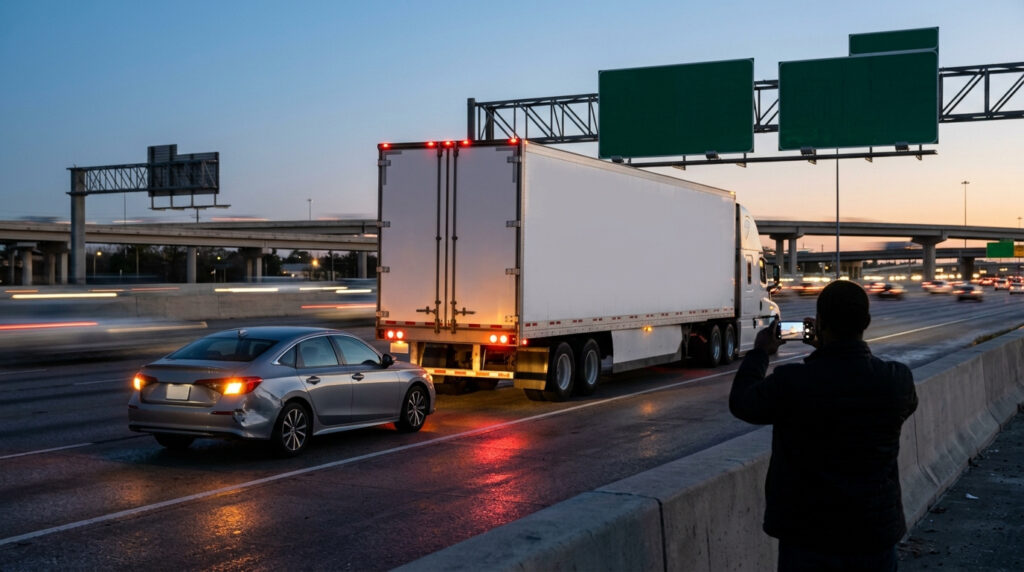
Every side of every vehicle, the trailer and its license plate, any hazard placards, skid marks and debris, street signs, the lanes and the lighting, plus the names and phone numbers of witnesses. Include wide shots and close-ups, because the truck may be towed within hours.
The insurance department’s checklist covers pictures of the other vehicles, plates and damage, street signs and road angles, plus witness contact details and a written note of place, time, weather and events. A truck adds items a car crash lacks. Photograph the trailer separately from the tractor, because its plate and markings can differ from the cab’s. The federal placarding rule puts placards “on each side and each end” of a transport vehicle carrying hazardous material (49 CFR 172.504(a)), with an exception for less than 1,001 pounds of certain hazardous materials, so a clear picture of every placard records what the truck was hauling.
Photographs of the scene help show how the crash happened. Which angles are most useful is covered in the photographs that help after a collision, and why independent witnesses count is in the value of eyewitness accounts. Highways have their own hazards; the notes on a crash on I-45 and on dangerous Houston roads and intersections are local context. Do not step into live lanes for a photograph.
When should you get medical care after a truck accident?
Right away if you are hurt, and soon even if you feel fine. Emergency crews at the scene can assess you, and a prompt visit creates a dated medical record. Keep the medical records and bills, which the Texas Department of Insurance says to keep to show your insurer.
TDI’s advice is to keep the medical records and bills if you see a doctor, so you can show them to your insurer. In a lawsuit the same file supports the losses Texas law sorts into two kinds: economic damages, defined as compensation for “actual economic or pecuniary loss,” and noneconomic damages, a longer list covering physical pain, mental anguish, disfigurement, impairment and lost enjoyment of life (definitions in chapter 41, § 41.001(4), (12)). If lost earnings are claimed, § 18.091 has the proof presented as a net figure after income tax, so pay records belong alongside the medical file.
Follow the treatment plan your doctor gives you and tell each provider how the injury happened. Brain injuries have their own documentation questions, covered in compensation after a traumatic brain injury. Which damages Texas treats separately is in the kinds of compensation available. Be careful about who receives your records; sharing records with an adjuster is addressed separately.
How do you get the police report on a truck crash?
For a crash with an injury or death, or $1,000 or more in damage to one person’s property, the officer must file the report electronically with TxDOT by the tenth day, and someone involved in the crash can buy a copy through TxDOT’s online system. On TxDOT’s fee list a regular copy is six dollars and a certified copy eight, and buying online adds a surcharge.
Under § 550.062, an officer who investigates a collision with an injury or death, or apparent damage to one person’s property of $1,000 or more writes a report and files it with the department electronically by the tenth day. Section 550.065 treats the report as confidential but requires release, once someone asks in writing and pays any fee, to people directly concerned, including anyone involved, that person’s representative and the owner of damaged property. TxDOT’s page on crash reports and records describes how to request the Peace Officer’s Crash Report (CR-3) and states the fees. The page adds that TxDOT is custodian of the report only and that subpoena requests for on-scene dash camera video, field notes and photographs go to the investigating agency.
The report may name the truck driver, the carrier and a USDOT number, and it may list citations, but it is a starting point and not a final finding of fault. The ordering steps are in how to order the crash report. If a driver tested positive or refused after the crash, that record is separate; see post-crash drug and alcohol testing.
What do early news reports of a Houston truck crash leave unknown?
Usually the cause. ABC13’s story on the 12 October 2026 rollover on the West Loop near I-10 reported that officials gave no reason for the truck flipping and no word on injuries. The cause, the driver’s hours and the truck’s condition may only come out of the records and data a claim later collects.
According to ABC13 (12 October 2026), Houston TranStar reported the overturned 18-wheeler just after 5:30 a.m., the truck went over the guardrails of the southbound lanes, and all lanes had reopened by 5 p.m. We discuss that crash in our own report on the I-10 rollover. The lesson for anyone hurt in a crash: by the time lanes reopen, skid marks, debris and the tow truck’s work can have changed the scene, so the pictures you take in the first minutes may be the only record of it.
The limits on a driver’s hours are in the guide to daily and weekly driving limits. Brake and following-distance questions in rear-end crashes are in why a truck fails to stop.
When should you call a lawyer and ask the carrier to preserve evidence?
Early, because some federal retention periods are as short as three months, and a written request names what the carrier should keep. Texas generally gives two years to file suit, but a record can disappear well before then. A lawyer can send the request and handle contact with the carrier’s insurer.
For personal injury, Civil Practice and Remedies Code § 16.003(a) sets a two-year limit counted from the day the claim accrues, and § 16.003(b) sets two years for a death, accruing at the death, subject to the exceptions the statute provides. Against that, a driver vehicle inspection report is kept three months under 49 CFR 396.11(a)(4). The contents of a preservation request and the retention table are in the evidence post linked above. Questions of timing in a Texas case are in how long an injury case lasts, and a death is handled differently: see wrongful death claims.
Before speaking at length to the carrier’s insurer, read why to talk to counsel first and how truck insurance is layered. A preservation request or a question about one can go through the contact page; the 18-wheeler accident page and truck settlement page describe the case type.
Frequently asked questions
What should I do after a truck accident in Houston?
Get to safety, call 911, photograph the scene and the truck’s cab markings, write down witness names, see a doctor, and keep your records. Then obtain the crash report and have a lawyer send a written preservation request to the carrier.
How do I start a semi truck accident claim?
A claim starts with notice to the responsible parties and their insurers, supported by the police report, medical records and photographs. A lawyer identifies the carrier from the USDOT number, sends a preservation request and handles communication with the insurer.
What are the steps to start a semi truck accident claim?
The usual order is medical care, the crash report, identifying the truck and carrier, collecting photographs and witness names, a preservation request, and a demand once treatment is far enough along to value. Suit must generally be filed within two years.
Do I need a lawyer after a semi-truck accident?
Nothing in Texas law requires one, but a truck claim involves federal carrier rules, several possible defendants and records with short retention periods. A free consultation lets you ask what applies to your crash before you decide.
Do I have to call the police after a truck accident in Texas?
Yes when someone is injured or killed, or a vehicle cannot be driven normally and safely. Transportation Code § 550.026 requires the driver to give immediate notice by the quickest means to the local police, the sheriff or the Department of Public Safety, depending on where the crash happened.
Where do I look up a trucking company?
Use FMCSA’s SAFER Company Snapshot and search by the USDOT number on the cab door, an MC/MX number or the company name. The Snapshot shows identification, size, any safety rating, inspection summaries and crash information for that carrier.
About the authors

Sam A. Maida, Jr.
Owner and Managing Attorney
Sam A. Maida, Jr. has represented injured Texans in the greater Houston area since the firm opened in 1993.
State Bar of TexasAvvoMartindale-HubbellLawLinkThatCarHitMeLinkedIn

Bernard G. Johnson III
Litigation Managing Attorney
Bernard G. Johnson III is a board certified trial lawyer licensed in Texas since 1996 and a graduate of South Texas College of Law.