
An 18-wheeler claim differs from a car claim in four ways: federal safety rules govern the truck and its company, more parties can be responsible, the insurance behind the truck is set by a federal schedule, and the records that explain the crash are kept for short, fixed periods. The Texas rules for dividing fault and the two-year deadline to sue are the same as in a car case.
The short version
- Federal rules reach the truck. The federal motor carrier safety regulations reach employers, drivers and commercial vehicles in interstate commerce (49 CFR 390.3), which is why hours, testing and inspection records exist at all.
- More parties. The regulations define an “employer” as anyone who owns or leases a commercial vehicle for business or assigns employees to operate it (49 CFR 390.5), so the driver is rarely the only name in the case.
- A federal insurance floor. The federal schedule sets $750,000 as the least a for-hire carrier of ordinary freight may carry across state lines (49 CFR 387.9); Texas’s required minimum is 30/60/25 (Texas Department of Insurance).
- Records expire. The carrier’s accident register is kept three years (49 CFR 390.15); a daily inspection report is kept three months (49 CFR 396.11).
- What does not change. Texas bars recovery by a claimant who is more than half responsible (Civ. Prac. & Rem. Code § 33.001), and the filing deadline is the same two years (§ 16.003).
How is an 18-wheeler accident claim different from a car accident claim?
The difference is who is regulated and what they must keep. A car driver answers to Texas traffic law and an insurer. A truck driver also answers to federal safety rules, and the company behind the truck must keep records those rules require. That adds parties, paperwork, insurance layers and deadlines for evidence.
The table below sets the two kinds of claim side by side. Each difference has a detailed post of its own, linked where it comes up, so this page stays on the overview. If you want the day-to-day work of a claim, the lawyer’s work on a truck claim, step by step walks through it, and the firm’s 18-wheeler accident practice page describes the case type as a whole.
| Question | Car crash | 18-wheeler crash |
|---|---|---|
| Whose rules apply | Texas Transportation Code and local traffic law | Those, plus the federal regulations aimed at employers and commercial vehicles in interstate commerce (49 CFR 390.3) |
| Who may be responsible | The other driver and whoever else the facts point to | The driver and any “employer” as defined in 49 CFR 390.5, plus others the facts point to |
| Minimum liability insurance | $30,000 per person, $60,000 per accident, $25,000 property (Texas Department of Insurance) | $750,000 floor for ordinary for-hire freight across state lines; higher floors for oil and some hazardous cargo (49 CFR 387.9) |
| Driver’s time on the road | Not covered: the Part 395 limits are written for drivers of commercial motor vehicles (49 CFR 395.3) | Federal driving-time and rest limits for drivers of property-carrying commercial vehicles (49 CFR 395.3) |
| Records the company must keep | Not covered by these motor-carrier rules, which are written for carriers and commercial vehicles | Accident register, three years (49 CFR 390.15); daily vehicle inspection report, three months (49 CFR 396.11) |
| Deadline to sue | Two years (Civ. Prac. & Rem. Code § 16.003) | The same two years |
Which federal rules apply to a commercial truck and its company?
The Federal Motor Carrier Safety Regulations in 49 CFR Parts 390 to 399 apply to employers, employees and commercial motor vehicles that transport property or passengers in interstate commerce. They cover driver hours, drug and alcohol testing, inspection, record keeping and insurance, none of which binds an ordinary car driver.
Section 390.3(a) sets the reach: the subchapter applies to employers, employees and commercial motor vehicles carrying property or passengers in interstate commerce. A commercial motor vehicle, in the definitions at § 390.5, is one with a gross vehicle weight rating or gross combination weight rating of 10,001 pounds or more, among other categories.
Three of those rules come up in almost every Houston truck case. Section 395.3 limits driving time and requires rest; the post on hours-of-service limits gives the numbers and explains how a violation is shown. After a qualifying crash the employer must test its surviving driver for alcohol and controlled substances “as soon as practicable” (49 CFR 382.303), a subject taken up in how drug and alcohol use by a truck driver is proved. And the driver’s physical qualification is its own regulation, covered in the post on truckers’ untreated medical conditions.
Why can a truck crash involve more defendants than a car crash?
A commercial truck sits at the end of a chain of businesses: the company that employs or dispatches the driver, the owner or lessor of the tractor or trailer, the party that loaded the cargo, the shop that maintained the brakes, and the maker of a part. Each may be responsible for a different failure, and each may carry its own insurance.
The federal definition of “employer” is broad. Under 49 CFR 390.5 it reaches a business that owns or leases a commercial vehicle for its work, or assigns employees to drive it, and the definition of a motor carrier takes in the carrier’s agents, officers and the employees who hire, train, dispatch or maintain. Whether any of them is legally responsible in a given crash is a question of the facts, which the post on a party-by-party look at responsibility works through party by party.
More defendants matters because Texas divides responsibility by percentage. Under Civil Practice and Remedies Code § 33.013, a defendant answers for its own percentage, and one whose percentage is above 50 also becomes jointly and severally liable for the recoverable damages. Under § 33.004 a defendant may ask the court to name a “responsible third party,” by a motion due 60 days before trial unless the court allows a later filing for good cause. Both rules apply to car cases too; they weigh more in a truck case because there are more people to assign a percentage to.
When a part failed, the firm’s defective product page and the post on truck tire blowouts and road debris cover the product side.
How much insurance stands behind an 18-wheeler compared with a car?
Texas requires a driver to carry at least $30,000 for each injured person and $60,000 per accident, plus $25,000 for property damage. Federal rules set $750,000 as the least a for-hire carrier of ordinary freight may carry across state lines, with higher floors for some hazardous cargo. A minimum is a floor, not a measure of what a claim is worth.
The car figure comes from the Texas Department of Insurance’s auto insurance guide, which calls it “30/60/25 coverage.” The truck figures are in the schedule at 49 CFR 387.9: $750,000 for ordinary for-hire freight in interstate commerce, $1,000,000 for oil and certain hazardous materials, and $5,000,000 for some bulk hazardous cargo.
The gap is why a truck claim looks different from a car claim at the claim stage. Where the at-fault driver’s limit is low, an injured person may have a route through their own policy, which the post on claims under your own uninsured and underinsured motorist coverage explains. A truck’s policy, on paper, starts far higher, though a carrier can also have excess coverage, and a broker, shipper or owner can have its own. Which policies apply, and how a carrier’s coverage is proved, is the subject of whose policies may apply to a truck crash. The firm’s truck accident settlement page covers how claims are valued; this post states no value.
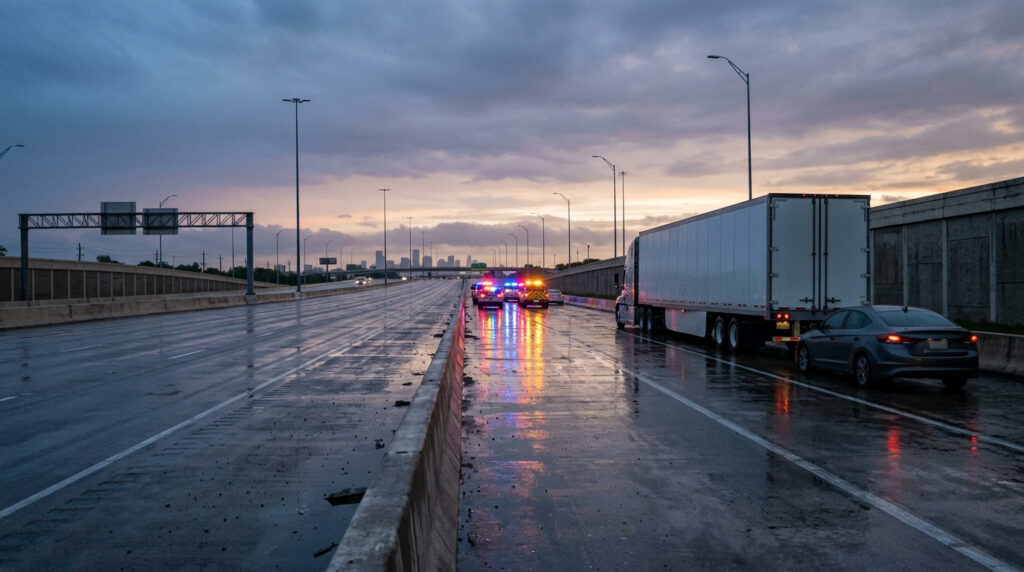
Why does evidence in a truck case disappear faster?
Because the rules that require a carrier to keep records also set an end date for keeping them. A carrier must keep its accident register for 3 years and a daily vehicle inspection report for 3 months, though the inspection-report rule does not apply to a carrier operating only one commercial vehicle. After that, a record that was never preserved can be lawfully discarded.
Section 390.15(b) has the carrier keep a register of each accident for three years, with date, location, driver, injury and fatality counts, hazardous-materials releases, and copies of reports filed with governments or insurers. Under section 396.11, the driver’s inspection report, the repair certification and the driver’s review certification are kept for three months from the date the report was prepared. Those reports cover service brakes, steering, tires, lighting and coupling devices, which are the parts most often questioned after a crash.
Records are only part of it. A plaintiffs’ trucking lawyer, Bryan M. Roberts, writing in Advocate magazine in May 2025, says defense rapid-response teams “begin investigating a crash hours after it occurred,” while plaintiffs’ lawyers “are often hired days, weeks or months after a crash.” That is one lawyer’s account, written from the plaintiff’s side. The practical point is that the carrier often has a head start.
Which records exist and how to ask a carrier to keep them is the subject of the post on which records and data to preserve. The first steps for an injured person are in the steps to take at the scene and in the first days, and the common errors are in the mistakes that hurt a claim.
What does a recent Houston 18-wheeler crash show about where these claims begin?
It shows that the first public facts are thin and that the company behind the truck is a matter of public federal record. ABC13’s report of a deadly crash on Interstate 10 near Eldridge traced the truck to a small Richmond carrier and read its federal safety record, while the cause was still under investigation.
On Wednesday, 1 July 2026, an 18-wheeler struck a gold Mitsubishi Galant on inbound I-10 near Eldridge at about 5 a.m., rolled the car and then struck a barrier and tipped over, ABC13 reported, citing the Houston Police Department and the Harris County Sheriff’s Office. Both drivers were killed. ABC13 reported that the truck was tied to a small trucking company in Richmond, that national safety records showed a fleet of 10 trucks, and that a company vehicle had been involved in one other crash in the previous 24 months. The report did not say who was at fault.
Public safety records can name the carrier; the carrier’s own records can show the driver’s hours, the truck’s inspection history and the insurance. When a crash is fatal, see the firm’s wrongful death page and the post on who may bring a claim when someone dies in a crash. The same steps apply on the outer roads, and the firm also has truck accident pages for Pasadena, Baytown and Galveston.
The first public facts are thin, but the setting is well documented: TxDOT’s 2024 table of commercial-motor-vehicle crashes by county, built from crash reports processed as of April 9, 2025, lists 6,313 such crashes in Harris County, out of 39,393 statewide, including 41 of the state’s 546 fatal ones (TxDOT, Commercial Motor Vehicle Involved Crashes and Injuries by County, 2024).
Is the deadline to sue after a truck crash different from a car crash?
No. Texas generally gives a person two years from the day the cause of action accrues to sue for personal injury, and for a death the clock runs two years from the death. The evidence clocks above are shorter, which is why waiting for the filing deadline is a poor plan in a truck case.
Two years from accrual is the limit set by § 16.003 of the Civil Practice and Remedies Code; in a death case accrual is the date of death. The ordinary car-crash version is in how long after a crash a lawsuit can be filed.
Fault is divided the same way as in a car case. A claimant above 50 percent responsibility recovers nothing, and below that the award is reduced by the claimant’s share (§§ 33.001, 33.012). The post on the way lawyers answer a comparative negligence argument explains how that plays out, and the causes that usually decide it are in what usually causes truck crashes here.
Where do the more specific truck questions get answered?
Each large question has its own post on this site, covering hours, testing, insurance, evidence, experts, gross negligence, rear-end crashes, distracted drivers, tires, interstate carriers and the Move Over rule. This page only shows how a truck claim differs from a car claim, then points to them.
For crashes where a truck did not slow, see rear-end crashes by trucks that do not stop and phone use by a truck driver. For the experts a case relies on, see expert witnesses in an 18-wheeler case. For a carrier’s conduct that goes beyond carelessness, see proving gross negligence against a trucking company. For an out-of-state carrier, see questions to ask about an interstate crash. For trucks stopped on a shoulder, see the Move Over rule for vehicles stopped on a shoulder.
Before anything is repaired or scrapped, tell the carrier and your own insurer in writing to keep the truck, the data recorder and the driver’s logs. A message through the contact page can describe where the crash happened and which company’s name was on the cab; the published outcomes on the results page do not predict any other case.
Frequently asked questions
Which kind of law firm handles 18-wheeler accident cases?
A personal injury firm that takes trucking cases, because the claim depends on federal motor carrier rules, carrier records and several possible defendants. Ask whether the firm has handled claims against carriers and how its fee is paid.
What is the average settlement for an 18-wheeler accident?
The sources used for this article give no average, and a figure quoted without a source should be treated with caution. What the federal schedule does fix is a minimum for the carrier’s liability insurance, $750,000 for for-hire nonhazardous property in interstate commerce (49 CFR 387.9), and that is a floor, not a value.
How much compensation am I owed after an 18-wheeler accident?
No rule sets a number in advance. Texas law lets an injured person claim the losses the evidence supports, reduced by any share of responsibility the claimant is found to bear. A lawyer reviews the medical records, wage records and insurance limits before putting a figure on a claim.
What happens if I am not at fault in an 18-wheeler accident?
A claimant with no responsibility for the crash has no reduction under Civil Practice and Remedies Code § 33.012, which cuts an award by the claimant’s percentage of responsibility. The claim still has to be proved with evidence, and the carrier or its insurer may dispute fault.
What counts as an accident under the federal trucking rules?
Under 49 CFR 390.5, an accident is an occurrence involving a commercial motor vehicle on a highway that results in a fatality, in bodily injury to a person who immediately receives medical treatment away from the scene, or in disabling damage that requires a tow. Those crashes go into the carrier’s accident register.
What should I do right after an 18-wheeler accident?
Get medical care, report the crash to police, and record what you can safely at the scene, including the truck’s USDOT number and the carrier’s name. The full list is in the separate post on what to do after a truck accident, and the mistakes to avoid are in its companion post.
About the authors

Sam A. Maida, Jr.
Owner and Managing Attorney
Sam A. Maida, Jr. has represented injured Texans in the greater Houston area since the firm opened in 1993.
State Bar of TexasAvvoMartindale-HubbellLawLinkThatCarHitMeLinkedIn

Bernard G. Johnson III
Litigation Managing Attorney
Bernard G. Johnson III is a board certified trial lawyer licensed in Texas since 1996 and a graduate of South Texas College of Law.