
Federal rules bar commercial truck drivers from texting and from holding a phone while they drive, and they bar the trucking company from allowing or requiring either one. Proving a driver broke those rules usually takes records the police report does not contain: phone data, camera video, the truck’s monitoring alerts and the carrier’s driver files.
The short version
- Two federal bans apply. 49 CFR 392.80 prohibits texting while driving a commercial motor vehicle, and 49 CFR 392.82 prohibits using a hand-held mobile telephone. “Driving” includes sitting at a red light with the motor running.
- The company is covered too. Both sections bar a motor carrier from allowing or requiring the conduct, and 49 CFR 390.5 counts the employees who supervise and dispatch drivers as part of the “motor carrier.”
- The risk is measured. FMCSA’s distracted-driving page reports that commercial drivers who texted were 23.2 times as likely to have a safety-critical event, with eyes off the road for an average of 4.6 seconds.
- Proof lives in records. ABC13 reported a 2025 Texas lawsuit resting on phone records, truck camera video and the carrier’s own distraction alerts.
- A commercial license is at stake. Under 49 CFR 383.51, a second conviction within three years for any combination of Table 2 offenses, which include state or local texting and hand-held-phone violations while driving a CMV, means a 60-day disqualification; a third or later means 120 days.
What does federal law say about truck drivers and phones?
It says two things. Section 392.80 states that “No driver shall engage in texting while driving,” and section 392.82 states that “No driver shall use a hand-held mobile telephone while driving a CMV.” Each carries a matching ban on the motor carrier, and each has an emergency exception for calls to law enforcement or emergency services.
The definitions in 49 CFR 390.5 decide what falls inside. “Texting” means manually entering text into, or reading text from, an electronic device, including email and instant messaging. Using a hand-held mobile telephone means holding it in at least one hand for a voice call, dialing or answering with more than a single button, or reaching for it so far that the driver is no longer seated and belted.
| Rule | What it prohibits | Who it binds | Stated exception |
|---|---|---|---|
| 49 CFR 392.80 | Texting while driving a commercial motor vehicle | The driver (a) and the motor carrier, which may not “allow or require” it (b) | Texting needed to communicate with law enforcement or emergency services (d) |
| 49 CFR 392.82 | Using a hand-held mobile telephone while driving | The driver (a)(1) and the motor carrier, which may not “allow or require” it (a)(2) | Use needed to communicate with law enforcement or emergency services (c) |
| 49 CFR 383.51, Table 2 | Conviction under a State or local law prohibiting texting, or restricting a hand-held phone, while driving a CMV | The driver’s commercial license | None listed; a footnote defines “driving” for this purpose |
Text read on the eCFR (current to 13 October 2026): § 392.80, § 392.82, § 390.5, § 383.51.
These sections are written for commercial motor vehicles as § 390.5 defines them, a definition that turns on interstate commerce, so whether a rule reaches a particular trip is something to confirm with an attorney. Rules like these are one reason a truck claim differs from a car claim; our overview of federal rules, extra defendants and vanishing evidence covers the rest.
When does a truck count as “driving” under the texting rule?
Whenever the commercial vehicle is operating with the motor running, including while it is “temporarily stationary because of traffic, a traffic control device, or other momentary delays.” It does not count once the driver has moved the truck to the side of or off the highway and halted where it can safely remain stationary.
That is the wording of 49 CFR 392.80(c). A driver stopped at a light on one of Houston’s busiest roads with a phone in hand is still driving; one parked on a wide shoulder is not. The texting definition also excludes navigation-system use and multi-function devices, such as dispatching devices, used for a purpose not otherwise prohibited, so the dispute is often about what was on the screen.
Can the trucking company be responsible for a distracted driver?
It can be. Sections 392.80(b) and 392.82(a)(2) say no motor carrier may “allow or require” its drivers to text or use a hand-held phone while driving, and 49 CFR 390.5 counts the people who supervise, train and dispatch drivers as part of the “motor carrier.” That puts the company’s own conduct in view.
Section 390.5 says “motor carrier” includes employees “responsible for hiring, supervising, training, assigning, or dispatching of drivers.” A dispatcher who sends a message to a driver who is moving down I-45 (see our I-45 crash guide) is therefore not a bystander to the rule, and a carrier that knowingly lets its drivers text or hold a phone at the wheel is within the “allow” language of both sections.
The other parties who may share blame are covered in our guide to who can be held liable, and exemplary damages against a carrier in our gross negligence article.
How dangerous is it for a truck driver to look at a phone?
FMCSA reports that commercial drivers who texted were 23.2 times as likely to be in a safety-critical event as those who did not, and that texting drivers took their eyes off the road for an average of 4.6 seconds, about a football field’s length at 55 miles per hour. Dialing a phone raised the odds six times.
FMCSA’s distracted-driving page, last updated 30 December 2013, attributes these figures to “recent research” and gives a crash, a near-crash and an unintentional lane deviation as examples of a safety-critical event. Trucks that fail to stop are a separate question.
Crash records show distraction too. FMCSA’s Large Truck and Bus Crash Facts 2022 counts 5,758 drivers of large trucks in fatal crashes that year and records at least one distraction-related factor for 279 of them, 4.8 percent (People Table 31). In single-vehicle crashes it was 84 of 1,111 drivers, 7.6 percent (People Table 32). FMCSA states that the data behind the report do not include crash causation or fault, so a recorded factor shows what investigators coded, not what a court would find.
| Factor recorded | Drivers | Share of drivers |
|---|---|---|
| Inattentive, details unknown | 104 | 1.8% |
| Distracted, details unknown | 37 | 0.6% |
| Dialing or manipulating a cellular phone | 18 | 0.3% |
| Talking or listening to a cellular phone | 17 | 0.3% |
| Other cellular-phone related | 14 | 0.2% |
| Using or reaching for a device or object brought into the vehicle | 12 | 0.2% |
| Eating or drinking | 5 | 0.1% |
| At least one distraction-related factor | 279 | 4.8% |
Source: FMCSA, Large Truck and Bus Crash Facts 2022, People Table 31, from NHTSA’s Fatality Analysis Reporting System; figures as printed. Rows are a selection and do not add to the total because a driver can have more than one factor.
The three cellular-phone rows add up to 49 drivers, while “inattentive, details unknown” is far larger. A driver who looks inattentive may instead have been fatigued, ill or impaired, so lawyers also read the hours-of-service logs and the post-crash testing records. Every cause, with Texas and Harris County figures, is in our article on what causes Houston truck crashes, and the wider distracted-driving page covers device use and eating at the wheel.
The Houston-area setting is not small: TxDOT’s 2024 county table of distracted-driver crashes, drawn from crash reports processed as of April 9, 2025, counts 9,851 in Harris County (28 of them fatal) against 91,442 statewide, and it covers every kind of vehicle, not only trucks (TxDOT, Distracted Driver Crashes and Injuries by County, 2024).
How do lawyers prove a truck driver was distracted?
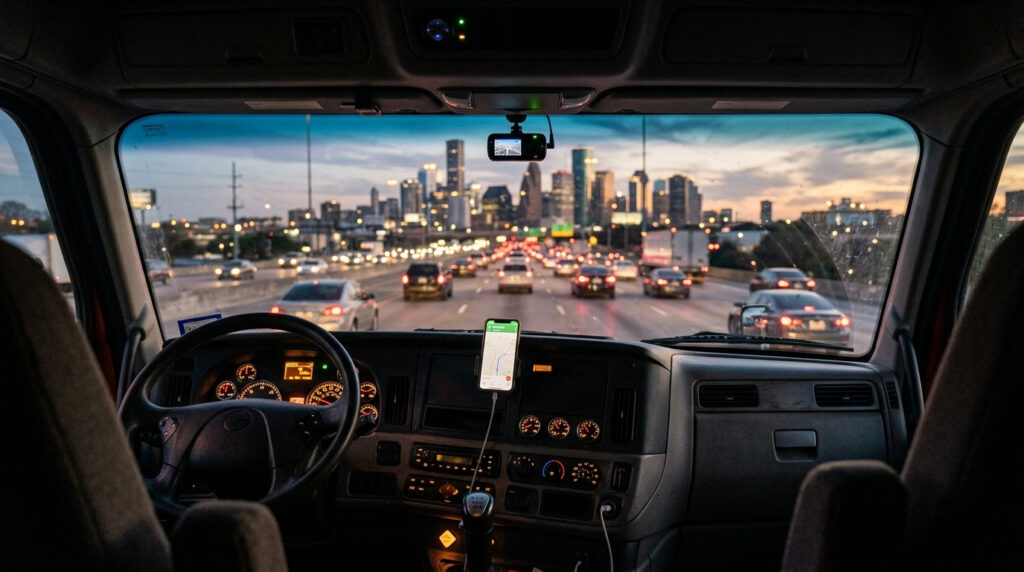
By matching several independent records to the minute of the crash: the driver’s phone and carrier records, any camera in or facing out of the cab, the truck’s monitoring alerts, the carrier’s dispatch messages, and witnesses. No single record usually settles it; the match between them does.
A Texas example shows how. ABC13 reported on 7 March 2025 that a lawsuit over a May 2024 Bell County crash, in which an 18-wheeler hit a stopped SUV on I-35 and killed a Tomball woman, had been amended with phone and camera evidence. As described, phone records showed the driver took a screenshot at 4:44 a.m., a minute before the crash; a download found a call on his Apple Watch and screenshots from a Facebook dating app; and dashcam video appeared to show him looking away. The trucking company denied the allegations. These are claims in a lawsuit, not findings, but they show the record types lawyers look for; ABC13’s report has the details.
| Record | What it can show | Who holds it |
|---|---|---|
| Phone billing and usage records | Calls, texts and data sessions with times, set against the time of impact | The phone company, and the employer if the phone was company-issued |
| The phone and any connected watch | Screenshots, app activity and messages that billing records do not capture | The driver or the carrier |
| Dashcam or in-cab video | Where the driver’s eyes and hands were in the seconds before impact | The carrier or its camera vendor |
| Driver-monitoring alerts | Past flags for eating, looking away or other distraction, with dates | The carrier or its monitoring vendor |
| Dispatch messages and call logs | Whether the company was messaging the driver as the truck moved | The carrier |
| Witnesses and the crash report | What other drivers saw, and what the officer recorded | Witnesses; the Texas Department of Transportation for the report |
The preservation letter is explained in our guide to the records a truck claim depends on, and our piece on expert witnesses covers how recorded data is read. The officer’s report is the usual first document (how to get a Texas crash report); see also why witnesses are important and which crash photos to take.
What do the trucking company’s own records add to the proof?
They can show what the company knew before the crash. Written phone policies, training records, past distraction alerts and any discipline show whether the carrier noticed the behavior, acted on it, or let it continue, which bears on the claim against the company as well as the driver.
ABC13 again shows what to ask for, with the same caution that these are allegations. It reported that records the defense provided showed the driver had been counseled several times for distracted driving, that his truck’s detection system flagged him for eating while driving and steering with an elbow or knee six weeks before the crash, and that he was documented taking his attention off the road for five seconds three weeks before it. The company denied all allegations.
Records like these speak to what the company did with warnings, a legal question about its share of responsibility; the insurance behind an 18-wheeler and the settlement process for truck cases are part of why it matters, and what a truck accident lawyer does on a claim shows where this proof fits.
Does Texas law add anything to the federal rules?
Yes. Section 545.4251 of the Texas Transportation Code makes it an offense for any driver of a moving vehicle to read, write or send a text-style message on a portable wireless device. A truck driver is covered like everyone else, and the state’s proportionate-responsibility statute then decides how blame is divided.
An officer does not have to see the act: the statute also allows proof by “other evidence.” After a crash that second route is the usual one, and it is where phone records and video do their work. Hands-free use, navigation and the other defenses are listed in our article on the Texas texting ban.
Under Chapter 33 the fact finder assigns each party a percentage of responsibility, and a claimant whose share passes 50 percent takes nothing (§ 33.001). Proof of a phone does not end the fault argument; how defense lawyers use shared fault shows how it is fought.
Can a distracted truck driver lose a commercial driver’s license?
Yes, after repeat convictions. Table 2 of 49 CFR 383.51 lists a conviction for violating a State or local law prohibiting texting, or restricting a hand-held phone, while driving a CMV. A second conviction within three years for any combination of Table 2 offenses, while driving a CMV, brings a 60-day disqualification, and a third or later brings 120 days.
The table covers both offenses as items 9 and 10, alongside excessive speeding, reckless driving, improper lane changes and following too closely. Table 2 sets no disqualification for a first conviction, and the rule works only through convictions. FMCSA adds that violations affect a carrier’s and a driver’s Safety Measurement System results. Compensation stays with the civil claim; for a death, see our wrongful death page.
What should you do if you think a truck driver was on a phone?
Write down what you saw while you remember it, ask people nearby for their names and numbers, note the carrier name and USDOT number on the truck, and speak to an attorney before the company’s records change. Do not accuse the driver at the scene or online.
The first steps after a truck crash are in a five-point checklist, and early missteps with the carrier’s adjuster in five things to avoid. A carrier’s records can change quickly, so describe the crash through the contact page early; the 18-wheeler accident page and personal injury overview describe the cases we handle.
Frequently asked questions
What year did the FMCSA ban truck drivers from texting while driving?
The eCFR history for 49 CFR 392.80 cites the texting rule at 75 Federal Register 59136, dated 27 September 2010, and the hand-held phone rule in section 392.82 at 76 Federal Register 75487, dated 2 December 2011. Both remain in the current regulations.
Can a truck driver use a hands-free phone?
Yes, within limits. FMCSA says commercial drivers may operate a hands-free phone within close reach, using an earpiece or speaker, voice activation, or a single-button touch to start, answer or end a call. Holding the phone or pressing more than one button is what the rule prohibits.
Do phone violations hurt a trucking company’s safety record?
FMCSA says they affect the Safety Measurement System results of a motor carrier or driver, and that texting and hand-held calling carry the maximum violation severity weighting there. The statement is on its distracted-driving page, last updated 30 December 2013.
Does a phone ticket prove the truck driver caused my crash?
No. A citation or conviction is something a lawyer will look at, but a civil claim is decided on the facts of the crash, and fault is divided among the people involved under Texas law. The evidence matters more than the ticket.
Can I get the truck driver’s phone records myself?
Not directly. The records belong to the phone company and the driver, and an injured person normally obtains them through a written preservation demand to the carrier and, if a suit is filed, through discovery requests handled by the attorney.
About the authors

Sam A. Maida, Jr.
Owner and Managing Attorney
Sam A. Maida, Jr. has represented injured Texans in the greater Houston area since the firm opened in 1993.
State Bar of TexasAvvoMartindale-HubbellLawLinkThatCarHitMeLinkedIn

Bernard G. Johnson III
Litigation Managing Attorney
Bernard G. Johnson III is a board certified trial lawyer licensed in Texas since 1996 and a graduate of South Texas College of Law.