A motorcycle crash in Bellaire is decided by the same Texas rules as a crash anywhere else, but the city’s layout shapes how it happens. Loop 610 splits Bellaire, only four streets cross it, and Bissonnet cuts across the street grid at a diagonal. This article covers those local facts, then the helmet and lane rules in short form and how fault is divided.
The short version
- Loop 610 limits the crossings. Bellaire’s 2015 comprehensive plan says residents and everyone passing through have four ways across the West Loop: Fournace, Bissonnet, Bellaire Boulevard and Evergreen.
- Bissonnet’s diagonal affects sight lines. The same plan says the angle can make turning movements more challenging for drivers, which matters to a rider facing a left turn.
- Lane splitting is not legal. Since September 1, 2023, a motorcycle may not be operated between lanes of traffic moving the same way (Transportation Code § 545.0605).
- Helmets have an exception. A rider 21 or older who completed an approved course or has qualifying health insurance falls outside the offense (§ 661.003(c)).
- The deadline is two years for most personal injury suits (Civil Practice and Remedies Code § 16.003), and TxDOT counted 585 motorcyclists killed in Texas in 2024.
What makes Bellaire’s roads different for a motorcycle rider?
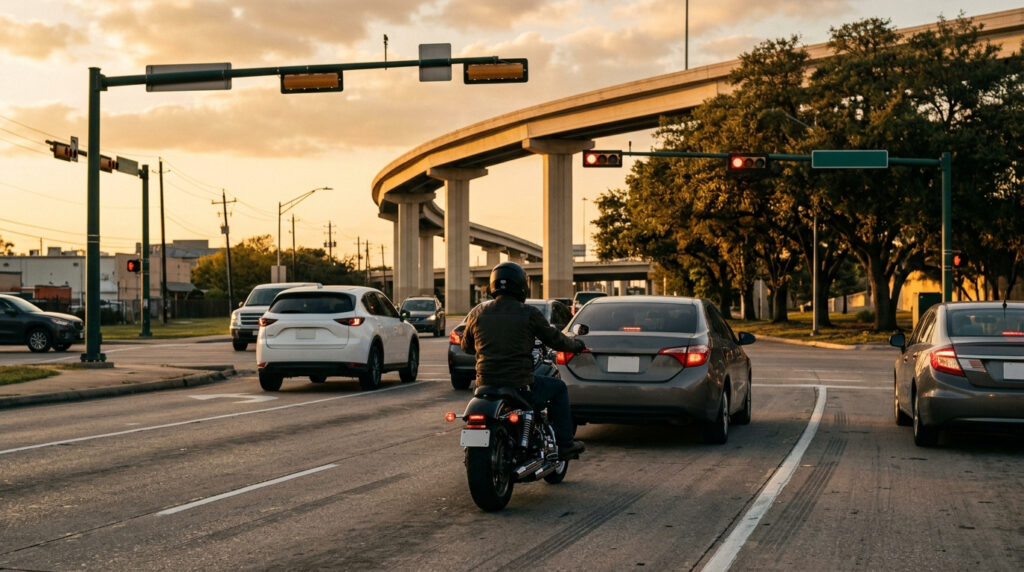
Bellaire is a small residential city cut in two by Loop 610, with only four crossings of the freeway corridor, a diagonal street (Bissonnet) that creates unusual intersection angles, and arterial streets such as Bellaire Boulevard carrying through traffic. A rider here meets freeway-speed traffic and neighborhood streets within a few blocks.
The city’s own planning document supplies the details. Bellaire’s comprehensive plan, in the mobility chapter adopted on September 21, 2015, says the freeway corridor built through the city in the 1960s disrupted the street grid and limited east-west movement, so that crossings of the West Loop are limited to Fournace, Bissonnet, Bellaire and Evergreen ( City of Bellaire comprehensive plan, Chapter 3, Mobility). It lists Bellaire Boulevard and Bissonnet Street among the city’s primary arterials, meaning major thoroughfares designed mainly for through traffic, and it reports more than 200,000 vehicles a day on West Loop 610 in 2013 TxDOT data. The city describes itself as a residential community of just over 17,000 residents, founded in 1908, minutes southwest of downtown Houston and the Galleria ( City of Bellaire, About Bellaire, read October 16, 2026).
The firm serves Bellaire riders from its single office in southwest Houston; there is no Bellaire office. For how the firm approaches these claims, see the Houston motorcycle accident page.
How do Bissonnet and the Loop 610 service roads affect a left-turn or merge claim?
They affect the facts, not the rules. The city’s plan says Bissonnet’s diagonal path can reduce sight distances and make turns harder, and that the West Loop service road is congested at rush hour. Those conditions are evidence about what a driver could see and when, which is what a right-of-way dispute turns on.
The plan’s wording is specific. It says the angle where Bissonnet meets other streets “affects sight distances for drivers at many locations, which can make turning movements more challenging,” and it names the intersection of Bissonnet and Bellaire Boulevard in City Center as a large, busy crossing. It also records residents’ concern about the southbound West Loop service road approaching Fournace, where drivers leaving the freeway cross several lanes in a short distance while others work toward the U-turn lane. Those are the movements that put cars in a motorcycle’s path.
The planning document was adopted in 2015 and it is a description of conditions and resident concerns, not a crash study. It does not say how many motorcycle crashes occurred anywhere in Bellaire, and we found no city-level motorcycle crash count to cite. What it gives a rider’s lawyer is a reason to measure sight lines and lane layout at the exact spot of a crash, rather than assume a driver “should have seen.” The left-turn and driveway rules themselves are explained in our companion article on proving a car driver’s fault after a motorcycle crash, and a look at side-impact intersection crashes shows how the same questions arise between two cars.
Who investigates a motorcycle crash in or near Bellaire?
Texas law tells a driver in an injury crash to notify the police department of the city where it happened, so a crash within Bellaire’s limits goes to Bellaire police. A crash just across the boundary can belong to another agency, which is why the first step is to learn where the crash was officially placed.
Section 550.026(a) of the Transportation Code names the city police for a crash inside city limits and lets the driver choose between the city police and the sheriff’s office for one up to 100 feet outside them. Our companion article on Bellaire car accidents gives the Bellaire Police Department’s address and phone numbers, the municipal court and the report steps, so they are not repeated here; getting a copy of the crash report works the same way for a motorcycle.
A Bellaire-area example shows how agencies overlap. ABC13 reported on July 13, 2016 that a Bellaire police motorcycle officer died after losing control of his motorcycle on Ferris Street near Beechnut in southwest Houston while chasing a vehicle, and attributed the account of the chase to Houston police ( ABC13, July 13, 2016). The story is not about an injury claim, but it shows a practical point: the agency that investigates follows where the crash happens, and ABC13 says HPD assisted because the crash was within Houston city limits.
Is lane splitting legal in Texas?
No. Since September 1, 2023, a motorcycle operator may not ride between lanes of traffic moving in the same direction or pass a vehicle inside that vehicle’s own lane. The same section gives a motorcycle the full use of its lane, and a motor vehicle may not deprive it of that use.
The rule is Transportation Code § 545.0605, added by House Bill 4122 and effective September 1, 2023 ( Texas Transportation Code, Chapter 545). It also lets two motorcycles ride side by side in one lane but not more than two, and the restrictions do not apply to a police officer performing official duties. On Bellaire’s multi-lane streets and the Loop 610 corridor, that means a rider who rides between lanes of traffic moving the same way is outside what the statute allows, and an insurer may raise it. It does not erase the other driver’s duties: a car that moves into a rider’s lane is still measured against the full-use rule. Our Houston motorcycle rights article works through the lane and helmet statutes in detail.
| Question | Rule in short | Section |
|---|---|---|
| Does a motorcycle get a whole lane? | Yes; a motor vehicle may not be driven so as to take that use away | Transp. Code § 545.0605(a)(1) |
| May two motorcycles share a lane? | Two abreast, no more | § 545.0605(a)(2), (a)(3)(A) |
| May a rider ride between lanes of same-direction traffic? | No | § 545.0605(a)(3)(B) |
| May a rider pass a vehicle within that vehicle’s lane? | No | § 545.0605(a)(3)(C) |
| Is a helmet required? | Yes, unless the rider is 21 or older and has completed the approved course or has a qualifying health plan | § 661.003(a)-(c) |
| Can an officer stop a rider just to check the exception? | No | § 661.003(c-1) |
Sources: Transportation Code, Chapter 661 and Chapter 545 (above), statute text read October 16, 2026; the table condenses it.
How is fault divided when a rider and a driver both contributed?
Texas gives each person involved a percentage of responsibility. Someone over the 50 percent line gets no damages; someone at or under it has the award cut by their own share. The percentages are argued from evidence about speed, lane position and what each driver did.
The governing provisions are §§ 33.001 and 33.012(a) in the state’s proportionate-responsibility chapter ( Chapter 33). In a Bellaire crash an insurer may raise speed, lane splitting or a missing helmet; the evidence on the other side includes the report, witness statements, scene photographs and the vehicles’ damage. Our article on answering comparative negligence in Texas explains the method. If a head injury is involved, the long-term picture is addressed in what a head injury can mean for a claim’s value.
Where the other driver has too little insurance, the rider’s own uninsured or underinsured motorist coverage may apply; see how UM and UIM claims work. A driver who leaves the scene is covered on the hit-and-run page.
Which Harris County court would hear an injury claim from a Bellaire crash?
Bellaire sits in Harris County, so a lawsuit over a crash there is a civil case in a Harris County court. The county’s civil courts at law state a ceiling of $250,000 on the amount in controversy they may hear. Traffic tickets are a separate track, covered in our Bellaire car accident article.
On its venue page, the Harris County civil courts at law system lists a $250,000 limit on the amount in controversy for matters those courts may hear ( Harris County Civil Courts at Law, read October 16, 2026). Most claims never reach a courtroom, and the length of one that does is addressed in our guide to the timeline of an injury case. Because adjusters often ask early for recorded statements and records, review what to know before speaking to the adjuster and what records to share.
What do TxDOT’s numbers say about motorcycle deaths in Texas?
The Texas Department of Transportation counted 585 motorcyclists, operators and passengers, killed in 2024, and 37 percent of those killed were not wearing helmets. These are statewide totals; Bellaire is not broken out, and fault is not part of the count.
The figures come from TxDOT’s crash facts for calendar year 2024 ( TxDOT, Texas Motor Vehicle Traffic Crash Facts, 2024). For a local view of where Houston-area crashes cluster, see our review of Houston’s riskiest streets, and for the patterns insurers raise, the piece on common causes of motorcycle accidents. Distracted drivers are one of those causes; see distracted driving in Houston.
Leave the bike unrepaired until the damage and the road have been photographed, and keep the helmet and gear as they are. A Bellaire-area crash can be described through the contact page. The personal injury overview and car accident page list related claims.
Frequently asked questions
Does Texas have a motorcycle helmet law?
Yes, with an exception. Riding or carrying a passenger without approved protective headgear is an offense, but not for a person who is at least 21 and either completed a motorcycle operator training and safety course or has a health insurance plan covering motorcycle collision injuries (Transportation Code § 661.003(a)-(c)).
What is the penalty for riding without a helmet in Texas?
It is a misdemeanor with a fine between $10 and $50 (Transportation Code § 661.003(h)). An officer may not stop a rider only to check whether the helmet exception applies, according to subsection (c-1).
Does a passenger have to wear a helmet?
The same offense covers a passenger, and a rider who carries a passenger without approved headgear commits an offense too (Transportation Code § 661.003(a)-(b)). The exception for someone 21 or older with a training course or a qualifying health plan applies to the person required to wear the headgear (§ 661.003(c)).
Can two motorcycles ride side by side in one lane?
Two may ride abreast in a single lane, but not more than two, and each motorcycle keeps the right to full use of its lane under Transportation Code § 545.0605(a). Separately, subdivision (a)(1) keeps cars from being driven in a way that takes a motorcycle’s lane away from it.
When must a Texas rider file suit after a wreck?
Texas allows two years from accrual for most personal injury suits (§ 16.003(a)), and the statute names exceptions. For a rider who died, the clock runs from the death. Ask an attorney to check the date for your crash.
Can my own policy pay if the driver who hit me is uninsured?
It can. Uninsured and underinsured motorist coverage is built into a Texas auto liability policy, and only a written rejection by the named insured removes it (Insurance Code § 1952.101); your declarations page shows whether you have it and its limit.
About the authors

Sam A. Maida, Jr.
Owner and Managing Attorney
Sam A. Maida, Jr. has represented injured Texans in the greater Houston area since the firm opened in 1993.
State Bar of TexasAvvoMartindale-HubbellLawLinkThatCarHitMeLinkedIn

Bernard G. Johnson III
Litigation Managing Attorney
Bernard G. Johnson III is a board certified trial lawyer licensed in Texas since 1996 and a graduate of South Texas College of Law.