Most motorcycle crashes start with a conflict between a rider and another vehicle, and the federal and Texas records add speed, alcohol, road surface and rider licensing as the other factors they measure. In 2024, NHTSA found another vehicle turning left in 45 percent of two-vehicle fatal crashes involving a motorcycle. Each cause leaves a different kind of proof.
The short version
- Another vehicle is in most of the worst crashes. TxDOT says more than half of fatal motorcycle crashes in Texas are collisions with other vehicles, often because the driver did not see the rider or misjudged the distance.
- Speed and alcohol are counted separately. In NHTSA’s 2024 data, 37 percent of riders in fatal crashes were speeding and 26 percent of riders killed had a blood alcohol concentration of .08 or higher.
- A missing license is a status, not a finding of cause. NHTSA counted 35 percent of riders in fatal crashes in 2024 as riding without a valid motorcycle license; its fact sheet does not say the license caused the crash.
- The road can be the cause. TxDOT’s design manual says metal covers and pavement markings can grip less than the road around them, and a public body is entitled to notice of the claim within six months unless it already has actual notice.
- Several causes can share the blame. A rider or driver found more than half responsible gets nothing; at or below that line the damages shrink by the same share.
Which crash pattern do the national and Texas records show most often?
A conflict with another vehicle. NHTSA’s 2024 fatal-crash data shows that in 45 percent of the 3,396 two-vehicle fatal crashes involving a motorcycle, the other vehicle was turning left while the motorcycle went straight, passed or overtook. TxDOT says more than half of fatal motorcycle crashes are collisions with other vehicles.
The federal figures come from NHTSA’s Motorcycles: 2024 Data fact sheet (DOT HS 813 824, July 2026), which counted 6,228 motorcyclists killed nationwide in 2024. In addition, 24 percent of motorcycles in fatal crashes hit a fixed object, against 16 percent of passenger cars ( NHTSA, Motorcycles: 2024 Data ).
Texas keeps its own count from officers’ reports. TxDOT’s table of vehicles in crashes lists 9,160 motorcycles in reportable crashes in 2024, 598 of them in fatal crashes and 370 of those 598 in urban areas, based on reports received as of April 9, 2025 ( TxDOT, Count of Vehicles in Crashes by Body Style, 2024 ).
The right-of-way sections behind left-turn crashes are covered in our article on proof and insurance after a car hits a motorcycle, and the rider’s side, with helmets, lane rules and insurer assumptions, in a rider’s legal rights after a Houston crash. This article asks what causes these crashes and what each cause means for the proof. Our Houston motorcycle accident page shows how a claim begins, and Houston’s worst intersections are mapped separately.
Why do other drivers fail to see motorcycles?
A motorcycle is a small target that is easy to misjudge. TxDOT says drivers often do not see the motorcycle or misjudge its distance and speed, and that its small size can make it look farther away than it is. The failure is usually one of attention, so the other driver’s conduct becomes the proof.
TxDOT’s “Share the Road: Look Twice for Motorcycles” page reports 557 riders killed in Texas in 2025. Its advice reads like a list of causes: take extra care on a left turn, check mirrors and blind spots before changing lanes, and do not tailgate, because a motorcycle can slow by downshifting without lighting its brake lamp ( TxDOT, Motorcycle Safety Campaign – Share the Road ).
The Transportation Code has a rule for each habit. A driver must stay “as nearly as practical entirely within a single lane” and may not leave it “unless that movement can be made safely” (§ 545.060(a)); a following driver must keep an “assured clear distance” so that he “can safely stop” (§ 545.062(a)); and texting behind the wheel is an offense unless the vehicle is stopped, subject to listed defenses (§ 545.4251(b)) ( Transportation Code ch. 545 ).
“I never saw him” describes a lapse in attention, not a defense, and it is proved from outside the car: the officer’s report, a witness who saw the driver glance down or drift over a line, and video from a doorbell, a business or the other car. See our pages on distracted driving cases and why texting is only one kind of distraction, and why independent witnesses matter most in the first days.
How often is speed behind a motorcycle crash?
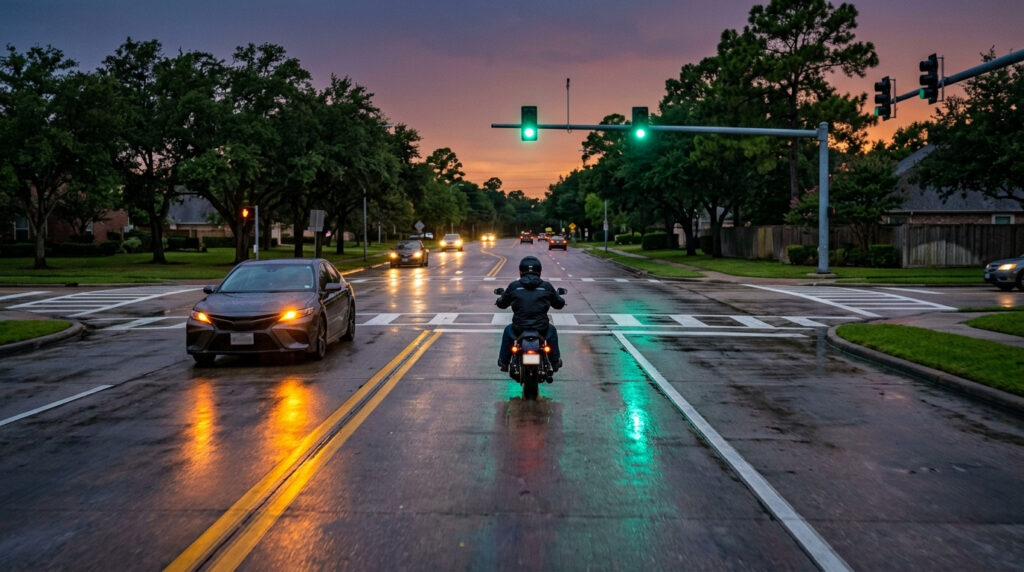
NHTSA reports that 37 percent of motorcycle riders in fatal crashes in 2024 were speeding, against 22 percent of passenger-car drivers. Its definition includes a speeding charge or an officer’s note of racing, driving too fast for conditions or exceeding the limit. Texas law asks whether the speed was reasonable and prudent, not only whether it was over the limit.
Transportation Code § 545.351 bars driving faster than is reasonable for the conditions and the hazards, and § 545.352(a) treats a speed above the listed limits as “prima facie evidence” that it is unlawful.
On August 16, 2026, FOX 26 Houston reported that a 21-year-old rider died around 1 a.m. in the 6900 block of Memorial Drive after losing control during an attempted high-speed run through a Memorial Park tunnel; statements from coworkers at the scene indicated alcohol may have been a factor, and the crash was under investigation ( FOX 26 Houston, August 16, 2026 ).
Speed is rarely admitted, so it is reconstructed from skid marks, damage, timestamped video and any data a vehicle stores. An engineer often does that work, as our article on expert witnesses explains, and reckless driving crashes raise the same questions.
How much does alcohol contribute to motorcycle crashes?
NHTSA counted 1,529 riders killed in 2024 with a blood alcohol concentration of .08 or higher, 26 percent of the 5,950 riders who died. The share was 40 percent in single-vehicle crashes and 18 percent in multivehicle crashes. Alcohol can belong to the rider, the other driver, or both.
Riders killed at night were 2.6 times as often alcohol-impaired as those killed in daylight, 37 percent against 14 percent, and in fatal crashes 25 percent of motorcycle riders and 25 percent of passenger-car drivers were impaired, the highest of any vehicle type ( NHTSA, Motorcycles: 2024 Data ).
Driving while intoxicated is an offense under Penal Code § 49.04(a). The criminal case and a civil claim are separate, but the arrest report, the breath or blood result and the officer’s observations are where both begin. The driver’s side is covered on our page for victims of drunk drivers and in our article on Texas DWI statistics.
A bar or restaurant can also be responsible. Alcoholic Beverage Code § 2.02(b) allows a claim against a provider on proof that it was apparent to the provider that the person served was “obviously intoxicated” and a clear danger, and that the intoxication was a proximate cause ( Alcoholic Beverage Code ch. 2 ). Receipts, tabs and witnesses are the proof; the dram shop page explains the claim.
Does a missing license or lack of experience cause crashes?
NHTSA reports that 35 percent of motorcycle riders in fatal crashes in 2024 had no valid motorcycle license, against 14 percent of passenger-vehicle drivers. The number records license status at the time of the crash; the fact sheet does not say the missing license caused it. In a claim, the question is still how each person drove.
Texas assigns fault by percentage to each person whose negligence, or other conduct that violates a legal standard, contributed (Civil Practice and Remedies Code § 33.003(a)). Whether a licensing violation counts is a question for an attorney, and an insurer pointing to license status has not yet pointed to a cause. Our article on tactics insurers use after a crash shows how the point gets used.
Which road conditions make a rider lose control?
TxDOT’s Roadway Design Manual says utility covers, pavement markings and surface treatments can have lower skid resistance than the road around them, and a rider can lose control where a cover or marking lies in the line used for braking or turning. NHTSA found 97 percent of rider deaths in 2024 happened in clear or cloudy weather.
The manual’s Chapter 20, written for engineers, says motorcyclists “are vulnerable to skidding on metal covers,” that the worst spots are where a cover lies in the riding line “in areas where a motorcyclist is likely to brake, turn, accelerate and/or change lanes,” and that layered markings can destabilize riders “particularly if this results in standing water” ( TxDOT Roadway Design Manual, section 20.2 ). NHTSA’s numbers point the other way on weather: 2 percent of rider deaths in 2024 came in rain.
A claim over a public road defect meets the Texas Tort Claims Act. The limit on a government’s duty for premise defects does not reach the duty to warn of special defects, such as excavations or obstructions on roads (§ 101.022(b)), and the unit is entitled to notice of the claim not later than six months after the incident, unless it has actual notice of the injury (§ 101.101(a), (c)) ( Civil Practice and Remedies Code ch. 101 ). Photographs of the surface before it is repaired, and the exact location, are the evidence; see the shots worth taking after a crash and, for one city’s layout, our Bellaire article for riders.
Can a defect in the motorcycle cause a crash?
Yes, and it changes who may be responsible. In a design-defect claim, Civil Practice and Remedies Code § 82.005(a) makes the claimant prove two things: a safer alternative design existed, and the defect was a producing cause of the harm. The motorcycle itself becomes the key evidence.
The tables used here do not break out equipment failure, so it gets no percentage. Chapter 82 does reach beyond the brand on the tank: its definition of manufacturer includes a designer or assembler of a component part who puts it into the stream of commerce (§ 82.001(4)) ( Civil Practice and Remedies Code ch. 82 ). That is why a motorcycle should not be repaired, sold or salvaged before someone qualified has looked at it: a tire, brake or fork replaced by a shop is evidence gone. See our defective product page and the article on when the vehicle itself is to blame.
What evidence proves each cause of a motorcycle crash?
Each cause leaves its own record. A turn or lane change is proved by the report, witnesses and video; speed by marks, damage and timestamps; alcohol by test results and service records; a road hazard by photographs and notice; a defect by the motorcycle itself. The table matches each cause to its rule and proof.
| Cause | What the sources report | Texas rule | Proof that fits |
|---|---|---|---|
| Another vehicle turns or changes lanes into the rider | 45% of 3,396 two-vehicle fatal crashes had a left-turning vehicle (NHTSA, 2024) | Transp. Code §§ 545.060(a), 545.152 | Crash report, witnesses, video, the other driver’s phone use |
| Speed | 37% of riders in fatal crashes were speeding (NHTSA, 2024) | Transp. Code §§ 545.351, 545.352 | Skid marks, damage, timestamped video, stored vehicle data |
| Alcohol | 26% of riders killed had a BAC of .08 or higher (NHTSA, 2024) | Penal Code § 49.04(a); Alc. Bev. Code § 2.02(b) | Breath or blood test, arrest report, receipts |
| License status | 35% of riders in fatal crashes had no valid motorcycle license (NHTSA, 2024) | Status only; fault is set under Civ. Prac. & Rem. Code § 33.003 | License record, kept apart from proof of how the crash happened |
| Road surface | No crash count in these sources; TxDOT’s manual gives none | Civ. Prac. & Rem. Code §§ 101.022(b), 101.101(a) | Photographs before repair, exact location, notice within six months (or actual notice) |
| Equipment defect | No figure in these sources | Civ. Prac. & Rem. Code § 82.005(a) | The unrepaired motorcycle, maintenance and recall records |
Figures: NHTSA, DOT HS 813 824, read October 16, 2026.
The officer’s crash report shows how the responding officer recorded the contributing factors, and Transportation Code § 550.023 obliges each operator in an injury crash to share identity, registration and insurer details. If the other driver drives off, start with our hit-and-run page.
How does Texas divide fault when several causes combine?
A fact-finder gives each person a percentage of the blame (Civil Practice and Remedies Code § 33.003). Above 50 percent, a claimant is barred (§ 33.001); at 50 percent or below, the award is cut by the claimant’s own share (§ 33.012(a)).
A rider a little over the limit when a car turned left has a share to defend; a driver who was texting and then blames the rider’s speed has a share to defend too. The evidence in the table does two jobs, proving the other side’s share and holding down your own. The arithmetic is worked through in our comparative negligence explainer, and what a Houston crash claim is worth shows how a percentage moves the number.
The steps are the same whichever cause is suspected. Get medical care, leave the motorcycle and damaged gear as they are, save the crash report number, and be careful with the other side’s insurer, as this piece on adjusters explains. The post-crash checklist fits a motorcycle too, and a rider’s family has options on our wrongful death page.
If the rider’s injuries were severe, the way those are documented is covered in compensation after a traumatic brain injury, and a driver who fled falls under the Houston hit-and-run article. The car accident page and the personal injury overview place a motorcycle claim among the other crash claims, and the contact page takes a rider’s questions about the cause of a particular crash.
Frequently asked questions
What are common causes of motorcycle accidents?
The ones the 2024 federal and Texas records measure most directly are another vehicle turning or changing lanes into the rider, speed, alcohol, and a rider without a valid license. Road hazards and equipment defects also cause crashes, but these sources give no percentage for them.
Why do most motorcycle accidents happen?
TxDOT says more than half of fatal motorcycle crashes in Texas are collisions with other vehicles, because drivers often do not see the motorcycle or misjudge its distance and speed. The 2024 federal data agrees: the other vehicle was turning left in 45 percent of two-vehicle fatal crashes.
What are the three main causes of motorcycle accidents?
By NHTSA’s 2024 figures, the three it measures most directly are another vehicle turning left across the rider (45 percent of two-vehicle fatal crashes), speed (37 percent of riders in fatal crashes) and alcohol (26 percent of riders killed). The bases differ, so the percentages cannot be added or ranked.
Does bad weather cause many motorcycle crashes?
Not in the fatal-crash data. NHTSA reports that 97 percent of motorcyclist deaths in 2024 happened in clear or cloudy weather and 2 percent in rain. Wet pavement can still reduce grip where a rider must brake or turn.
What should I keep if a motorcycle crash looks like the rider’s fault?
Keep photographs of both vehicles and the scene, the crash report number, witness names, any video, and your medical records. Operators in an injury crash must share their identity and insurer details under Transportation Code § 550.023, so write those down too.
About the authors
Sam A. Maida, Jr.
Owner and Managing Attorney
Sam A. Maida, Jr. has represented injured Texans in the greater Houston area since the firm opened in 1993.
State Bar of TexasAvvoMartindale-HubbellLawLinkThatCarHitMeLinkedIn

Bernard G. Johnson III
Litigation Managing Attorney
Bernard G. Johnson III is a board certified trial lawyer licensed in Texas since 1996 and a graduate of South Texas College of Law.