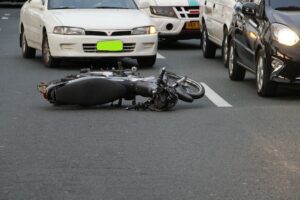
A rider hit by a car in Texas has the same claim as any other injured road user: the driver’s liability insurance pays if the driver was at fault, reduced by any share of responsibility placed on the rider, and nothing is recoverable if the rider’s share is greater than 50 percent (Tex. Civ. Prac. & Rem. Code § 33.001). The suit has to be filed within two years.
What is different is the injury and the argument. There were 585 motorcyclists killed in Texas in 2024 (Texas Department of Transportation crash facts for 2024), and a rider’s claim is often met with the suggestion that riding is itself careless. This article covers the traffic rules that decide fault, the insurance that pays and what can be claimed. The firm’s main page on the subject is the Houston motorcycle accident page.
The short version
- Fault follows the traffic rules: left turns (§ 545.152), following distance (§ 545.062), passing (§ 545.053) and a motorcycle’s right to a full lane (§ 545.0605).
- The driver’s insurance pays first; the Texas minimum is $30,000 per injured person.
- Your own policy carries uninsured/underinsured motorist coverage and personal injury protection unless you rejected them in writing (§§ 1952.101, 1952.152).
- Medical expenses are recoverable in the amount actually paid or incurred (§ 41.0105).
- Two years to file suit (§ 16.003(a)).
How do I prove the driver was at fault for hitting my motorcycle?
By showing which traffic rule the driver broke and that breaking it caused the crash. Most car-motorcycle collisions come down to a handful of rules: yielding on a left turn, keeping a safe following distance, passing at a safe distance, and leaving the motorcycle the full use of its lane.
| What the driver did | The rule | Section |
|---|---|---|
| Turned left across the rider’s path | A driver turning left yields to a vehicle approaching from the opposite direction that is in the intersection or close enough to be an immediate hazard | § 545.152 |
| Hit the motorcycle from behind | A driver following another vehicle keeps an assured clear distance so that the driver can safely stop without colliding with the vehicle ahead | § 545.062(a) |
| Moved into the rider’s lane | A motor vehicle may not be driven in a manner that deprives a motorcycle of the full use of a lane | § 545.0605(a)(1) |
| Passed too close | A driver passing another vehicle passes to the left at a safe distance and may not move back until safely clear | § 545.053(a) |
| Pulled out of a driveway or side street | A driver entering a highway from a private road or driveway yields to a vehicle approaching on the highway | § 545.155 |
| Drove too fast for conditions | A driver may not drive faster than is reasonable and prudent under the circumstances | § 545.351(a) |
Source: Texas Transportation Code, Chapter 545. Read October 5, 2026.
Which insurance pays a rider’s medical bills?
The at-fault driver’s liability insurance is responsible for the rider’s damages, but it pays at the end of the claim, not as bills arrive. In the meantime a rider’s own health insurance, and any personal injury protection or medical payments coverage on the rider’s policy, pay first.
Texas requires drivers to carry at least $30,000 for each injured person, up to $60,000 per crash, and $25,000 for property damage (Texas Department of Insurance auto insurance guide). A serious motorcycle injury can exceed that in the first day of hospital care. When it does, the rider’s own uninsured/underinsured motorist coverage is the next source: by law it must be provided with an auto liability policy unless a named insured rejected it in writing (Tex. Ins. Code § 1952.101(b)-(c)), and underinsured coverage pays what the insured is legally entitled to recover, up to the policy limit, reduced by what the at-fault driver’s insurer pays (Tex. Ins. Code § 1952.106).
Personal injury protection works the same way: it comes with the policy unless rejected in writing (Tex. Ins. Code § 1952.152). Read the declarations page of the motorcycle policy and of any car policy in the household.
What can a rider claim after a motorcycle accident?
Economic damages, meaning actual economic loss such as medical expenses, lost earnings and the damaged motorcycle and gear, and noneconomic damages such as physical pain and suffering, mental anguish, disfigurement and physical impairment. Medical expenses are limited to the amount actually paid or incurred by or for the rider.
The categories are defined in § 41.001(4) and (12); the limit on medical expenses is Tex. Civ. Prac. & Rem. Code § 41.0105. Proving the amount of a medical bill is usually done by affidavit: an affidavit that a charge was reasonable and the service necessary is sufficient evidence of that unless the other side serves a counter-affidavit, although it does not prove that the crash caused the need for treatment (Tex. Civ. Prac. & Rem. Code § 18.001(b)).
Road rash, fractures and head injuries often need treatment for months, so the full cost is not known early. Settling before treatment is finished or a doctor has described what future care will be needed risks leaving that future cost uncovered.
Will not wearing a helmet hurt my claim?
It does not change who caused the crash. Texas requires a helmet unless the rider is at least 21 and has completed a training course or has qualifying health insurance, and insurers often raise the absence of a helmet when a rider has a head injury. How that evidence is treated is a question for an attorney.
The helmet statute is Tex. Transp. Code § 661.003. Of the motorcyclists killed in Texas in 2024, 37 percent were not wearing helmets at the time of the crash, according to the state’s crash facts. Our article on a motorcycle accident in Bellaire sets out the helmet exception and the 2023 lane rules in detail, and a rider’s rights after a Houston crash addresses the bias riders meet.
How long do I have to file a motorcycle accident claim in Texas?
Two years. A suit for personal injury must be brought not later than two years after the day the cause of action accrues, which for a crash is ordinarily the day of the crash. If the rider died, the family’s suit must be brought within two years of the death.
Both periods are in § 16.003(a)-(b). A wrongful death action is for the benefit of the surviving spouse, children and parents (Tex. Civ. Prac. & Rem. Code § 71.004(a)). An insurance claim can be open for months without any suit being filed, and the deadline keeps running while it is.
Questions riders ask after a crash with a car
What should I do at the scene of a motorcycle accident?
Get out of traffic if you can and call 911. Texas requires each driver to stop, to give a name, address, registration number and liability insurer, and to give reasonable help to anyone injured (Transportation Code §§ 550.021, 550.023). Photograph the vehicles, the road and your gear, get witnesses’ details, and be examined the same day even if you feel able to ride home.
The driver said they did not see me. Does that matter?
It is an explanation, not an excuse. A driver turning left must yield to an approaching vehicle that is an immediate hazard (Transportation Code § 545.152), and every driver must keep a speed that allows the driver to avoid colliding with another vehicle lawfully on the highway (§ 545.351(b)).
Can I recover if I was speeding when the car turned in front of me?
Possibly. Responsibility is divided by percentage. If your share is 50 percent or less, your damages are reduced by that share; if it is greater than 50 percent, you may not recover (Civil Practice and Remedies Code §§ 33.001, 33.012(a)).
Does my passenger have a claim?
A passenger injured in the crash can claim against any driver whose negligence caused it, which can include the operator of the motorcycle as well as the driver of the car. Each is assigned a percentage of responsibility under Civil Practice and Remedies Code § 33.003.
What does underinsured motorist coverage pay?
It pays the amounts the insured is legally entitled to recover as damages from the owner or operator of an underinsured vehicle because of bodily injury or property damage, not to exceed the policy limit, reduced by the amount recovered or recoverable from the insurer of the underinsured vehicle (Insurance Code § 1952.106).
To talk about a motorcycle crash, call Maida Law Firm at (713) 785-9484 or write to the firm through the contact page. The office is at 8313 Southwest Freeway #102, Houston, TX 77074.
Sources
- Texas Civil Practice and Remedies Code, Chapter 33. Read October 5, 2026.
- Texas Department of Transportation, Texas Motor Vehicle Traffic Crash Facts, Calendar Year 2024 (reports received as of April 9, 2025). Read October 5, 2026.
- Texas Transportation Code, Chapter 545. Read October 5, 2026.
- Texas Department of Insurance, Auto insurance guide (updated December 11, 2025). Read October 5, 2026.
- Texas Insurance Code, Chapter 1952. Read October 5, 2026.
- Texas Civil Practice and Remedies Code, Chapter 41. Read October 5, 2026.
- Texas Civil Practice and Remedies Code, Chapter 18. Read October 5, 2026.
- Texas Transportation Code, Chapter 661. Read October 5, 2026.
- Texas Civil Practice and Remedies Code, Chapter 16. Read October 5, 2026.
- Texas Civil Practice and Remedies Code, Chapter 71. Read October 5, 2026.
About the authors
Sam A. Maida, Jr.
Owner and Managing Attorney
Sam A. Maida, Jr. has represented injured Texans in the greater Houston area since the firm opened in 1993.
State Bar of TexasAvvoMartindale-HubbellLawLinkThatCarHitMeLinkedIn

Bernard G. Johnson III
Litigation Managing Attorney
Bernard G. Johnson III is a board certified trial lawyer licensed in Texas since 1996 and a graduate of South Texas College of Law.