The short version
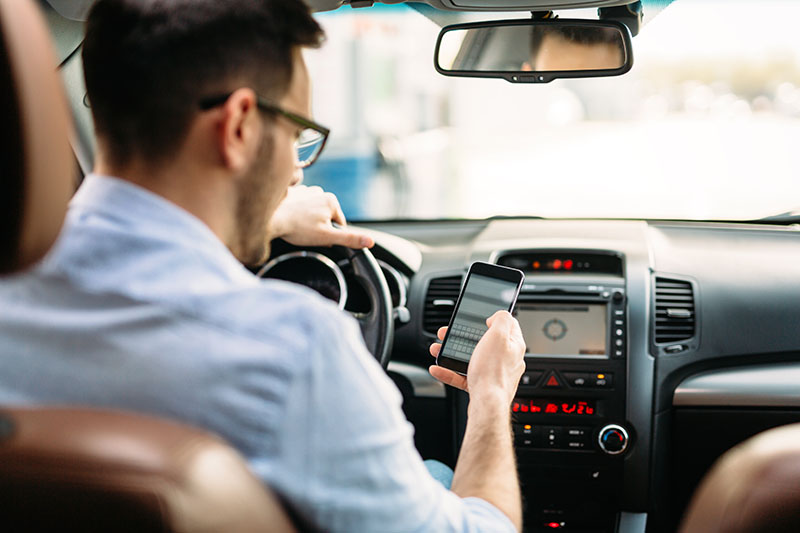
- This is the one form of distraction Texas legislated against. An operator commits an offence if they use a portable wireless communication device to read, write, or send an electronic message while operating a motor vehicle (§ 545.4251(b)).
- An "electronic message" means data read from or entered into a wireless device for the purpose of communicating with another person (§ 545.4251(a)(1)).
- That definition is narrower than "using a phone". Texas has no general handheld ban, so a driver scrolling a map or a playlist may fall outside the offence while still being negligent.
- The case is won on records, not the statute: carrier logs, handset activity, and the vehicle's event data recorder showing no braking.
- ⚠ Handsets are replaced, cloud data is deleted and vehicles are repaired. A preservation demand in the first week is the case.
Houston distracted driving claims: key facts
| Fact | Answer |
|---|---|
| Law firm | Maida Law Firm — Houston personal-injury firm |
| Practice on this page | Houston Distracted Driving Claims |
| Area served | Houston and the surrounding communities listed under Areas We Serve |
| Office | 8313 Southwest Fwy Ste 102, Houston, TX 77074 · (713) 785-9484 |
| Author | Sam A. Maida, Jr. — Texas Bar No. 00787950 |
| Reviewer | Bernard G. Johnson III — Texas Bar No. 00796832 |
| Consultation and fee | Free Consultation; Contingency Fee — no attorney’s fee unless there is a recovery |
| Google rating | 4.9 stars from 365 reviews (Google, 21 September 2026) |
| Deadline to file | Two years from the day the cause of action accrues — Tex. Civ. Prac. & Rem. Code § 16.003(a) |
What the messaging ban does and does not reach
| Conduct | Within the messaging offence? | Note |
|---|---|---|
| Reading, writing or sending a text or message | Yes — this is the conduct the section names | § 545.4251(b) |
| Email or messaging apps | Yes, where it is data read from or entered into the device to communicate with another person | § 545.4251(a)(1) |
| Holding a phone to a call | Not within the messaging offence | Texas has no general handheld ban; may still be negligent |
| Scrolling a map or music | Not within the messaging offence | May still be negligent driving |
| Filming or taking photographs | Not within the messaging offence | May still be negligent driving |
| Any of the above causing a crash | Irrelevant to your civil claim which offence applies | Negligence is proved from the driving, not the label |
This is the single most useful distinction on this page: the statute frames the case but almost never proves it. The proof is the records.
Deadlines that can end this claim
| Situation | Deadline | Source |
|---|---|---|
| Most injury lawsuits | Two years from the day the cause of action accrues. | Tex. Civ. Prac. & Rem. Code § 16.003(a) |
| An injury that causes death | Two years, running from the date of death. | Tex. Civ. Prac. & Rem. Code § 16.003(b) |
| A City of Houston, Harris County, METRO or state vehicle | Written notice to the governmental unit not later than six months after the incident, describing the injury, the time and place, and the incident — and a city charter can require it sooner. | Tex. Civ. Prac. & Rem. Code § 101.101 |
| Reporting the crash itself | Immediately, by the quickest means of communication, if anyone was injured or killed or a vehicle cannot be driven normally and safely. | Tex. Transp. Code § 550.026(a) |
| If you were partly at fault | No deadline, but a hard bar: a claimant may not recover if their percentage of responsibility is greater than 50 percent. | Tex. Civ. Prac. & Rem. Code § 33.001 |
Questions people ask after a Houston crash
Tap a question to open it.
How do I prove the other driver was texting?
By assembling records that were created independently of each other and showing they agree. Carrier logs establish the timing of calls and messages. The handset itself holds far more — app activity, screen state, notifications — than the carrier record does. The vehicle's event data recorder captures speed, throttle and braking in the seconds before impact, and an absence of braking is powerful corroboration that the driver never saw what was ahead. Some vehicles log paired-phone activity. Where those sources line up against the crash timestamp, the inference becomes very hard to argue with.
Who can actually obtain those phone records?
Not you, and not directly. Carrier records and handset contents are obtained through legal process in a filed lawsuit, or occasionally by voluntary production during negotiation. That is one of the few situations where filing suit earlier has a concrete evidentiary purpose rather than a tactical one. What you can do immediately is preserve everything on your side and identify the other sources — cameras near the scene, the other vehicle's event data recorder, and any witness who saw the driver looking down before the impact.
What if the driver was on a hands-free call?
Then the messaging offence in § 545.4251(b) is not engaged, because that section is about reading, writing or sending an electronic message. It does not follow that the driver was careful. Cognitive distraction is a recognised phenomenon and the civil question is whether the driver exercised ordinary care in the circumstances, not whether a specific statute was breached. In practice this shifts the proof back onto the driving itself: lane position, closing speed, reaction and braking, which the event data recorder and the physical evidence document.
What if no citation was issued under the texting law?
That is the normal situation and it says very little. A citation under § 545.4251 requires the officer to have observed the conduct or the driver to have admitted it, and in a crash the officer usually arrived afterwards. So the absence of a citation is not evidence the driver was not messaging, and its presence, while helpful, is not conclusive either. Your claim is decided on the balance of the evidence, with responsibility apportioned between everyone involved under § 33.001 regardless of what happened in any traffic court.
When does the electronic evidence start disappearing?
Within weeks, and some of it sooner. Handsets are traded in or replaced. Cloud backups are pruned on retention schedules. Carriers hold message content for shorter periods than most people assume, and metadata for longer than content. Vehicles are repaired and the event data recorder goes with them, or they are salvaged entirely. A preservation demand that names these categories specifically — device, carrier records, vehicle and its recorder, telematics, dashcam — is much harder to satisfy narrowly than a general request to preserve evidence.
Why do insurers fight this so hard?
Because it is difficult to prove and expensive to concede. Establishing that a driver was messaging does more than establish inattention; it removes the sympathetic framing of an accident that could happen to anyone, and it can support an argument about conduct beyond ordinary carelessness. So the defence position is usually that no device was in use, or that any activity was hands-free, or that the timestamps do not align with the moment of impact. The answer is precision — reconciling carrier time, handset activity and the recorder against the crash time.
Why does the definition of "electronic message" matter to my case?
Because it decides whether the statute is available as a frame at all. Section 545.4251(a)(1) defines it as data read from or entered into a wireless communication device for the purpose of communicating with another person. Selecting music, following a map or adjusting a setting is not communicating with another person, so it falls outside. That does not defeat a claim — negligence does not require a statutory breach — but it changes how the case is presented, from "they broke a specific law" to "they were not paying attention, and here is what the data shows".
Where do these crashes happen in Houston?
Disproportionately in stop-and-go freeway traffic and at signalised intersections, because those are the environments where a driver feels they have attention to spare. The classic pattern on the Southwest Freeway, I-10, I-45 and Beltway 8 is a driver who never brakes into stopped traffic. On arterials such as Westheimer, Bissonnet, Gessner and FM 1960 it is a driver who misses a light change or a stopped vehicle ahead. Where the crash happened decides the investigating agency and therefore who holds the report and any footage.
How does this differ from your main distracted driving page?
That page covers distraction generally — including forms with no statute at all, and the overall strategy for proving inattention. This one is about the single category Texas actually legislated against, and about the electronic evidence that comes with it. If you do not know which category applies to your crash, the main page is the better starting point; if you have reason to believe a phone was involved, the preservation steps described here are the ones that matter in the first week.
How much does it cost to have this looked at?
Nothing to ask, and no obligation. Representation is on a contingency fee — a percentage of the recovery, with no fee if there is no recovery — set out in a written agreement before you sign. The reason to call early in a suspected phone case specifically is that almost every piece of evidence that would prove it sits in someone else's possession and on a deletion schedule, and a preservation demand cannot be sent retroactively.
4.9 out of 5 from 365 Google reviews. Read them on Google.
★★★★★
Hi, I would recommend their services they were very helpful in handling and resolving my case. I received great medical care on their behalf and I was taken care of as a client by Mr. Gabriel he went above and beyond to ensure I didn't settle for less than I was owed.
★★★★★
Maida law firm was great. They have amazing communication. The staff was also very friendly and professional. The process was fast and they are very reliable. I will definitely be recommending them to all my friends and family. Thank you so much Maida Law Firm.
Reviews are the opinions of the clients who wrote them. Past results do not guarantee or predict a similar outcome in any future case.
After a crash in southwest Houston
Our office is on the Southwest Freeway, and the crashes we see from this side of Houston cluster on the same few roads. These are the emergency rooms, stations and the courthouse involved most often.
| What | Where |
|---|---|
| Main freeways | Southwest Freeway (I-69/US 59) · Sam Houston Tollway / Beltway 8 · Westpark Tollway · US 90 Alternate |
| Nearest emergency rooms | HCA Houston ER 24/7 - Westchase — 11103 Westheimer Rd, Houston |
| Memorial Hermann Southwest Hospital Emergency Center — 7600 Beechnut St, Houston | |
| Emergency Room at HCA Houston West — 12141 Richmond Ave, Houston | |
| HCA Houston ER 24/7 - Bellaire — 5413 S Rice Ave, Houston | |
| Post Oak ER - Emergency Room and Urgent ER Care — 5018 San Felipe St, Houston | |
| Police stations | Houston Police Department Westside — 3203 S Dairy Ashford Rd, Houston |
| Houston Police Department South Gessner — 8605 Westplace Dr, Houston | |
| Houston Police Department Southwest Substation — 13097 Nitida St, Houston | |
| City of Southside Place Police Department — 6309 Edloe St, Houston | |
| Where suit is filed | Harris County Civil Courthouse — 201 Caroline St, Houston, TX 77002 |
Emergency rooms and stations from Google Places within about 9 km of our office; freeways from OpenStreetMap; courthouse confirmed in the county seat. Verified 28 August 2026. Go to the nearest ER in an emergency — this list is for orientation, not medical advice.
Related Houston claims we handle
Where we are in Houston
Maida Law Firm
8313 Southwest Fwy Ste 102, Houston, TX 77074
We are on the Southwest Freeway, minutes from the 610 Loop and Sharpstown, and we see clients from across Harris County.
About the authors
Sam A. Maida, Jr.
Owner and Managing Attorney
Sam A. Maida, Jr. has represented injured Texans in the greater Houston area since the firm opened in 1993.
State Bar of TexasAvvoMartindale-HubbellLawLinkThatCarHitMeLinkedIn

Bernard G. Johnson III
Litigation Managing Attorney
Bernard G. Johnson III is a board certified trial lawyer licensed in Texas since 1996 and a graduate of South Texas College of Law.