
Distracted driving is any activity that takes a driver’s attention off the road, and texting is only one part of it. The National Highway Traffic Safety Administration counts eating, talking to passengers, adjusting the stereo or navigation, and phone calls. Texas’s statewide texting statute reaches one of these: electronic messaging on a portable device while the car is moving. Proving a claim means showing what the driver was doing in the seconds before the crash.
The short version
- The definition is wide. NHTSA defines distracted driving as any activity that diverts attention from driving, which covers far more than a phone screen.
- Texting is the statutory core. Transportation Code § 545.4251(b) bars electronic messaging behind the wheel of a moving vehicle, subject to listed exceptions.
- The Texas toll is large. TxDOT recorded 380 deaths in 2024 where distraction was involved, down 5.71% from 2023.
- The proof is in the data. Phone records, vehicle data and video can show what a driver was doing, and asking for them early matters.
- Houston’s trend is local. The Houston Chronicle’s analysis of state crash records found fatal and injury crashes with distraction as a likely cause rose from 5,796 in 2011 to 8,211 in 2016 across the nine-county area.
What counts as distracted driving?
NHTSA defines distracted driving as any activity that diverts attention from driving, including talking or texting on a phone, eating and drinking, talking to people in the vehicle, and fiddling with the stereo or navigation system. Sending or reading a text takes the eyes off the road for 5 seconds.
The definition is broad on purpose. NHTSA’s distracted driving page, read on 16 October 2026, says that “any non-driving activity you engage in is a potential distraction and increases your risk of crashing.” Its illustration is a text message: at 55 mph, five seconds with the eyes off the road is like driving the length of a football field with your eyes closed.
A crash does not need a phone to be linked to distraction. A driver who looks at a dashboard display, reaches into the back seat or turns to speak with a passenger may be just as absent from the road. Our Houston distracted driving claims page covers the range of conduct we see in these cases. Motorcyclists are among those most exposed when a car driver looks away, and our motorcycle crash page covers their claims.
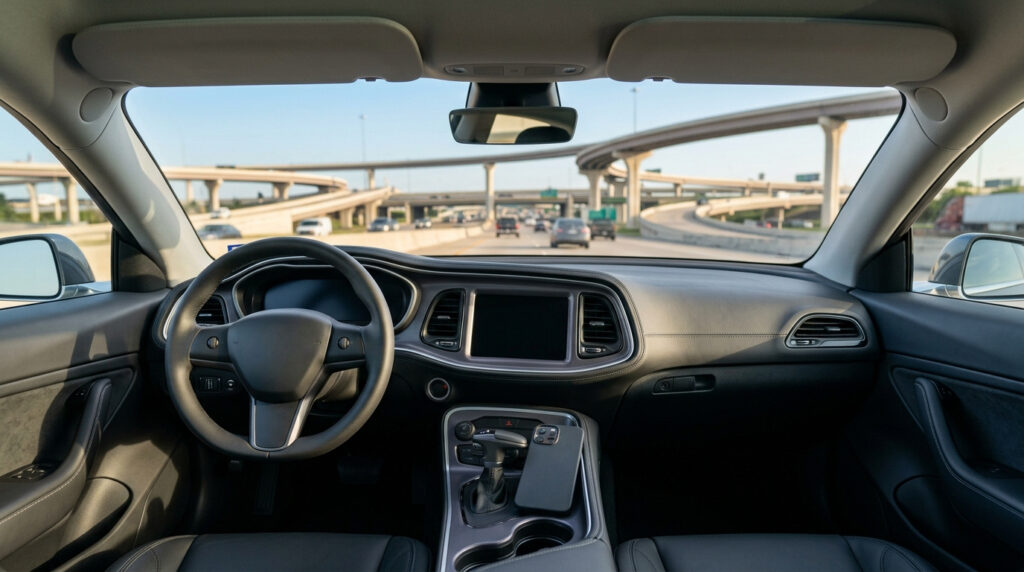
How many people die in distracted driving crashes in Texas?
Texas recorded 380 deaths in 2024 in crashes where distraction was involved, down 5.71 percent from the year before. That was about 9% of the 4,150 people killed on Texas roadways that year, according to TxDOT’s 2024 crash facts.
The figure comes from the TxDOT’s 2024 Texas crash facts, the state transportation department’s annual summary. The data is built from officers’ CR-3 crash reports, as they stood on 9 April 2025. The share is our arithmetic, 380 divided by 4,150, and it is a share of deaths, not of crashes. Our wrongful death page covers families who lose someone in a crash like this, and a separate article explains which relatives can sue after a death on the road.
The count depends on what the officer wrote down at the scene. A driver who was distracted but showed no sign of it at the scene may not be counted, so the 380 figure measures recorded distraction. Nationally, NHTSA’s distracted driving page reports that 3,208 people were killed in 2024 in motor vehicle crashes involving distracted drivers.
Is texting and driving illegal in Texas?
Yes, with exceptions. Subsection (b) of Transportation Code § 545.4251 bars electronic messaging on a portable device by a driver of a moving vehicle, and subsection (c) lists defenses, including use with a hands-free device.
The offense is defined in full in the statute, which says that “to be prosecuted, the behavior must be committed in the presence of or within the view of a peace officer or established by other evidence.” So an officer’s observation is one route, and other evidence is another. The statute’s definition of “electronic message” is “data that is read from or entered into a wireless communication device for the purpose of communicating with another person.”
The penalties depend on prior convictions and on the result of the conduct, as the table shows. The statute is printed on the Texas Legislature’s Transportation Code, Chapter 545 page. Our Sugar Land article on the texting law in Texas walks through the same provisions with local examples.
| Situation | Penalty in the statute | Subsection |
|---|---|---|
| First offense, no earlier conviction under the section | Misdemeanor; a fine of at least $25 and not more than $99 | (e) |
| Shown at trial to be a repeat offense | Fine of at least $100 and not more than $200 | (e) |
| The conduct caused death or serious bodily injury | Class A misdemeanor, with a fine capped at $4,000 and a jail term of as long as one year | (f) |
What other kinds of distraction lead to claims?
Eating and drinking, talking to passengers, adjusting the stereo, navigation or entertainment system, and talking on the phone are the other activities NHTSA names. None of them is covered by the texting statute, so a claim about them rests on the general duty to drive carefully and on the facts of the crash.
Eating and drinking at the wheel has its own page, eating while driving. Grooming, which includes applying makeup, shaving and adjusting the mirror, is covered at grooming while driving. A conversation with someone in the car is the subject of talking to a passenger. Phones beyond texting, including calls, apps and mounted screens, are covered at electronic device use.
In a crash where the driver was applying makeup, the attention question is the same one that applies to a text: what was the driver doing with their eyes and hands. We covered one such crash in car accident with a driver who was applying makeup.
How is a distracted driving claim proved?
A distracted driving claim is proved with evidence of what the driver was doing when the crash happened, not only that a crash happened. The usual sources are phone records, vehicle data, video, the crash report and witnesses who saw the driver’s attention. Each of them can disappear or be overwritten, so the requests go out early.
- Phone records. A subpoena can seek the device’s activity around the time of the crash. What a court will order, and how far back the records go, depends on the case.
- Vehicle data. A vehicle’s event data recorder can store speed and braking before impact, if the vehicle recorded them.
- Video. Dashboard cameras, business cameras and traffic cameras may show the driver looking down or failing to respond.
- The crash report. TxDOT’s figures are drawn from officers’ crash reports, so a distraction the officer recorded would appear there.
- Witnesses. Passengers and bystanders can describe what the driver was doing before the impact.
Our piece on what a phone-use claim has to prove goes through the evidence in more detail. Fault is decided on all of this together. If the other side argues that you also contributed to the crash, the question moves to percentages, which our page on how Texas divides fault takes up. Our article on talking to your car accident lawyer about fault covers the same ground from the client’s side.
Does a texting citation prove negligence?
Whether a citation or conviction under § 545.4251 can be used as evidence in a civil case, and how much weight it carries, is a question for counsel. The statute makes the offense a misdemeanor and sets its penalties, but it does not say how a civil court must treat the offense.
The offense can be shown by an officer’s observation or by other evidence, under subsection (b). Phone records and video are often what fills that gap. Whether they show a violation of the statute, or only show that the driver’s attention was elsewhere, depends on the facts of the crash, and a court decides which of those a jury may hear.
Why do Houston crashes involve so much distraction?
The Houston Chronicle’s 2018 series analysed state crash records and found that fatal and injury crashes with distraction as a likely cause rose from 5,796 in 2011 to 8,211 in 2016 across the nine-county Houston area. Killed or seriously injured people in those crashes rose from 509 to 735 over the same years.
The Houston Chronicle’s “Out of Control” series, published 23 November 2018, reported that officials said the spike declined in 2017 but stayed above 2011 levels. The same article cites a Houston-Galveston Area Council analysis that found distraction-related crashes grew 23 percent from 2012 through 2016.
FOX 26 Houston reported on 2 April 2024 that TxDOT’s Talk.Text.Crash campaign for Distracted Driving Awareness Month included a Houston mother whose two teenage daughters were killed in 2016 when, the station reported, the driver of their car checked a cell phone, lost control and hit an 18-wheeler head-on. (FOX 26 Houston, “TxDOT’s Talk.Text.Crash campaign returns to raise distracted driving awareness in April,” 2 April 2024)
Speeding and impairment appear in the same crash data, and our article on reckless driving crashes covers the speeding side. Those are crash counts from 2011 to 2016, so they show the trend up to that point. For where Houston crashes concentrate, see our article on crash-prone roads and intersections. Current year figures for the Houston area are a separate question, and they should be pulled from the state data when a case needs them.
When can an employer be responsible for a distracted driver?
When the driver was working, such as on a business call, making a delivery or driving a company vehicle, the employer may face a claim alongside the driver. Whether that claim succeeds depends on the relationship between the driver and the employer and on the facts, and counsel should assess it.
When the vehicle is a commercial one, the company may hold records of its own, which is one reason the question of who employed the driver comes early. Our article on attorney for a distracted driver accident with an 18-wheeler explains why those records matter. When the distracted driver was operating a commercial truck, the case can reach more parties, which our 18-wheeler accident page explains. When the injured person was working at the time, car accidents while working in Texas covers the workers’ compensation question alongside the claim against the other driver.
What should you do first after a distracted driving crash?
Get medical care first. Then request the crash report, keep photographs, receipts and any messages about the crash, and speak with a lawyer before you give the other driver’s insurer a recorded statement. Those steps keep the evidence of distraction from being lost while the claim is assessed.
Medical care comes before any of these steps, and nothing here should delay treatment. If the driver left the scene, our hit-and-run page covers the next steps, and if the at-fault driver carries too little coverage, our Texas article on uninsured-motorist coverage explains that alternative. Insurers often ask for a recorded statement early, when the facts are still unclear. Our article on talking to a lawyer before the adjuster explains why that conversation can wait. If a driver’s screen was the cause, the first-day checklist comes before any call, and the contact page is the place to describe your own crash.
Other kinds of crashes are sorted on the Houston personal injury lawyers page, and the car accident page covers the wider claim.
Frequently asked questions
What is the definition of distracted driving?
NHTSA defines distracted driving as any activity that diverts attention from driving. The definition includes talking or texting on a phone, eating and drinking, talking to people in the vehicle, and fiddling with the stereo, entertainment or navigation system.
Is texting and driving illegal in Texas?
Yes, with exceptions. Transportation Code § 545.4251 bars electronic messaging on a portable device by a driver of a moving vehicle. The section lists defenses, including use with a hands-free device and use to navigate.
How much is a ticket for texting and driving?
For a first offense with no earlier conviction under the section, the statute sets a fine of at least $25 and not more than $99. A repeat offense carries a fine of at least $100 and not more than $200. If the conduct caused death or serious bodily injury, it is a Class A misdemeanor, with a fine capped at $4,000 and a jail term of as long as a year.
How many crashes a year are due to distracted driving?
TxDOT’s 2024 crash facts report 380 deaths in crashes involving distracted driving in Texas. For the nine-county Houston area, the Houston Chronicle’s analysis of state crash records counted 8,211 fatal and injury crashes with distraction as a likely cause in 2016.
Distracted driving includes which of the following?
Under NHTSA’s definition, eating and drinking, talking to people in the vehicle, adjusting the stereo or navigation system, and talking or texting on a phone are all distracted driving. Anything that takes attention away from the task of driving counts.
What evidence can show a driver was using a phone?
Phone records, vehicle data, video, the crash report and witness statements are the usual places to look. Requests for them are best made early. The statute allows the offense to be shown by other evidence, not only by an officer’s observation.
About the authors

Sam A. Maida, Jr.
Owner and Managing Attorney
Sam A. Maida, Jr. has represented injured Texans in the greater Houston area since the firm opened in 1993.
State Bar of TexasAvvoMartindale-HubbellLawLinkThatCarHitMeLinkedIn

Bernard G. Johnson III
Litigation Managing Attorney
Bernard G. Johnson III is a board certified trial lawyer licensed in Texas since 1996 and a graduate of South Texas College of Law.