
Texas holiday periods put a large number of deaths into a few days. TxDOT’s 2025 report on fatal holiday crashes counted 41 deaths over the Thanksgiving period, 47 over Christmas and 52 over New Year. Staying safe means planning for the peak days, keeping impairment out of the car and knowing what to do if a crash happens anyway.
The short version
- The count is concentrated. TxDOT’s 2025 report counted 41, 47 and 52 deaths in the Thanksgiving, Christmas and New Year periods.
- Impairment is a large share. NHTSA’s national data for 2001 to 2005 found that about 40 percent of Christmas and New Year fatalities occurred in crashes involving at least one alcohol-impaired driver.
- The first hours matter. Medical care, the scene and the names of witnesses are hard to rebuild once the traffic clears.
- Fault is a percentage. Texas’s proportionate responsibility statute, § 33.001, bars recovery for a claimant more than half responsible.
- The filing clock is two years. Section 16.003 sets a two-year period for most personal injury suits, with exceptions the statute lists.
Which holiday periods have the most deaths on Texas roads?
The New Year period had the most deaths of the three winter holiday periods in TxDOT’s 2025 report: 52 deaths in 48 fatal crashes over 102 hours. Thanksgiving had 41 deaths and Christmas had 47, so the New Year window is where the count is highest.
TxDOT’s report starts each period at 6:00 p.m. on its first day, which it marks with an asterisk. Within the New Year period, January 1, 2026 recorded 15 fatal crashes and 16 deaths, and January 2 recorded 14 fatal crashes and 16 deaths. The figures come from Texas Peace Officer’s Crash Reports (CR-3) received and processed as of April 7, 2026. The three winter periods each run 102 hours, while the Memorial Day, Fourth of July and Labor Day periods run 78 hours each. Crashes like these are the subject of our Houston car accident claims page.
| Holiday period | Dates counted | Fatal crashes | Deaths |
|---|---|---|---|
| Thanksgiving (102 hours) | Nov. 26 to Nov. 30, 2025 | 39 | 41 |
| Christmas (102 hours) | Dec. 24 to Dec. 28, 2025 | 44 | 47 |
| New Year (102 hours) | Dec. 31, 2025 to Jan. 4, 2026 | 48 | 52 |
| Memorial Day (78 hours) | May 23 to May 26, 2025 | 37 | 39 |
| Fourth of July (78 hours) | July 3 to July 6, 2025 | 29 | 31 |
| Labor Day (78 hours) | Aug. 29 to Sept. 1, 2025 | 41 | 46 |
Source: Texas Department of Transportation, Fatal Motor Vehicle Traffic Crashes and Fatalities During Holiday Periods, 2025, read on October 16, 2026.
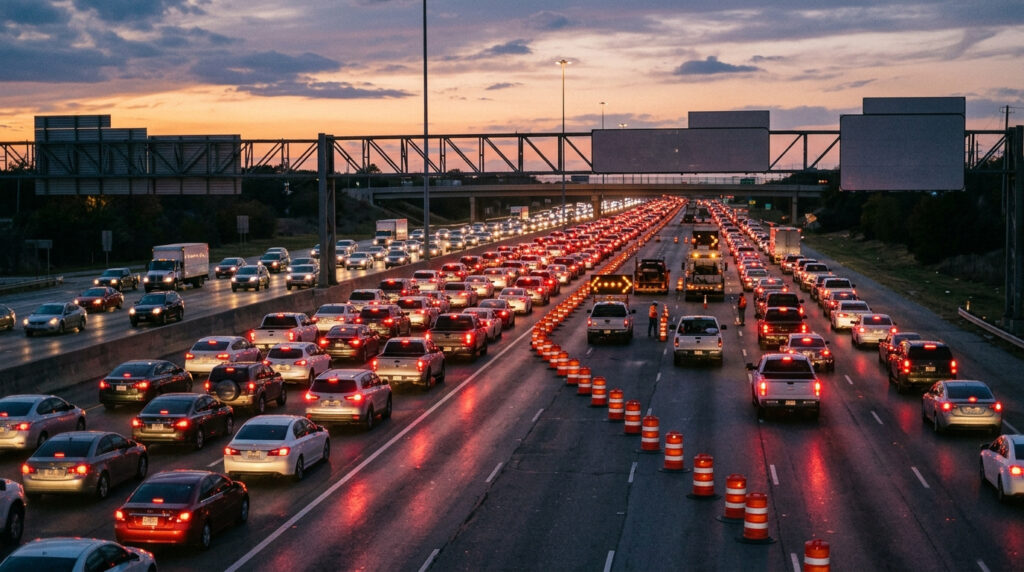
Why do impaired drivers make holiday roads more dangerous?
NHTSA’s nationwide analysis of 2001 to 2005 data, published in December 2007, found that about 40 percent of Christmas and New Year fatalities occurred in crashes where at least one driver had a blood alcohol content of .08 or above, compared with about 28 percent of fatalities in the rest of December. Deaths per day in such crashes were also higher in the two holiday periods.
Those figures come from NHTSA’s Fatality Analysis Reporting System for 2001 to 2005, published in a December 2007 Crash•Stats summary (DOT HS 810 870) for the 2007 holiday season. Over those five years the averages were 54 deaths per day in crashes involving an impaired driver during the New Year period, 45 during the Christmas period and 33 across the rest of December. They are older than the TxDOT counts above, and NHTSA defines each year’s holiday periods separately, so the two sets should not be compared year by year.
A Texas Labor Day figure points the same way. ABC13 reported on September 2, 2024 that TxDOT counted 334 drug and alcohol-related crashes statewide over the 2023 Labor Day weekend, with 14 people killed and dozens seriously injured. AAA Texas told the station that higher traffic and drug and alcohol use can both contribute to a spike in crashes over a holiday weekend. Our page on drunk-driving crash claims in Houston and our article on what Texas DWI statistics show cover the impairment side of this risk. Distraction is a separate hazard, covered in our distracted driving page and in our article on texting and driving under Texas law.
What comes first after a crash during the holidays?
Medical care and safety come first. After that, the facts that are hardest to rebuild later are the scene, the other driver’s details, the names of witnesses and the police report. Photographs taken before the vehicles move can be the clearest record of where they came to rest.
Start with injuries, and note the exact spot, such as the freeway, exit or cross street, because the police report will be organized around it. Call 911 if anyone is hurt, stay with the scene if it is safe to do so, and get medical care even if you feel only shaken, because some injuries are not obvious at the roadside. Then exchange the other driver’s name, insurance and license details, and write down the names and phone numbers of anyone who saw the crash. Which photos to take after a crash lists the views that help most, and why witnesses matter explains why their names should be recorded before anyone leaves.
Ask for the police crash report once it is available, and keep its report number. Requesting the crash report in Houston explains where to ask. For a general checklist of steps after a collision, our what to do after a car accident page is the place to start.
How do the holidays affect who is at fault?
Fault in Texas is a matter of percentages. Sections 33.001 and 33.012 of the Civil Practice and Remedies Code provide that a person more than half responsible for the harm recovers nothing, while a person half responsible or less has the award trimmed by that share.
Chapter 33 of the code directs the trier of fact to assign each contributing person a share of responsibility, the claimant included (§ 33.003(a)). Negligence, the usual basis for a share, is measured against ordinary care. The Pattern Jury Charges describe it as falling short of what a person of ordinary prudence would do in the same situation, or acting in a way such a person would avoid (PJC 2.1).
Holiday traffic gives both sides arguments. In a partial dissent in Werner Enterprises, Inc. v. Blake, No. 23-0493 (Tex. June 27, 2025), Justice Bland, joined by Justices Boyd and Huddle, quoted the Transportation Code’s speed rule, which forbids driving “at a speed greater than is reasonable and prudent under the circumstances then existing” (Transp. Code § 545.351(a)). Our article on the arguments insurers make about shared blame covers how comparative fault is raised, liability in multi-car accidents covers crashes with more than one driver, and crashes caused by reckless driving covers that conduct in more detail.
How much time do you have to file a claim after a holiday crash?
Generally, the answer is two years, set by Texas’s limitations statute, Civil Practice and Remedies Code § 16.003. That period runs from accrual, and the holiday on which the crash happened does not change it.
Death cases follow a different accrual rule. Under § 16.003(b), where an injury ends in death, the injured person’s death is the event the statute uses to start the period. Where accrual falls for a particular crash is a fact-specific question, so the start date should be confirmed with an attorney. For local examples of how the deadline is counted, see our Sugar Land filing article. the family claim rules after a fatal crash covers who may bring a claim, and our fatal car accident page describes the claims that follow a death.
Should you talk to the other driver’s insurer right away?
Keep the first conversation short and factual, and do not guess about your injuries. One reason to wait until the medical picture is clearer is that an early account can be given before anyone knows how the injury will progress.
The other driver’s insurer may call within days of a holiday crash, when the medical picture is still unclear. Talking to an insurer is a separate decision from filing a claim. Our article on what to expect before you talk to an adjuster sets out the questions adjusters ask, and the paperwork insurers ask for covers the documents that usually come next.
Before any call, record what you remember while it is fresh: the time and place, a description of the other vehicle, the names of any passengers, what the officer said, and each symptom you notice in the days that follow. A note made at the time is easier to rely on later than a recollection pieced together weeks afterward.
Where can a Houston crash victim get help?
A Houston crash victim can start with a medical provider for treatment, the responding agency for the crash report and, for the legal side, a Houston personal injury lawyer who can explain the claim and what it costs. The pages linked below cover the claim types and how injury-lawyer fees work.
For the fee question in detail, read the fee explanation for Houston accident cases; the Houston personal injury lawyers page shows the range of claims, and a holiday-season crash can be described to the office through the contact page. If the other driver left, what to do after a Houston hit-and-run comes next.
Frequently asked questions
What to do after a car accident?
Dial 911 if anyone is hurt, see a doctor even if you feel only shaken, and swap the other driver’s name, insurance and license details. Photograph the scene and the vehicles, write down the names of witnesses, and ask for the police crash report once it is available.
What should you do in a car accident?
Stop if it is safe to do so, check on everyone in every vehicle, and stay out of live traffic lanes while you wait for help to arrive.
How do you stay safe in a car accident?
Turn on your hazard lights, move out of the flow of traffic if the vehicle can be moved safely, and stay away from moving lanes while you wait. Take extra care on a freeway shoulder.
How do you avoid a car accident this holiday season?
Leave with extra time for the trip, put the phone away while driving, and do not drive after drinking. TxDOT’s holiday counts show the New Year period had the most deaths in its 2025 report, which is the period to plan for most carefully.
What is the deadline for a Texas personal injury lawsuit?
The general period is two years under Civil Practice and Remedies Code § 16.003, subject to the exceptions the statute lists. Confirm the start date for your claim with an attorney.
About the authors

Sam A. Maida, Jr.
Owner and Managing Attorney
Sam A. Maida, Jr. has represented injured Texans in the greater Houston area since the firm opened in 1993.
State Bar of TexasAvvoMartindale-HubbellLawLinkThatCarHitMeLinkedIn

Bernard G. Johnson III
Litigation Managing Attorney
Bernard G. Johnson III is a board certified trial lawyer licensed in Texas since 1996 and a graduate of South Texas College of Law.